Why Mars Landings Are So Hard: The Seven Minutes of Terror Explained
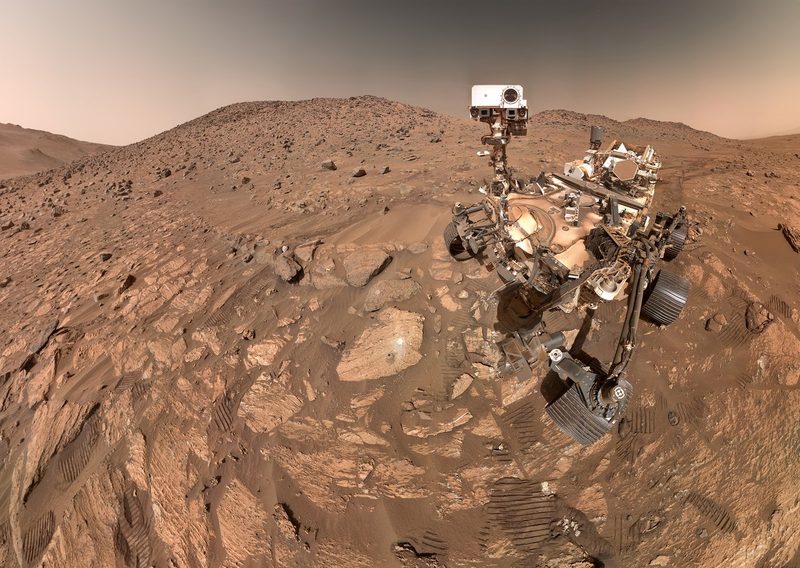
Landing on Mars is the hardest routine operation in spaceflight. A spacecraft arrives at the red planet travelling at around 20,000 kilometres per hour, and it must slow to a gentle touchdown in about seven minutes, entirely on its own, because radio signals take too long to reach Earth for any human to help. Engineers call it the seven minutes of terror: a fully automated sequence of heat shields, parachutes, rockets and airbags that must work perfectly the first time, millions of kilometres from the nearest repair shop.
Why Mars is uniquely difficult
Mars sits in an awkward middle ground that defeats every simple landing method. Its atmosphere is thick enough to burn up an incoming spacecraft through friction, yet too thin for parachutes alone to slow a heavy lander the way they do on Earth. It has only about one percent of Earth’s atmospheric density. Gravity, at 38 percent of Earth’s, is strong enough to accelerate a falling craft dangerously but too weak to matter much for aerobraking. There is no thick air to float down through and no airless surface to simply rocket down to, so every Mars landing is a hybrid of techniques, each handing off to the next at exactly the right moment.
The seven minutes, step by step
The descent sequence, known as entry, descent and landing, is choreographed to the second. First comes atmospheric entry: the capsule slams into the thin Martian air at hypersonic speed, and a heat shield glowing at over 1,000 degrees Celsius bleeds off most of the velocity through friction. Then, while still travelling faster than sound, the spacecraft deploys a parachute, the largest and strongest ever flown, which must inflate in a near-vacuum without tearing. Finally the heat shield drops away, the lander separates, and retrorockets or a skycrane system fire to kill the last of the speed for touchdown. The whole violent ballet is over in roughly seven minutes.
Why nobody can fly it from Earth
The terror in the seven minutes of terror is the time delay. Radio signals take between 4 and 24 minutes to travel between Earth and Mars, depending on where the planets are in their orbits. By the time mission control sees that entry has begun, the landing has already succeeded or failed. Everything must therefore be pre-programmed, and the spacecraft must make its own decisions: sensing the atmosphere, judging its altitude, and triggering each stage. Modern landers carry terrain-relative navigation, comparing camera images to onboard maps to steer away from boulders and cliffs in the final seconds.
A history written in wreckage
Mars has humbled almost every space programme that has tried it. The Soviet Union’s early attempts mostly failed; NASA lost the Mars Polar Lander and the Climate Orbiter to heartbreaking errors. Europe’s Schiaparelli lander crashed in 2016 when a sensor glitch made it think it had already landed. The successes form a shorter list:
- Viking 1 and 2 (1976) proved soft landings were possible with brute-force engineering.
- Pathfinder (1997) bounced down on airbags, a gloriously inelegant solution that worked.
- Curiosity (2012) introduced the skycrane, lowering the rover on cables from a hovering rocket stage.
- Perseverance (2021) added autonomous hazard avoidance, landing itself in the treacherous Jezero Crater.
FAQs
Why seven minutes? That is roughly how long it takes a spacecraft to go from atmospheric entry to touchdown. The name also nods to the radio delay: controllers wait in helpless suspense for the signal confirming survival.
Why not just use bigger parachutes? Mars’s air is too thin. Even an enormous parachute cannot slow a tonne-scale lander enough, which is why rockets must finish the job.
Has India landed on Mars? India’s Mars Orbiter Mission succeeded brilliantly as an orbiter in 2014, but no Indian mission has attempted a landing yet.
Every successful Mars landing is a small miracle of automation, a machine thinking faster than any human could, millions of kilometres away. Until we can land heavy cargo reliably, human footprints on Mars will remain a dream, and the seven minutes of terror is the gate every dream must pass through. The engineers who design these sequences rehearse them thousands of times in simulation, because on Mars there are no second chances.
Source: NASA

Khabar 24h Editorial Desk — our explainers are prepared by the Khabar 24h editorial team using AI-assisted research tools, and every piece is reviewed by a human editor before publishing. We do not claim original reporting: our work is turning complex topics into simple, accurate summaries. Spotted an error? Write to contact@khabar24h.com — our corrections policy aims for same-day review.
More from this author →