Galaxy Messier 74 Is Nearly Twice as Big as Thought
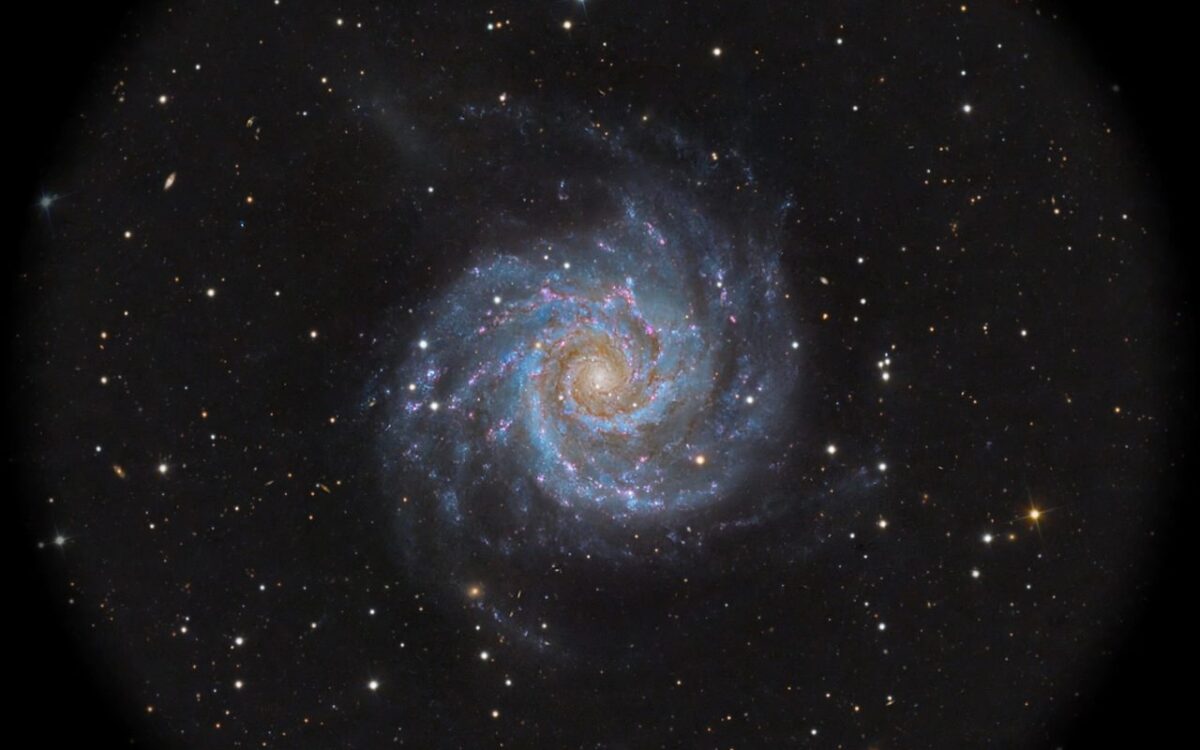
The galaxy Messier 74 is nearly twice as large as astronomers previously believed. New observations found a faint ring of young stars stretching far beyond its known edge. The discovery was published in Astronomy and Astrophysics on September 4.
Astronomers used the one-metre Two-Meter Twin Telescope, or TST, at the Teide Observatory in Tenerife. Long-exposure imaging revealed a stellar disk about 30 kiloparsecs across, more than double the earlier estimate of 14 kiloparsecs.
The newly found stars are about 640 million years old, much younger than the galaxy’s central regions. The team believes the outer disk formed after a close flyby of the nearby dwarf galaxy UGC 1176 about a billion years ago.
The flyby appears to have stirred the galaxy’s outer regions and triggered new star formation. Messier 74 lies about 30 to 32 million light-years away in the constellation Pisces.
The finding changes how astronomers view the galaxy’s structure. It also shows that sensitive long-exposure imaging can reveal hidden parts of nearby galaxies. Researchers say similar faint disks may exist around other galaxies but have gone unnoticed. The study adds to a growing picture of galaxies as dynamic systems still shaped by past encounters.

Khabar 24h Editorial Desk — our explainers are prepared by the Khabar 24h editorial team using AI-assisted research tools, and every piece is reviewed by a human editor before publishing. We do not claim original reporting: our work is turning complex topics into simple, accurate summaries. Spotted an error? Write to contact@khabar24h.com — our corrections policy aims for same-day review.
More from this author →
Leave a Reply