How Caves Form: The Geology of Stalactites and Limestone Caverns
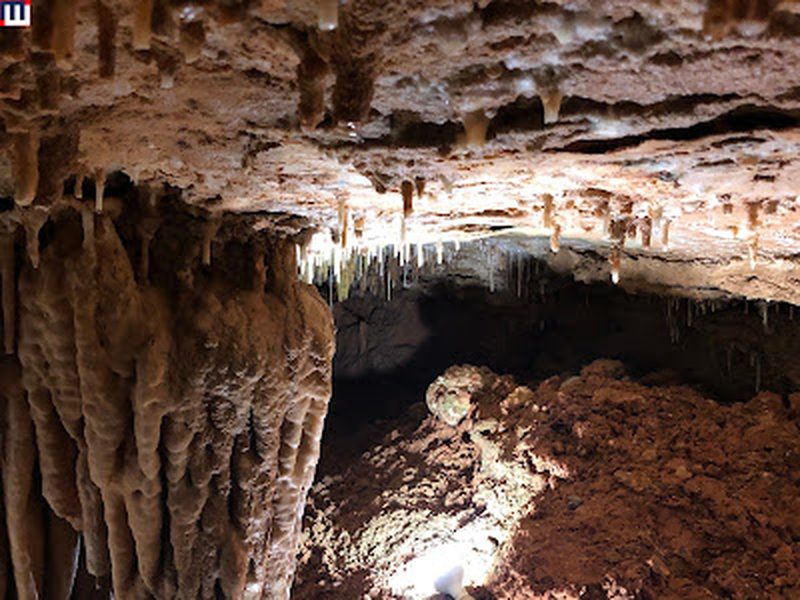
Beneath the hills of Meghalaya, among the wettest places on Earth, lie some of Asia’s longest caves: winding passages, underground rivers, and chambers decorated with stone icicles that grew a centimetre a century. Caves are geology in slow motion, carved not by force but by chemistry, as rainwater made faintly acidic by carbon dioxide dissolves limestone grain by grain over hundreds of thousands of years. The result is karst, a landscape of sinkholes, disappearing rivers and caverns found from Borra in Andhra Pradesh to the Belgian Congo of explorers’ tales. Caves are also time capsules: their stalagmites record past climates in chemical layers, their sediments preserve fossils and human artefacts, and their isolated ecosystems harbour blind, pigmentless creatures found nowhere else. Here is how the underworld is built.
Dissolution: the acid that carves mountains
It begins with rain. As water falls through the air and percolates through soil, it absorbs carbon dioxide, forming weak carbonic acid, the same acid that gives soda its fizz. Limestone and dolomite, rocks made of calcium and magnesium carbonate, dissolve readily in this faint acid: each litre of water carries away a tiny load of dissolved rock, and over millennia, the cumulative effect is enormous. Water exploits every weakness, widening joints and bedding planes into fissures, fissures into passages, passages into caverns. Where the water table drops, drained passages become air-filled caves; where it rises, they flood. The chemistry reverses to decorate: when mineral-laden drip water reaches cave air, CO2 escapes and calcite precipitates, building stalactites downward from ceilings, stalagmites upward from floors, and where they meet, columns. Flowstone curtains, rimstone pools and delicate helictites that defy gravity through capillary action complete the ornament. The growth is glacially slow, typically 0.1 to 1 millimetre yearly, so a metre-long stalactite may be 100,000 years old, and a broken one is a loss on geological timescales.
India’s underworld
India’s caves are world-class but underappreciated. Meghalaya’s Khasi, Jaintia and Garo hills, built of limestone under the planet’s heaviest rainfall, host over 1,700 known caves, including Krem Liat Prah, at over 34 kilometres one of Asia’s longest, still being explored and extended by expedition cavers. The caves preserve a spectacular fossil record and, in their speleothems, a high-resolution archive of monsoon history stretching back hundreds of millennia. Borra Caves in the Ananthagiri hills of Andhra Pradesh, a kilometre deep in marketed length, draw tourists to their illuminated stalactites and the legend of a cowherd discovering them. The Belum Caves of Andhra Pradesh, among the subcontinent’s longest, feature subterranean chambers and a natural meditation hall. Madhya Pradesh’s Bhimbetka rock shelters, though not solution caves, preserve 30,000 years of human art. Indian caves also host unique fauna: blind fish, crickets and crabs adapted to eternal darkness. Yet many face threats from limestone mining, unregulated tourism and vandalism; a stalactite snapped for a souvenir took longer to grow than human civilisation has existed.
Caves as scientific archives
Speleothems are among palaeoclimate science’s most precise tools. As stalagmites grow layer by layer, they trap oxygen isotopes whose ratios record temperature and rainfall, and uranium-thorium dating pins each layer’s age to within decades, producing climate records of extraordinary resolution. Meghalaya’s Mawmluh Cave gave its name to the Meghalayan Age, the geological age covering the last 4,200 years, defined by a stalagmite layer recording an abrupt global drought that toppled ancient civilisations. Cave sediments preserve fossils beyond the reach of surface erosion: the Denisovans were identified from a Siberian cave, Neanderthal art adorns Spanish caves, and Australia’s Naracoorte caves hold half a million years of marsupial fossils. Cave biology studies evolution in fast-forward: isolated for millions of years, cave species lose eyes and pigment convergently across continents. And astrobiologists look to caves as analogues for Mars, where lava tubes might shelter life or future astronauts. The underworld, patiently dissolved one raindrop at a time, turns out to be one of science’s richest libraries.
- Stalactites typically grow 0.1 to 1 millimetre per year; a metre may take 100,000 years.
- Meghalaya hosts over 1,700 known caves in its rain-soaked limestone hills.
- Krem Liat Prah exceeds 34 km, among Asia’s longest cave systems.
- Mawmluh Cave’s stalagmite defines the Meghalayan geological age, starting 4,200 years ago.
- Carbonic acid from rainwater and soil CO2 dissolves limestone grain by grain.
FAQs
What is the difference between stalactites and stalagmites? Stalactites hang tight to the ceiling, growing down; stalagmites grow up from the floor; mnemonics aside, dripping water builds both.
Are caves dangerous to explore? Wild caves demand training, equipment and guides: flooding, hypothermia, getting lost and bad air are real hazards. Show caves like Borra are safely developed.
Why shouldn’t I touch cave formations? Skin oils disrupt calcite deposition and stain formations; the damage persists for centuries of regrowth.
Every cave is a collaboration between rain and rock across deep time. Walk through one, and you walk through a hundred thousand years of dripping water writing in stone.
Compiled by the Khabar 24h Editorial Desk from publicly available sources.

Khabar 24h Editorial Desk — our explainers are prepared by the Khabar 24h editorial team using AI-assisted research tools, and every piece is reviewed by a human editor before publishing. We do not claim original reporting: our work is turning complex topics into simple, accurate summaries. Spotted an error? Write to contact@khabar24h.com — our corrections policy aims for same-day review.
More from this author →