The Great Ocean Conveyor: How Currents Move Heat Around the Planet
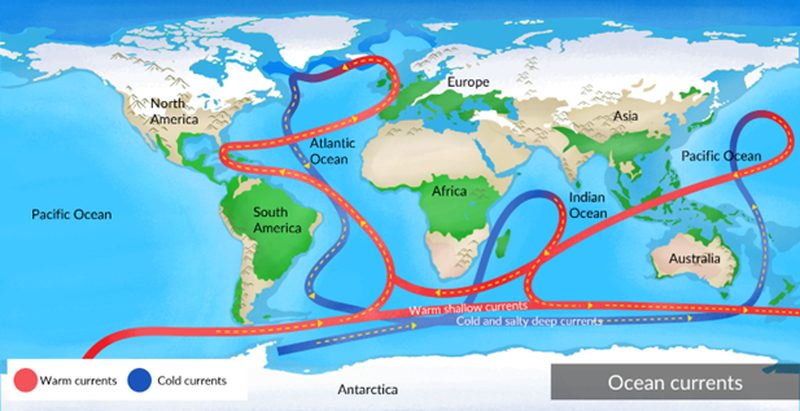
Beneath the ocean’s restless surface runs a planetary bloodstream: a truly global network of currents that carries warm water toward the poles and cold water back toward the equator, redistributing the Sun’s heat around the Earth. Oceanographers call it the thermohaline circulation, or the great ocean conveyor belt. It moves far more water than all the world’s rivers combined, keeps Western Europe far warmer than its latitude deserves, and locks away carbon in the deep sea for centuries. And there are signs it is slowing, with consequences that could reach every continent.
How the conveyor works
The engine is density. In the North Atlantic, warm salty water carried north by the Gulf Stream releases its heat to the atmosphere, keeping Europe remarkably mild for its latitude. As it cools, and as sea ice formation leaves salt behind, the water grows dense enough to sink, plunging two or three kilometres down. This North Atlantic Deep Water then creeps southward along the ocean floor, through the Atlantic, around Antarctica and into the Pacific and Indian Oceans, slowly rising and warming over centuries before returning. The full loop takes roughly a thousand years to complete: water sinking in the North Atlantic today will not see the surface again until long after our civilisations have changed beyond recognition.
Why Europe owes it everything
The conveyor’s heat transport is staggering, equivalent to millions of power stations. It is the reason London, at 51 degrees north, has milder winters than Newfoundland at the same latitude, and why Norway’s coast stays ice-free deep into the Arctic. Without this oceanic central heating, Western Europe would be several degrees colder, with a climate more like Siberia’s at the same latitude.
- Gulf Stream: the warm surface current racing north along North America’s east coast.
- North Atlantic Drift: its extension carrying heat toward Europe.
- Deep-water formation: cold, salty water sinking near Greenland and in the Labrador Sea.
- Deep western boundary current: the cold return flow creeping south along the ocean floor.
- Upwelling return: deep water rising in the Southern Ocean and Pacific, completing the loop.
The conveyor also drives the monsoon indirectly: by warming the North Atlantic, it influences atmospheric circulation patterns that reach across Africa and Asia.
The carbon connection
The conveyor is also a climate regulator. Cold sinking water carries dissolved CO2 into the deep ocean, where it stays for centuries, part of the solubility pump that has absorbed much of humanity’s emissions. The Southern Ocean, where deep waters resurface, is where this stored carbon can escape back to the air, making the region a critical valve in the global carbon cycle. Changes in circulation therefore change how much carbon the ocean can hold, linking the conveyor directly to the pace of atmospheric warming.
Signs of slowing
Here is the worry. Greenland’s melting ice and increased Arctic rainfall are freshening the North Atlantic, making surface water less salty and less dense, harder to sink. Multiple studies suggest the Atlantic overturning circulation is now at its weakest in a millennium, with a distinctive cold blob south of Greenland marking where sinking has faltered. Models project further weakening this century, with a small but real risk of abrupt collapse under high warming. A shutdown would chill Europe significantly, shift tropical rainfall belts, raise sea levels along the US east coast and disrupt fisheries worldwide.
How scientists watch it
Monitoring a thousand-year circulation in real time is a modern triumph. The RAPID array of moorings has measured the Atlantic overturning continuously since 2004, catching its variability. Thousands of Argo floats drift the global ocean, profiling temperature and salinity. Satellites track sea surface height, revealing current strength, and paleoclimate records from ice cores and sediments show past slowdowns linked to abrupt climate flips. Together they form an early-warning system for one of the climate’s most consequential tipping elements.
FAQs
Will the conveyor shut down? A full shutdown this century is considered unlikely but possible under high emissions; gradual weakening is already observed and expected to continue.
Would Europe freeze? Not into an ice age, but models show several degrees of regional cooling, enough to transform agriculture, energy demand and ecosystems.
Does India depend on it? Indirectly but importantly: Atlantic circulation influences the monsoon system and global sea levels, both vital to India.
The great ocean conveyor is the planet’s slowest, mightiest circulation, moving heat, carbon and nutrients on timescales that dwarf human history. That we may be disrupting it within a single century, after it ran undisturbed for millennia, is a measure of how profoundly industrial civilisation has become a geological force.
Source: National Oceanography Centre

Khabar 24h Editorial Desk — our explainers are prepared by the Khabar 24h editorial team using AI-assisted research tools, and every piece is reviewed by a human editor before publishing. We do not claim original reporting: our work is turning complex topics into simple, accurate summaries. Spotted an error? Write to contact@khabar24h.com — our corrections policy aims for same-day review.
More from this author →