Black Holes Explained: Event Horizons, Hawking Radiation and the First Photos
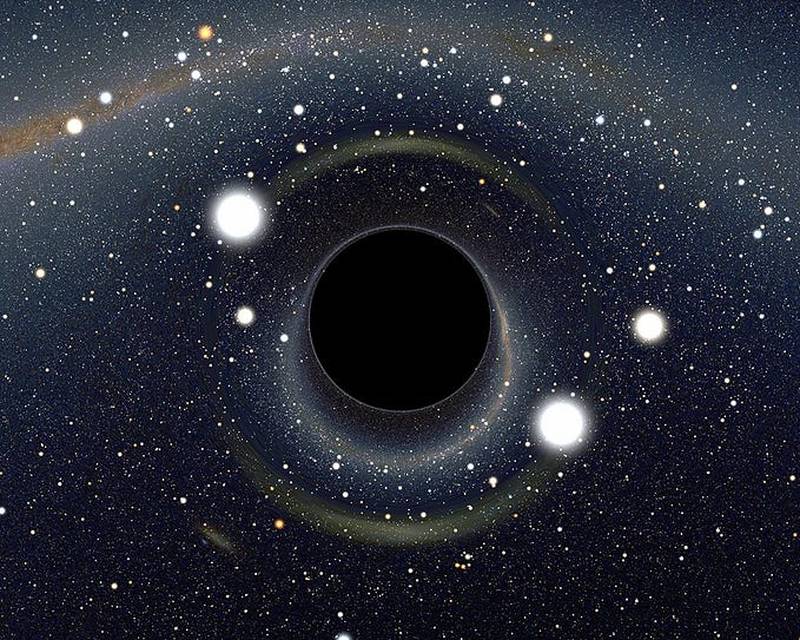
A black hole is a place where gravity has won completely. Squeeze enough mass into a small enough space and it collapses past the point of no return, warping spacetime so severely that nothing, not even light, can escape. For a century these objects were pure mathematics, then theoretical curiosities, then inferred from the X-rays of doomed companion stars. Today we have actual photographs of them, and a slow leak of radiation named after Stephen Hawking may mean they are not entirely black after all.
Anatomy of a black hole
Every black hole has two defining features. At its boundary lies the event horizon, the surface beyond which escape would require moving faster than light, which is impossible. Cross it and every path forward leads inward; the outside universe is cut off forever. At the centre, according to Einstein’s general relativity, sits a singularity, a point where matter is crushed to infinite density and our equations break down. For a black hole with the mass of the Sun, the event horizon would be just 3 kilometres in radius; for the monster at the centre of our galaxy, Sagittarius A*, it spans millions of kilometres.
How black holes are born
Most black holes begin as stars. When a massive star, at least twenty times the Sun’s mass, exhausts its nuclear fuel, its core collapses in seconds. The outer layers rebound in a supernova explosion while the core keeps falling, and if the remnant exceeds about three solar masses, nothing can halt the collapse. Smaller stellar corpses become neutron stars; the heavyweights become black holes. Then there are the supermassive ones, millions to billions of times the Sun’s mass, lurking at the centres of galaxies including our own. How they grew so large, so fast, in the early universe remains one of astronomy’s liveliest debates.
Hawking radiation: the slow leak
In 1974 Stephen Hawking showed that black holes are not perfectly black. Quantum effects near the event horizon should cause them to emit a faint trickle of particles, now called Hawking radiation, very slowly losing mass. For stellar-mass black holes the trickle is absurdly faint, far too weak to detect, and a black hole the Sun’s mass would take vastly longer than the age of the universe to evaporate. But the idea was revolutionary: it meant black holes have temperature and entropy, linking gravity, quantum mechanics and thermodynamics, and it sparked the decades-long black hole information paradox debate that still occupies theorists.
Photographing the unseeable
You cannot photograph a black hole directly, since it emits no light. But you can photograph its shadow. In 2019 the Event Horizon Telescope, a planet-sized virtual observatory linking radio dishes across the globe, released the first image of a black hole: the supermassive heart of galaxy M87, ringed by glowing gas bent into a fiery halo by gravity. In 2022 came the second portrait, of Sagittarius A* at our own galaxy’s centre. The images matched Einstein’s predictions almost eerily well, turning abstract mathematics into something you can see on a screen.
What we still don’t know
For all this progress, the deepest questions remain open:
- What happens at the singularity? General relativity predicts infinite density, which physicists take as a sign the theory is incomplete.
- Where does swallowed information go? The information paradox asks whether data about infalling matter is truly destroyed.
- How did supermassive black holes form so early? Some existed less than a billion years after the Big Bang, challenging growth models.
FAQs
Could a black hole swallow Earth? Only if one came very close, and the nearest known black hole is over a thousand light-years away. Black holes do not vacuum up the universe; from a distance their gravity is perfectly ordinary.
What would happen if you fell in? You would be stretched by tidal forces, a process physicists morbidly call spaghettification, and no signal you sent could ever escape.
Do black holes last forever? Through Hawking radiation they should eventually evaporate, but for any real black hole this takes far longer than the current age of the universe.
Black holes began as an equation’s embarrassment and became the most extreme laboratories in nature. Each new observation, from gravitational waves to direct images, confirms that Einstein’s wildest predictions were, if anything, too conservative.
Source: NASA

Khabar 24h Editorial Desk — our explainers are prepared by the Khabar 24h editorial team using AI-assisted research tools, and every piece is reviewed by a human editor before publishing. We do not claim original reporting: our work is turning complex topics into simple, accurate summaries. Spotted an error? Write to contact@khabar24h.com — our corrections policy aims for same-day review.
More from this author →