The Collegium System Explained: How India’s Judges Choose Their Successors
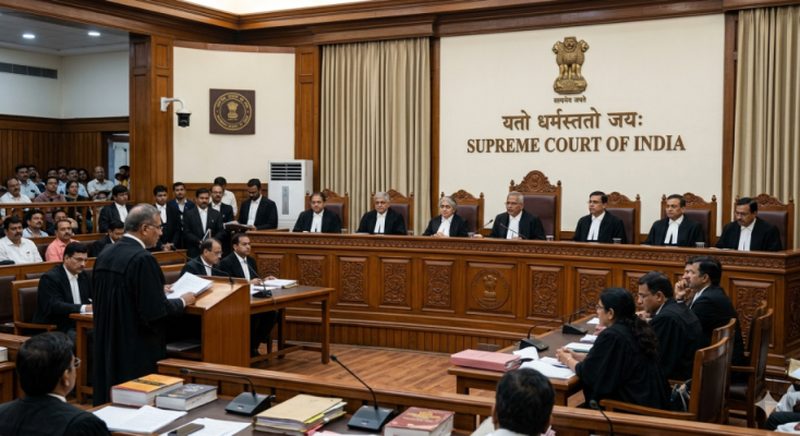
India is the only major democracy where judges appoint judges, with no formal role for the executive or legislature in choosing who sits on the higher judiciary. The collegium system, under which a panel of the senior-most Supreme Court judges selects judges for the Supreme Court and High Courts, evolved through Supreme Court judgments in the 1990s, not through any constitutional amendment. It has survived a full-scale legislative attempt to replace it and remains one of the most debated features of Indian democracy. This is how it works, and why the argument over it never ends.
How the collegium came to be
The Constitution says the President appoints Supreme Court and High Court judges in consultation with the Chief Justice and other judges, language that for decades was read as giving the executive the decisive voice. That changed through the Three Judges Cases. In the First Judges Case of 1981, the court held consultation did not mean concurrence, preserving executive primacy. In the Second Judges Case of 1993, the court reversed itself: the Chief Justice’s opinion, formed in consultation with senior colleagues, would have primacy, effectively creating the collegium. The Third Judges Case of 1998, a presidential reference, refined the mechanism into its current form: for Supreme Court appointments, a collegium of the Chief Justice plus the four senior-most judges; for High Court appointments, the Chief Justice plus the two senior-most judges, in consultation with the concerned High Court collegium and the state government. The Memorandum of Procedure, negotiated between the government and the judiciary, governs the process, though its finalisation has itself been a saga.
How appointments actually happen
The process begins in the High Courts, where the Chief Justice, in consultation with the two senior-most judges, proposes names for elevation, considering seniority, merit, and representation. The proposal travels with the state government’s views to the Supreme Court collegium, which consults among itself, seeks inputs including intelligence reports on candidates, and recommends names to the government. The government can return a recommendation once for reconsideration, but if the collegium reiterates it, the appointment must be made. For the Supreme Court, the collegium considers Chief Justices and senior judges of High Courts, and occasionally distinguished members of the Bar. The Chief Justice of India’s own appointment follows the convention of seniority, the senior-most judge succeeds, a convention broken during the Emergency and fiercely defended since. Transfers of High Court judges between states are also decided by the collegium, as an instrument of national integration of the judiciary.
The NJAC battle
The system’s most serious challenge came in 2014-15, when Parliament passed the 99th Constitutional Amendment and the National Judicial Appointments Commission Act, creating a six-member commission, the Chief Justice, two senior judges, the Law Minister, and two eminent persons, to replace the collegium. The amendment had near-unanimous parliamentary support and ratification by most states, reflecting a broad political consensus that the collegium was opaque and unaccountable. In 2015, a five-judge Constitution Bench struck the NJAC down by a 4:1 majority, holding that it violated the basic structure of the Constitution by undermining judicial independence. The judgment was a landmark assertion of judicial primacy, but it left the court with a problem: having demolished the alternative, it had to reform the collegium itself. The court invited suggestions for improving transparency and collegial functioning, leading to resolutions on publishing collegium decisions, but the fundamental opacity, no recorded reasons for selections or rejections, remained.
The criticisms, from all sides
The collegium’s critics span the spectrum. Governments complain of opacity and of delays in processing recommendations, with files sometimes pending for months. Critics within the legal system point to the absence of published criteria, the reliance on informal consultations, and the perception of favouritism, captured in the charge that the system rewards those with the right connections. Diversity advocates note the slow progress on representation of women, Dalits, Adivasis, and minorities in the higher judiciary, arguing that a closed system reproduces its own homogeneity. Defenders counter that every alternative tried or proposed, executive dominance before 1993, the NJAC’s political members, risks compromising judicial independence, and that the collegium, for all its flaws, has kept the higher judiciary largely free of political capture. They also note that transparency reforms, published resolutions and disclosed reasons in some cases, have begun, even if incomplete.
An argument without an end
The collegium debate persists because it poses a genuinely hard question: who should choose the choosers in a democracy? Executive appointment risks politicisation; legislative confirmation risks American-style partisanship; self-appointment risks insularity. India’s answer, forged by its particular history of Emergency-era executive overreach, is judicial primacy, and the NJAC judgment constitutionalised that choice. Incremental reform, clearer criteria, better diversity, published reasons, time-bound processing, is the realistic path, and some of it is underway. But the fundamental tension will remain as long as unelected judges exercise vast power in a democracy: independence requires insulation, and insulation looks, to outsiders, like unaccountability. The collegium is India’s attempt to square that circle, and the argument over whether it succeeds is itself a sign of democratic health.
FAQs
Who is in the Supreme Court collegium? The Chief Justice of India plus the four senior-most Supreme Court judges; for High Courts, the CJI plus the two senior-most judges.
Can the government reject a collegium recommendation? It can return it once for reconsideration, but a reiterated recommendation is binding.
What was the NJAC? A 2014 constitutional amendment creating a commission including the Law Minister and eminent persons to appoint judges; struck down by the Supreme Court in 2015.
The collegium system is an Indian invention born of Indian history: a judiciary that appoints itself because it once saw what executive appointment could do. Whether that remains the right answer is the question every generation of lawyers, judges, and lawmakers gets to argue.
Compiled by the Khabar 24h Editorial Desk from publicly available sources.

Khabar 24h Editorial Desk — our explainers are prepared by the Khabar 24h editorial team using AI-assisted research tools, and every piece is reviewed by a human editor before publishing. We do not claim original reporting: our work is turning complex topics into simple, accurate summaries. Spotted an error? Write to contact@khabar24h.com — our corrections policy aims for same-day review.
More from this author →