The Physics of the Monsoon: How Temperature Differences Drive Asia’s Rains
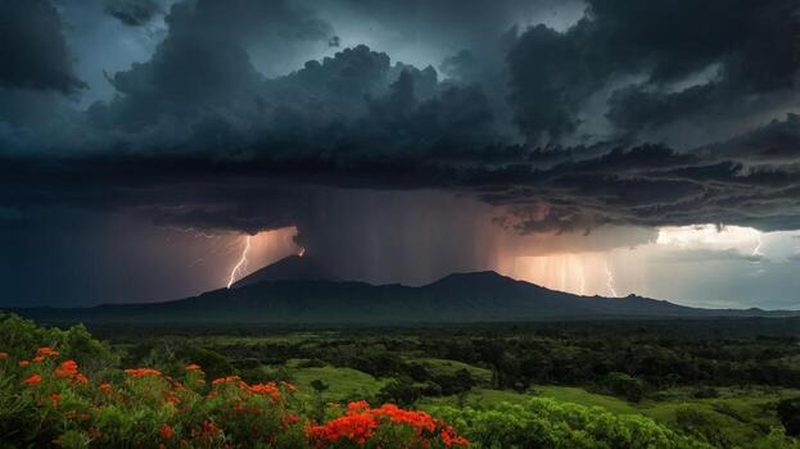
Each June, one of the planet’s great atmospheric engines switches on over South Asia. Moist air streams in from the Indian Ocean, climbs the Western Ghats and the Himalayas, and unloads months of rain in weeks, watering the crops that feed nearly a fifth of humanity and filling the reservoirs of a subcontinent. The Indian monsoon is the most dramatic seasonal weather system on Earth, and its physics, though rooted in a simple principle a child can grasp, unfolds into one of the most complex phenomena in climate science. At its heart it is a sea breeze grown to continental scale: land heats faster than ocean, air rises over the hot land, and moist ocean air rushes in to replace it. From that simple engine come the rains, the breaks, the floods, the droughts, and the profound uncertainty of forecasting them.
The engine: land heats, ocean doesn’t
The fundamental driver is differential heating. Land surfaces heat up and cool down far faster than water, which mixes heat through its depths. By May, the Indian subcontinent bakes under intense sun while the Indian Ocean stays relatively cool; the hot air over land rises, creating a vast low-pressure zone, and the pressure gradient pulls in moist air from the high-pressure ocean. As this air travels, it picks up moisture; forced upward by the Western Ghats and then the Himalayas, it cools, and the water vapour condenses into the towering cumulonimbus clouds of the monsoon. The Himalayas play a double role: a physical barrier that forces ascent and wrings out moisture, and a thermal one, the Tibetan Plateau heating the mid-troposphere and intensifying the circulation. The Coriolis effect, from Earth’s rotation, curves the incoming flow into the southwesterly winds that define the season. It is, in essence, the same physics as the afternoon sea breeze at a beach, scaled up to a continent and sustained for four months.
Why the monsoon pulses, breaks and surprises
The monsoon is not a steady tap but a pulsing system, and its variability is where the physics gets intricate. Active spells bring torrential rain; break spells, when the monsoon trough shifts to the Himalayan foothills, leave the plains hot and dry for a week or more, stressing crops at critical growth stages. These oscillations arise from atmospheric waves, the Madden-Julian Oscillation and monsoon intraseasonal oscillations, that propagate around the tropics on 30-to-60-day cycles. Year to year, the El Nino-Southern Oscillation dominates: El Nino events, warming the central Pacific, tend to suppress the Indian monsoon through shifts in the Walker circulation, and historically about 60 per cent of droughts coincided with El Nino, though the relationship has weakened in recent decades. The Indian Ocean Dipole adds its own influence. Forecasting has improved enormously: the India Meteorological Department’s models now predict seasonal rainfall within a few per cent in good years, but the holy grail, predicting the timing of active and break spells weeks ahead for farmers, remains frontier science.
Climate change and the monsoon’s future
Global warming is rewriting monsoon physics in real time, with contradictory-seeming effects that models are still disentangling. Warmer air holds about 7 per cent more moisture per degree, so when it rains, it rains harder: the trend toward more intense downpours and flooding, seen from Mumbai to Assam, follows directly from thermodynamics. But the circulation itself may weaken as the land-ocean contrast evolves and the upper atmosphere stabilises, potentially concentrating rainfall into fewer, more violent bursts with longer dry gaps between, the worst pattern for agriculture. Observations already show this emerging: total seasonal rainfall roughly steady, but rainy days fewer and extreme events more frequent. For India’s farmers, adaptation means water management for both flood and drought: watershed restoration, efficient irrigation, crop insurance and forecasts that reach the village level. The monsoon made Indian civilisation possible; its physics, stable for millennia, is now shifting under our feet, and understanding it has never mattered more.
- Warmer air holds about 7 per cent more moisture per degree Celsius of warming.
- The monsoon is essentially a continent-scale sea breeze driven by land-ocean heating contrast.
- El Nino events historically coincide with about 60 per cent of Indian monsoon droughts.
- The Himalayas and Western Ghats force moist air upward, wringing out rainfall.
- Rainfall is concentrating into fewer, more intense bursts with longer dry gaps.
FAQs
What causes the monsoon’s onset over Kerala? The establishment of the low-pressure heat low over northwest India and the strengthening of cross-equatorial winds, typically around June 1, plus or minus a week.
Why does the monsoon withdraw? As the Sun moves south after September, the land cools, the pressure gradient reverses, and dry northeasterly winds replace the moist southwesterlies.
Can we predict the monsoon months ahead? Seasonal totals can be forecast with moderate skill using ocean temperatures; predicting daily and weekly variations beyond two weeks remains unreliable.
A sea breeze the size of a subcontinent, pulsing to rhythms spanning weeks to decades: the monsoon is physics you can feel on your skin, and India’s fate has always ridden on understanding it.
Compiled by the Khabar 24h Editorial Desk from publicly available sources.

Khabar 24h Editorial Desk — our explainers are prepared by the Khabar 24h editorial team using AI-assisted research tools, and every piece is reviewed by a human editor before publishing. We do not claim original reporting: our work is turning complex topics into simple, accurate summaries. Spotted an error? Write to contact@khabar24h.com — our corrections policy aims for same-day review.
More from this author →