The UN Security Council’s veto: how five countries came to hold it and why reform keeps stalling
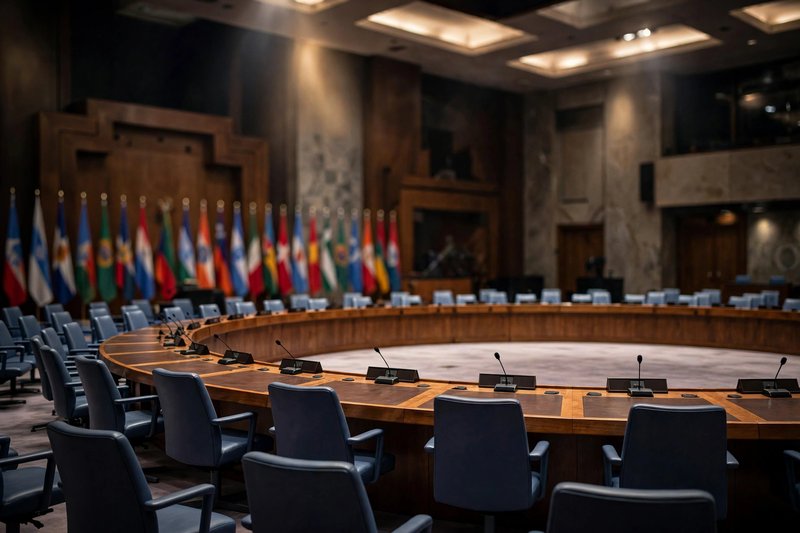
It is the only UN body whose decisions bind all member states — and the one most often blamed for failing to act. The Security Council was created to maintain international peace and security, yet its repeated deadlocks over wars from Gaza to Ukraine have revived a question as old as the United Nations itself: who gave five countries the power to overrule everyone else, and can the arrangement ever be changed?
Fifteen seats, two tiers
The Council has 15 members. Five are permanent — China, France, Russia, the United Kingdom and the United States, collectively known as the P5. This structure was fixed in 1945, reflecting the power balance at the end of the Second World War, and it has never changed. The other ten seats are non-permanent, allocated by region and elected by the General Assembly for two-year terms, with five replaced each year. For 2025–26 the non-permanent members include Pakistan, Denmark, Greece, Panama and Somalia; Bahrain, Colombia, the Democratic Republic of the Congo, Latvia and Liberia began their terms in 2026. Non-permanent members vote on resolutions but hold no veto. Each member, permanent or not, takes a turn as the Council’s president for a month, rotating in alphabetical order.
On procedural matters nine votes are enough. But on substantive resolutions — sanctions, peacekeeping missions, authorising force — a resolution needs nine votes and the concurrence of all five permanent members. In practice that means a single “no” from any one of the P5 kills the resolution outright, no matter how overwhelming the support for it. The veto itself does not appear in the UN Charter as such; it emerged from the requirement that substantive decisions need the “concurring votes of the permanent members,” a compromise insisted upon at the San Francisco conference in 1945 so that the great powers would join and stay in the organisation.
When the veto falls
When a veto blocks a resolution, the Council is not entirely finished with the matter. Members can negotiate and table fresh drafts, and — at the request of member states — the President of the General Assembly can convene a formal meeting of all 193 members within ten working days of a veto, forcing the wider membership to debate the situation that triggered it. In practice, this has become a regular spectacle: vetoes on Gaza resolutions in recent years have each been followed by emergency General Assembly sessions that pass near-identical texts with overwhelming majorities — texts the Assembly can recommend but cannot enforce. France and the United Kingdom have not exercised their vetoes in recent decades; Russia and the United States have been the most frequent users, blocking resolutions on Ukraine and the Middle East respectively, with China joining Russia on votes concerning Syria and Sudan.
The reform debate that never ends
Calls to reform the Council are nearly as old as the Council itself. The main proposals are straightforward to state and almost impossible to pass:
- Expand permanent membership to reflect today’s geopolitical realities, with India, Brazil, Germany and Japan the most frequently named contenders.
- Restrict or abolish the veto, particularly in cases of genocide and crimes against humanity, or in situations where a permanent member is party to the conflict.
- Give Africa a permanent voice, in line with the African Union’s 2005 Ezulwini Consensus demanding two permanent African seats with veto power.
A 2004 High-Level Panel on Threats, Challenges and Change urged permanent members to pledge restraint in using the veto in mass-atrocity situations — a pledge few have honoured.
The structural obstacle is baked into the Charter: amending it to change the Council’s composition requires ratification by all five permanent members under Article 108, giving each of them a veto over reforms that would dilute their own privilege. In September 2026, Secretary-General Antonio Guterres called Security Council reform an “absolute priority,” warning that its outdated 1945 composition fuels paralysis in the face of active crises and that violations of international law by permanent members themselves have created an environment of impunity. The Pact for the Future, adopted at the UN’s Summit of the Future, recommitted member states to reform — but unless one of the P5 shifts position or applies pressure from within, the debate looks set to continue into further General Assembly sessions, much as it has for the better part of eight decades.
Source: Better World Campaign

Khabar 24h Editorial Desk — our explainers are prepared by the Khabar 24h editorial team using AI-assisted research tools, and every piece is reviewed by a human editor before publishing. We do not claim original reporting: our work is turning complex topics into simple, accurate summaries. Spotted an error? Write to contact@khabar24h.com — our corrections policy aims for same-day review.
More from this author →
Leave a Reply