Tidal disruption events explained: when black holes tear stars
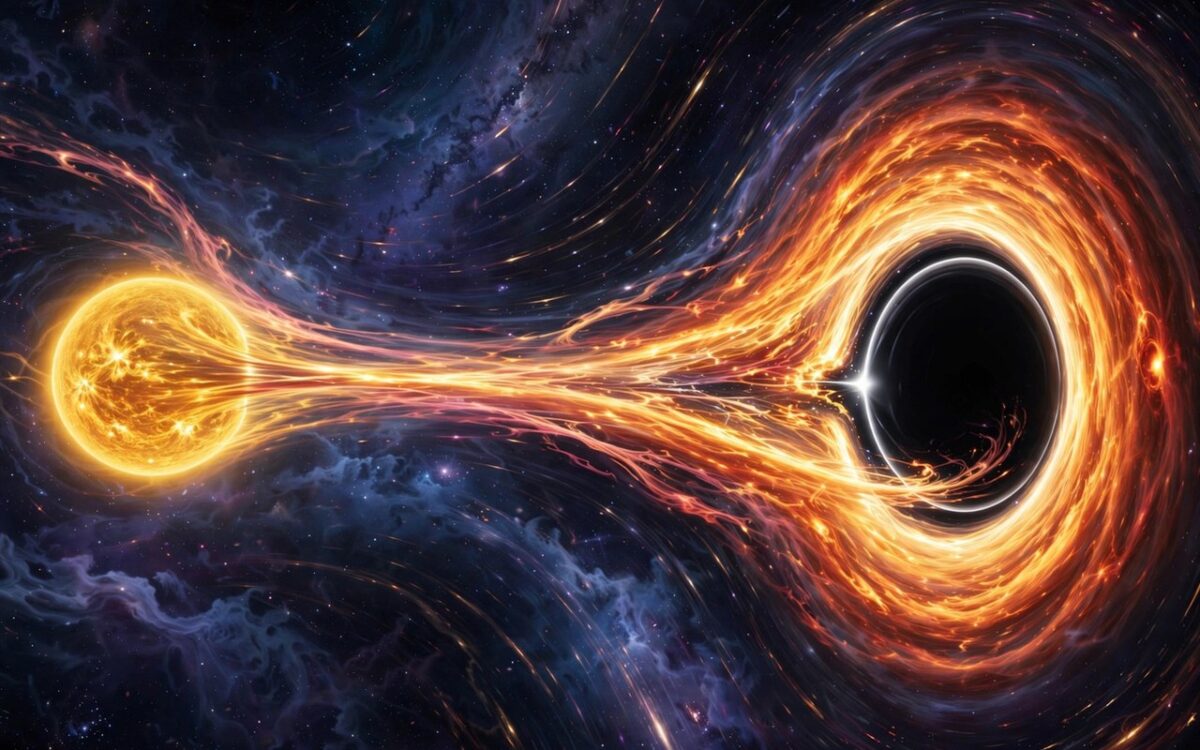
A tidal disruption event happens when a star wanders too close to a black hole. The black hole’s gravity tears the star apart.
The side of the star nearer the black hole feels a stronger pull. This stretches the star into a long, thin stream of gas. Some gas falls into the black hole. The rest is thrown out into space.
The falling gas heats up and glows brightly. Telescopes can see this flash across millions of light-years.
Sometimes the star survives. In a partial or repeating disruption, the black hole only nibbles at the star on each orbit. The star loses a little gas every time it passes.
One example is Swift J0230, found by NASA’s Swift Observatory. A Sun-like star there orbits a black hole more than 200,000 times the Sun’s mass. It loses about three Earth masses of gas per pass.
These events help astronomers weigh black holes. The brightness and timing of the flare reveal the size of the black hole and the star it is consuming.
Related stories
View all →
Bitcoin’s $83,000 rebound explained
Why bitcoin bounced above $83,000: Trump's Iran statement, ETF outflows, and the key levels traders watch.

Starlink Mobile explained: SpaceX’s carrier play
How SpaceX's 800 MHz spectrum deal and 15,000 new satellites could turn Starlink Mobile into a US carrier.

El Nino explained: why Maharashtra is parched
What El Nino is, how it weakens the monsoon, and why it left Maharashtra declaring drought in 265 talukas.

Khabar 24h Editorial Desk — our explainers are prepared by the Khabar 24h editorial team using AI-assisted research tools, and every piece is reviewed by a human editor before publishing. We do not claim original reporting: our work is turning complex topics into simple, accurate summaries. Spotted an error? Write to contact@khabar24h.com — our corrections policy aims for same-day review.
More from this author →
Leave a Reply