How Rocket Launches Work: The Science Behind ISRO’s Missions
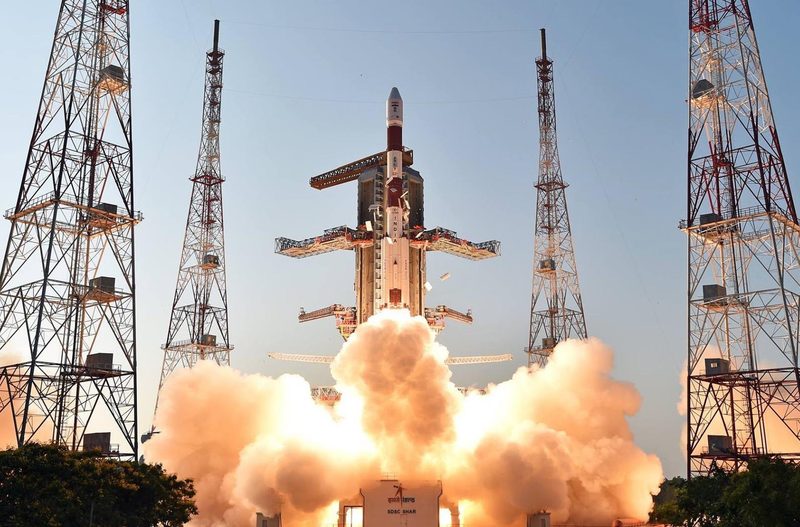
When an ISRO rocket lifts off from Sriharikota, climbing on a pillar of fire that turns night into day for kilometres around, it looks like pure power. But a rocket launch is really applied physics of the most precise kind: Newton’s laws expressed in thousands of tonnes of propellant, guided by computers making hundreds of corrections per second. India has become one of the world’s most accomplished spacefaring nations, from the Mars Orbiter’s famously frugal triumph to Chandrayaan-3’s historic lunar landing. Understanding how rocket launches work reveals the science behind the spectacle.
The basic physics: Newton’s third law
Rockets fly on the simplest law in physics: for every action there is an equal and opposite reaction. A rocket engine burns propellant and hurls exhaust gases out the nozzle at tremendous speed; the reaction pushes the rocket the other way. No air is needed to push against, which is why rockets work in the vacuum of space where aeroplanes cannot. The Tsiolkovsky rocket equation governs everything: a rocket’s final speed depends on its exhaust velocity and the ratio of its fuelled mass to its empty mass. This cruel mathematics is why rockets are mostly fuel, typically 85 to 90 per cent propellant by liftoff weight, and why every kilogram of structure must be pared to the minimum. Getting to orbit means reaching about 28,000 km/h horizontally; most of a launch’s energy goes into speed, not altitude.
Anatomy of a launch vehicle
ISRO’s workhorses illustrate the architecture. The PSLV, the Polar Satellite Launch Vehicle, is a four-stage rocket alternating solid and liquid propellant stages, famed for reliability across 60-plus missions. The LVM3, formerly GSLV Mk III, is India’s heavy lifter: two massive solid strap-on boosters flanking a liquid core stage, topped by a cryogenic upper stage burning liquid hydrogen and oxygen, the combination that launched Chandrayaan-3. Solid motors are simple and powerful but cannot be throttled or stopped once lit; liquid engines can be controlled precisely; cryogenic engines offer the highest efficiency but demand handling propellants at hundreds of degrees below zero. Staging, dropping empty stages as they burn out, sheds dead weight progressively, the key trick that makes orbit achievable at all.
Countdown to liftoff: how a launch unfolds
A launch is choreographed down to the second.
- Countdown and fuelling: cryogenic stages are fuelled in the final hours; computers run thousands of health checks while the range is cleared.
- Ignition and liftoff: engines ignite in sequence, computers confirm full thrust, and hold-down clamps release; the rocket cannot lift until thrust exceeds weight.
- Max-Q: about a minute in, the rocket passes through maximum aerodynamic pressure, the structurally most stressful moment, throttling slightly to survive it.
- Staging: spent boosters and stages separate with explosive bolts and small retrorockets, falling away as the next stage ignites.
- Fairing jettison: once above the atmosphere, the nose cone protecting the satellite splits and falls away.
- Orbit insertion: the final stage burns precisely to reach orbital velocity, then the satellite separates, unfolds its solar panels, and phones home.
Guidance: steering a controlled explosion
A rocket is inherently unstable, a pencil balanced on a flame, kept upright by active guidance. Gimballed engines swivel to vector thrust; small thrusters and aerodynamic fins assist in the atmosphere. Inertial measurement units sense every wobble hundreds of times per second, and flight computers correct continuously along a precomputed trajectory optimised for fuel efficiency. Wind is the great enemy: high-altitude winds can tear a rocket apart, which is why launches scrub for weather. Range safety adds a final layer: if a rocket veers off course, officers can destroy it remotely rather than risk populated areas. ISRO’s guidance computers, increasingly indigenous, execute all of this autonomously; by the time spectators see the flame, humans are monitoring, not flying.
ISRO’s signature: frugal engineering
What distinguishes ISRO is cost-effectiveness bordering on legend. The Mars Orbiter Mission reached Mars for about 450 crore rupees, less than the budget of the film Gravity, a feat achieved through minimalist design, proven components, and ingenious trajectory planning like using Earth’s gravity for slingshot boosts. The PSLV became the world’s favourite rideshare rocket, launching over 400 foreign satellites commercially. Chandrayaan-3’s soft lunar landing placed India in the most exclusive club in spaceflight. Now ISRO is pursuing reusable launch vehicles, demonstrated with landing experiments, human spaceflight through Gaganyaan, and a planned space station, each building on the frugal-engineering DNA that made the programme famous.
FAQs
Why do rockets launch from Sriharikota? Its east-coast location lets rockets launch eastward over the ocean, gaining Earth’s rotational boost safely, and its proximity to the equator maximises that advantage for geostationary missions.
How much does an ISRO launch cost? A PSLV launch costs roughly 200 crore rupees; LVM3 several times more. Both are among the world’s most economical for their capability.
Will ISRO’s rockets become reusable? That is the plan. Reusable vehicle demonstrator tests have landed prototypes successfully, and operational reusability would cut launch costs dramatically.
A rocket launch compresses centuries of physics into eight minutes of fire and thunder: Newton, Tsiolkovsky and thermodynamics riding a controlled explosion to 28,000 km/h. ISRO has shown the world it can be done brilliantly on a budget. The next time you watch that pillar of fire climb, you will know exactly what is happening inside it.
Source: ISRO

Khabar 24h Editorial Desk — our explainers are prepared by the Khabar 24h editorial team using AI-assisted research tools, and every piece is reviewed by a human editor before publishing. We do not claim original reporting: our work is turning complex topics into simple, accurate summaries. Spotted an error? Write to contact@khabar24h.com — our corrections policy aims for same-day review.
More from this author →