AI Hallucinations Explained: Why Chatbots Invent Facts and How to Catch Them
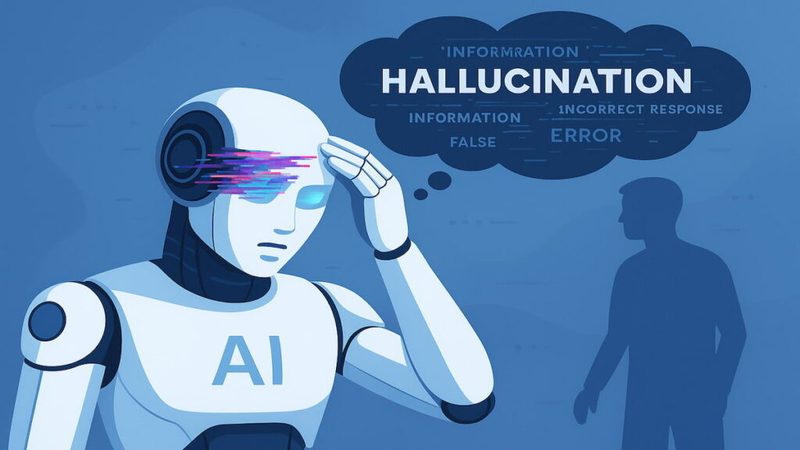
Ask a chatbot for a summary of a famous court case and it may invent quotations, dates and even judges who never existed, all delivered with serene confidence. These confident falsehoods have a name in the AI industry: hallucinations. They are not rare glitches but a fundamental feature of how large language models work. This guide explains why chatbots invent facts, what makes hallucinations more likely, how to catch them, and the practical habits that keep you safe.
Why predicting words produces false facts
A large language model generates text by predicting the most plausible next word, not by checking facts against reality. It has no internal truth meter and no live connection to verified knowledge. During training it absorbed statistical patterns from trillions of words, and when you ask a question, it reconstructs an answer that matches those patterns. If the training data contained the fact, the answer is often right. If it did not, or if the model only half-learned it, the model still produces fluent text, filling gaps with plausible-sounding invention rather than admitting ignorance. Fluency and accuracy are different skills, and the model was trained for fluency.
When hallucinations are most likely
Certain situations reliably trigger invented facts. Obscure topics are the biggest risk: ask about a little-known historical figure or a niche scientific paper and the model may fabricate biographies, citations and quotes because it has thin training data and no way to say it does not know. Specific details are vulnerable too: dates, statistics, names, legal citations and URLs are exactly the kind of precise information that pattern-matching handles worst. Long, complex answers drift more than short ones, because each generated word becomes context for the next, and a small error early on compounds. Questions about events after the model’s knowledge cutoff invite confident fiction. And leading prompts, questions that assume a false premise, often get agreeable invented elaboration rather than correction.
How to catch a hallucination
You can develop a nose for invented content with a few habits.
- Verify specific claims independently. Dates, numbers, quotes and citations should be checked against a search engine or primary source before use.
- Be suspicious of perfect detail. Real sources are messy; a suspiciously tidy list of references with vague journal names is a red flag.
- Ask the model to show its reasoning or cite sources, then check those sources actually exist.
- Cross-check with a second model or tool. Agreement across independent systems raises confidence.
- Watch for hedging that hides invention. Phrases like some experts say can dress up a guess as consensus.
- Test on things you know. Ask about your own field first to calibrate how much to trust the model elsewhere.
The golden rule: the more a fact matters, the less you should trust a single AI answer for it.
What the industry is doing about it
Hallucinations are an active research problem, and several approaches are reducing them. Retrieval-augmented generation connects chatbots to real documents, grounding answers in retrieved text rather than memory alone. Some systems now browse the web and cite sources, making claims checkable. Others are trained to express uncertainty or decline questions they cannot answer reliably. Evaluation benchmarks specifically measure hallucination rates, and the best models have improved markedly year over year. Yet no current approach eliminates the problem, because the underlying architecture still generates text from patterns rather than verifying against truth. Progress is real but the ceiling is architectural.
Why hallucinations also have an upside
The same mechanism that produces false facts also produces creativity. A system that only ever repeated verified information could not brainstorm, write fiction, or propose novel ideas. The industry’s challenge is calibration: models should be imaginative when you ask for a story and rigorous when you ask for medical guidance. Newer systems are getting better at adjusting their behaviour to context, being playful in creative tasks and cautious in factual ones. Understanding that hallucinations and creativity are two sides of the same coin helps you use these tools wisely: invite invention where you want it, and demand verification where you do not.
FAQs
Do bigger models hallucinate less? Generally yes, larger and newer models make fewer factual errors, but every current model still hallucinates sometimes. Size reduces the rate; it does not eliminate the cause.
Can I trust a chatbot for medical or legal advice? No. These are high-stakes domains where a confident error can cause real harm. Use AI as a starting point for understanding, then consult qualified professionals and primary sources.
Why does the chatbot sound so confident when it is wrong? Because confidence in the output reflects how predictable the text pattern was, not how true the content is. Fluency is not evidence.
Hallucinations are the price of a technology that creates rather than retrieves. They are manageable once you understand the mechanism: the model is a brilliant pattern-completer, not a witness to reality. Treat its factual claims as leads to verify, not conclusions to trust, and you get the creativity without paying for the fiction.
Compiled by the Khabar 24h Editorial Desk from publicly available sources.

Khabar 24h Editorial Desk — our explainers are prepared by the Khabar 24h editorial team using AI-assisted research tools, and every piece is reviewed by a human editor before publishing. We do not claim original reporting: our work is turning complex topics into simple, accurate summaries. Spotted an error? Write to contact@khabar24h.com — our corrections policy aims for same-day review.
More from this author →