Badminton Techniques Guide: Smashes, Drops and Net Play Explained
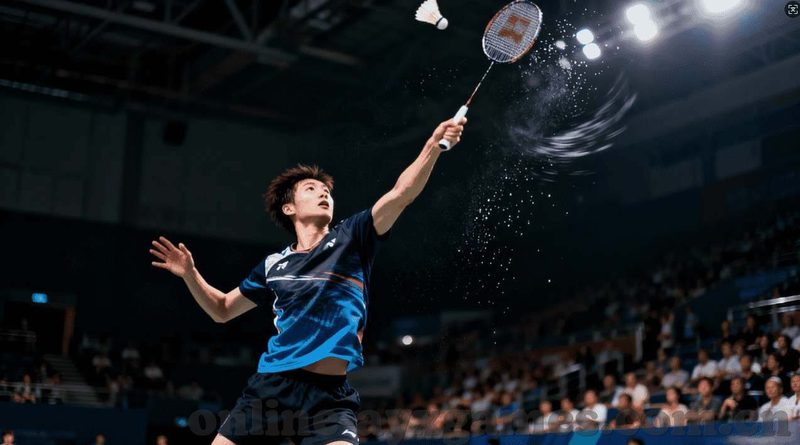
Badminton looks effortless when the world’s best play it, but beneath the speed lies a precise vocabulary of shots, each with its own technique, purpose and moment of use. The smash, the drop, the clear and the net kill are not just different ways of hitting a shuttle; they are tactical tools that players combine to construct rallies, expose weaknesses and force errors. This guide explains how badminton’s core techniques work and when elite players choose each one.
The smash: badminton’s most feared weapon
The smash is the fastest shot in racket sports, with elite players regularly clocking shuttles at over 400 kilometres per hour. It is an overhead attacking shot struck with a steep downward trajectory, usually from the back of the court. The technique begins with a sideways body position, a deep knee bend and a coiled torso. As the shuttle arrives, the player rotates the hips and shoulders explosively, extends the arm fully and snaps the wrist through the shuttle at the highest possible contact point. Players use the smash to finish rallies, but the best also use the threat of the smash to keep opponents pinned deep and guessing.
How does the drop shot work?
The drop shot is the smash’s quiet cousin: an overhead shot played with the same preparation but a soft, slicing contact that sends the shuttle tumbling just over the net into the front court. Its power lies in deception. Because the backswing looks identical to a smash or a clear, the opponent is forced to hold a deep defensive position, only to watch the shuttle die at the net. There are two main types. The slow drop falls close to the net and gives the attacker time to follow it in, while the fast drop travels flatter and deeper into the mid-court, pushing the opponent further out of position.
The clear: the foundation of rally construction
The clear is an overhead shot that sends the shuttle high and deep to the back boundary of the opponent’s court. It may be the least glamorous shot in badminton, but coaches consider it the foundation of the game. An attacking clear travels flat and fast to buy time, while a defensive clear arcs high to give a player under pressure a chance to recover position. In singles especially, deep clears push opponents to the back court and open up the front court for drops and net shots. Young players are drilled on clears for years because the footwork, timing and overhead technique they demand underpin every other shot in the book.
Net play: where rallies are won and lost
Net play covers the delicate shots exchanged within a metre of the net: the net shot, the net kill and the spinning net shot. A tight net shot tumbles the shuttle just over the tape so it falls almost vertically on the opponent’s side, forcing a weak lift that invites attack. The net kill is its ruthless opposite: a flat, hard interception of a loose net shot, struck downward with a short punching motion. The spinning net shot, played with a slicing action, makes the shuttle rotate and drop unpredictably, and it is one of the most difficult shots to return cleanly. At the elite level, net play is a battle of millimetres, and players practise touching the shuttle to within centimetres of the tape for hours.
Serving and the drive: the rally’s bookends
Every rally begins with a serve, and in doubles the serve is a specialist skill. The low serve must skim the tape and land just past the service line to deny attackers an easy kill, while the flick serve is a surprise long serve aimed at catching an aggressive receiver off guard. In singles, the high serve pushes opponents deep. The drive, a flat, fast shot exchanged at mid-court height, is the rally’s tempo-setter in doubles, where pairs trade drives at blistering speed to gain the attacking position. Good driving requires a compact swing and rock-solid racket preparation.
Putting it together: how techniques become tactics
No shot wins matches on its own. Elite players win by combining techniques into patterns: a deep clear followed by a disguised drop, a tight net shot that forces a lift, then a smash to finish. Footwork is the invisible glue, because every technique depends on arriving balanced and early. Coaches often say amateurs practise shots while professionals practise the movements between them. The next time you watch a top-level match, watch the feet as much as the racket: the player who arrives first usually wins the exchange.
- Smash: steep, powerful overhead attack, finished with a wrist snap at full extension.
- Drop shot: soft, disguised overhead shot that falls just over the net.
- Clear: high, deep overhead shot used to gain time and territory.
- Net kill: flat downward interception of a loose shot near the net.
- Drive: fast, flat mid-court exchange used to seize the attack in doubles.
FAQs
What is the fastest shot in badminton? The smash, which elite men’s players have recorded at speeds exceeding 400 kilometres per hour, making it the fastest shot in all racket sports.
Why do players spin the shuttle before serving? Spinning or feathering the shuttle checks that the feathers are intact and helps the server get a feel for its flight, since a damaged shuttle flies unpredictably.
What is a backhand clear and why is it so hard? A clear played on the backhand side, which demands exceptional wrist strength and technique because the body cannot rotate into the shot the way it can on the forehand.
From the thunder of the smash to the whisper of the spinning net shot, badminton’s techniques form a complete language. Learning to recognise each shot, and the tactic behind it, transforms watching the sport from a blur of speed into a contest of strategy you can read rally by rally.
Source: Badminton World Federation coaching resources

Khabar 24h Editorial Desk — our explainers are prepared by the Khabar 24h editorial team using AI-assisted research tools, and every piece is reviewed by a human editor before publishing. We do not claim original reporting: our work is turning complex topics into simple, accurate summaries. Spotted an error? Write to contact@khabar24h.com — our corrections policy aims for same-day review.
More from this author →