Why the Himalayas are India’s most dangerous earthquake zone
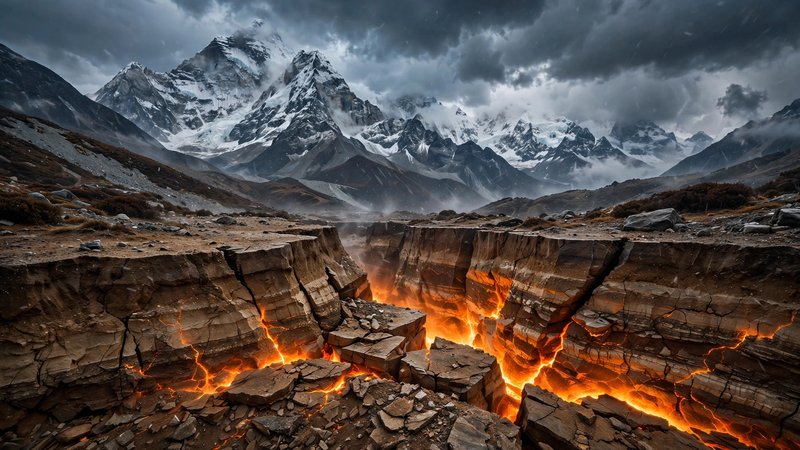
Every year, the ground beneath northern India shifts a few centimetres closer to Tibet. It has been doing so for 50 million years, and it is still doing it today. That slow, unstoppable collision is why the Himalayas exist — and why the mountain belt is one of the most dangerous earthquake zones on the planet.
To understand the risk, you have to start deep underground, with the engine that drives all earthquakes: plate tectonics.
Two plates, one slow crash
The Earth’s outer shell is broken into giant slabs called tectonic plates, which drift on the hot, slowly churning mantle below. The Indian plate is moving northward at roughly 4 to 5 centimetres a year and ploughing into the Eurasian plate. Because neither plate will yield, the crust between them crumples upward — that crumpling is the Himalayas, still rising to this day.
This kind of boundary, where two plates converge, is a classic earthquake factory. The plates do not slide smoothly past each other. Instead, their edges lock together along massive underground faults — including the Main Himalayan Thrust, the Main Frontal Thrust and the Main Central Thrust — while the driving force keeps building. Stress accumulates silently for decades or centuries until the locked rock can take no more. Then it ruptures in seconds, releasing all that stored energy as seismic waves. That sudden release is an earthquake.
Most Himalayan quakes strike at shallow depths of 10 to 15 kilometres, where brittle rock fractures violently — and shallow quakes cause the most violent surface shaking.
Why the Himalayas keep shaking
History shows what this collision can do. The Himalayan arc and its neighbours have produced some of the largest earthquakes ever recorded in India: the 1897 Shillong earthquake, the 1905 Kangra earthquake, the 1934 Bihar–Nepal earthquake and the 1950 Assam–Tibet earthquake, one of the strongest continental quakes of the 20th century. More recent reminders include the 1991 Uttarkashi and 1999 Chamoli earthquakes, the devastating 2001 Bhuj earthquake in Gujarat, and the 2015 Gorkha earthquake in Nepal, which killed nearly 9,000 people.
What worries geologists most is the quiet in between. Stretches of the Himalayan front — particularly in the central Himalayas — have not ruptured in a major earthquake for centuries. These “seismic gaps” are not safe zones; they are places where stress has been accumulating the longest, and where the next great rupture is most overdue.
The danger is no longer theoretical. In a major overhaul of India’s earthquake risk assessment, the entire Himalayan region has now been placed in the newly created highest-risk Zone VI, with more than 60 per cent of the country falling in moderate-to-high risk zones, according to a WION report on the revised seismic hazard map. New research is also revealing stranger mechanics at depth: a 2026 study reported by The Times of India found the Indian plate bending and tearing as it dives beneath Tibet, creating fresh stress points that could trigger further quakes.
Can we predict them? Can we prepare?
The honest answer to the first question is no. As geologists repeatedly stress, science cannot yet predict when or where an earthquake will strike — studies can map hazard, not forecast events. Anyone claiming otherwise is selling something.
But hazard maps tell us where to prepare, and preparation works. What makes an earthquake deadly is rarely the shaking alone; it is a combination of factors:
- Depth and magnitude: shallow, powerful quakes near populated areas do the worst damage.
- Building quality: most deaths come from collapsing structures, which is why the IS 1893 earthquake-resistant building code matters.
- Population density: the same quake in a remote valley and a crowded city produces vastly different tolls.
- Secondary hazards: landslides in the mountains and soil liquefaction in the plains can extend destruction far beyond the epicentre.
The Himalayas will keep rising, and the plates will keep colliding — that much is certain for millions of years to come. The question is not whether the next great Himalayan earthquake will happen, but whether the cities and towns sitting on top of that slow-motion crash will be ready when it does.
Source: The Times of India

Khabar 24h Editorial Desk — our explainers are prepared by the Khabar 24h editorial team using AI-assisted research tools, and every piece is reviewed by a human editor before publishing. We do not claim original reporting: our work is turning complex topics into simple, accurate summaries. Spotted an error? Write to contact@khabar24h.com — our corrections policy aims for same-day review.
More from this author →
Leave a Reply