Why Is the Ocean Blue – and Why Is It Salty?
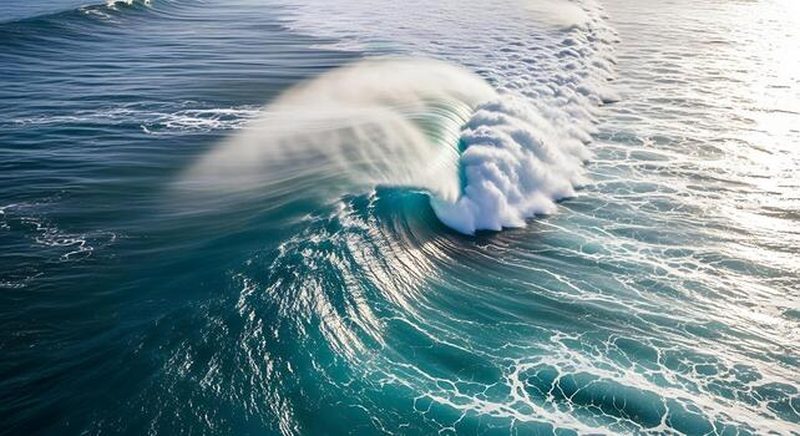
Two of the ocean’s most familiar qualities are also two of its subtlest physics puzzles. Why is the ocean blue, when a glass of seawater is perfectly clear? And why is it salty, when the rivers that feed it are fresh? The answers involve the quantum behaviour of water molecules and the slow grinding of continents over hundreds of millions of years. Together they explain how sunlight and stone conspired to make the seas blue and briny.
Why the ocean is blue
Sunlight contains all colours, and water treats them unequally. Water molecules absorb red, orange and yellow light far more readily than blue, through vibrations of the oxygen-hydrogen bonds that happen to resonate with longer wavelengths. In a glass of water the path is too short for the effect to show, but over metres and kilometres of ocean, the reds are progressively swallowed, leaving blue to be scattered back to our eyes. This is intrinsic to water itself: even the purest ocean would be blue. Suspended particles add variations, phytoplankton greens productive waters with chlorophyll, sediments brown coastal seas, but the deep ocean’s blue is water’s own colour.
Why the sky’s blue is different
It is tempting to think the ocean is blue because it reflects the blue sky, and reflection plays a small role on calm days. But the physics differs fundamentally. The sky is blue because air molecules scatter short blue wavelengths more strongly, Rayleigh scattering, while absorbing almost nothing. The ocean is blue primarily because water absorbs the long wavelengths, leaving blue behind. Proof: the ocean stays blue on overcast days when the sky is grey, and divers descending into deep water watch reds vanish first, exactly as absorption predicts. Two blues, two completely different mechanisms.
Where the salt comes from
The ocean’s salt began with rocks. Rainwater, slightly acidic from dissolved CO2, weathers continental rocks, dissolving ions, sodium, chloride, magnesium, calcium, potassium, and rivers carry them to the sea. Undersea volcanoes and hydrothermal vents add their own dissolved minerals. This input has run for billions of years, but the ocean is not getting dramatically saltier, because salt also leaves: it is buried in sediments, trapped in pore waters, and deposited in evaporite basins.
- Sodium chloride: ordinary table salt, about 85 percent of dissolved salts.
- Magnesium chloride: the second most abundant, bitter-tasting salt.
- Magnesium and calcium sulphates: contribute hardness to seawater.
- Calcium carbonate: used by corals and shellfish to build skeletons.
- Trace elements: dozens more, from potassium to gold, in minute amounts.
The ocean sits near a steady state, with inputs and outputs roughly balanced over geological time.
Why rivers stay fresh
If rivers deliver the salt, why aren’t they salty? Because of residence time and the water cycle. River water reaches the sea in weeks to months, too fast to accumulate much dissolved load, and evaporation then removes pure water, leaving salts behind to concentrate. The ocean is the end of the line: water leaves only by evaporation, which takes the water and leaves the salt. Over billions of years, this one-way ratchet built the sea’s salinity to about 35 grams per litre, while rivers, constantly flushed, stay fresh. It is the same reason a pot of soup gets saltier as it boils down.
Variations in saltiness
The ocean is not uniformly salty. The saltiest waters lie in hot, evaporative regions like the Red Sea and the Mediterranean; the freshest near river mouths, melting ice and heavy tropical rainfall. These differences drive ocean circulation: salty water is denser and sinks, powering the deep currents of the global conveyor. Climate change is intensifying the pattern, wet regions getting fresher and dry regions saltier, as the water cycle accelerates. Ocean salinity has thus become a rain gauge for the planet, revealing shifts in rainfall that rain gauges on land miss.
FAQs
Could we make the ocean fresh? Desalination works but is energy-intensive; desalinating the whole ocean is inconceivable. The sea’s salt is a geological fact, not an engineering problem.
Was the ocean always salty? Probably nearly so for billions of years, though early oceans may have been somewhat less salty; the balance of inputs and outputs stabilised long ago.
Why does salt water freeze differently? Dissolved salt lowers the freezing point to about minus 1.8 degrees Celsius, which is why sea ice forms later than lake ice and why salt melts icy roads.
The blue ocean and its salt are signatures of deep planetary processes: molecular vibrations selecting blue from sunlight, and continents slowly dissolving into the sea over eons. Every glance at blue water is a glimpse of physics and geology working at the grandest scales.
Source: National Oceanic and Atmospheric Administration

Khabar 24h Editorial Desk — our explainers are prepared by the Khabar 24h editorial team using AI-assisted research tools, and every piece is reviewed by a human editor before publishing. We do not claim original reporting: our work is turning complex topics into simple, accurate summaries. Spotted an error? Write to contact@khabar24h.com — our corrections policy aims for same-day review.
More from this author →