Volcanoes: What Erupts, and Why Some Explosions Are Catastrophic
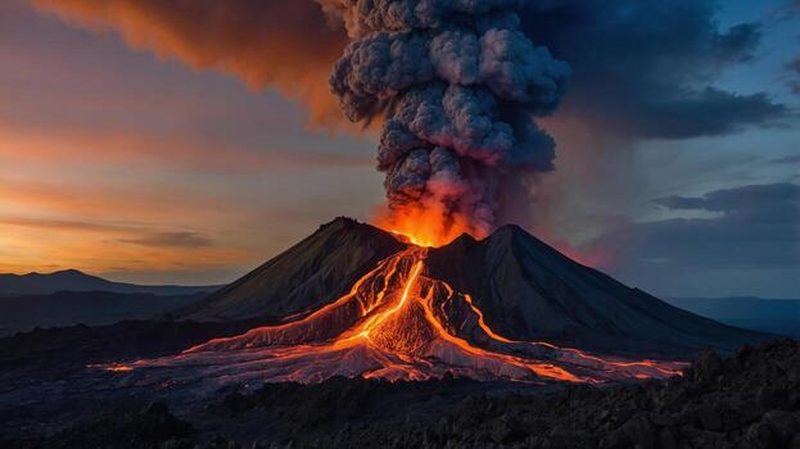
Volcanoes are Earth’s pressure valves, vents where the planet’s inner heat escapes to the surface. But not all eruptions are alike: Hawaii’s Kilauea oozes rivers of lava that tourists photograph from safe distances, while Mount St. Helens in 1980 exploded sideways with the force of a hydrogen bomb, and Krakatoa’s 1883 blast was heard 3,000 kilometres away. The difference between a fountain and a catastrophe lies in the magma itself: its silica content, its dissolved gas, and how it interacts with water. Volcanology, the science of reading these restless mountains, has saved countless lives through forecasting, yet volcanoes still kill, most recently and tragically in sudden phreatic explosions that give little warning. Here is what erupts from volcanoes, and what makes some eruptions catastrophic.
What actually comes out
An eruption’s products fall into three categories. Lava is molten rock that reaches the surface: basaltic lava, low in silica, is runny and flows in rivers, building shield volcanoes like Hawaii’s; rhyolitic lava, high in silica, is thick and pasty, piling into domes or plugging vents until pressure explodes. Tephra is fragmented material: ash, particles under 2 millimetres that drift on winds to blanket continents and disrupt aviation; lapilli; and volcanic bombs, flying blobs of lava. Gas is the invisible driver: water vapour, carbon dioxide and sulphur dioxide dissolved in magma under pressure, exsolving into bubbles as magma rises, exactly like opening a shaken soda bottle. It is the gas that powers explosivity: in runny magma, bubbles escape gently, producing fire fountains; in sticky magma, bubbles cannot escape, pressure builds, and the magma shreds into ash in a violent explosion. The 2022 Hunga Tonga eruption, which sent a plume 57 kilometres high and a shockwave around the planet, was supercharged by seawater flashing to steam, a reminder that magma-water interaction is volcanology’s wild card.
Why some eruptions turn catastrophic
Catastrophe comes in several flavours. Pyroclastic flows, avalanches of searing gas and ash racing downhill at hundreds of kilometres per hour, are the deadliest: they destroyed Pompeii and Herculaneum in 79 AD and killed 29,000 in St. Pierre, Martinique, in 1902, and they are nearly unsurvivable. Lateral blasts, like St. Helens, flatten forests for kilometres. Lahars, volcanic mudflows of ash mixed with water, can bury towns tens of kilometres away, as at Nevado del Ruiz in Colombia in 1985, where 23,000 died. Volcanic tsunamis, from flank collapse or underwater explosions, threaten coastlines, as Anak Krakatoa showed in 2018. And the largest eruptions affect the whole planet: Tambora in 1815 caused the Year Without a Summer, with global famine, and a future supereruption like Yellowstone’s past blasts could stress global food systems. The Volcanic Explosivity Index ranks eruptions from 0 to 8, each step ten times larger; humanity has never witnessed a VEI 8, and the geological record suggests they occur every few tens of thousands of years.
Reading restless mountains
Forecasting eruptions is one of geoscience’s great successes. Volcanoes usually warn: swarms of small earthquakes as magma forces upward, ground swelling measured by GPS and tiltmeters, changes in gas emissions, particularly the carbon dioxide to sulphur dioxide ratio, and heating detected by satellites. The 1991 Pinatubo forecast in the Philippines, which evacuated tens of thousands before a VEI 6 eruption, is the gold standard, saving an estimated 5,000 to 20,000 lives. India’s own volcanic outpost, Barren Island in the Andamans, India’s only active volcano, is monitored for its frequent Strombolian eruptions. But limits remain: phreatic explosions, driven by superheated groundwater with no fresh magma movement, can strike with almost no warning, as at Japan’s Mount Ontake in 2014 which killed 63 hikers. And the biggest uncertainty is not scientific but social: millions live on fertile volcanic slopes around the world, from Naples under Vesuvius to Yogyakarta near Merapi, in harm’s way because volcanic soils are rich. Living with volcanoes means respecting both their warnings and their silences.
- Hawaii’s basaltic lava flows gently; high-silica magma explodes violently.
- Pyroclastic flows can exceed 700 km per hour and are nearly unsurvivable.
- The 2022 Hunga Tonga plume reached 57 km, the highest ever recorded.
- Tambora’s 1815 eruption caused the global Year Without a Summer.
- Barren Island in the Andamans is India’s only active volcano.
FAQs
What is the Ring of Fire? The horseshoe of subduction zones around the Pacific hosting most of Earth’s earthquakes and active volcanoes, from Chile to Japan to Indonesia.
Can eruptions be predicted exactly? No. Scientists forecast heightened probability over days to weeks from monitoring signals, but exact timing and size remain uncertain.
Is Yellowstone about to erupt? There is no evidence of an imminent supereruption; monitoring shows normal background activity, and such events occur tens of thousands of years apart.
Volcanoes are where the deep Earth speaks to the surface, sometimes in a whisper of lava, sometimes in a shout heard around the world. Learning their language has saved thousands of lives, and the listening continues.
Compiled by the Khabar 24h Editorial Desk from publicly available sources.

Khabar 24h Editorial Desk — our explainers are prepared by the Khabar 24h editorial team using AI-assisted research tools, and every piece is reviewed by a human editor before publishing. We do not claim original reporting: our work is turning complex topics into simple, accurate summaries. Spotted an error? Write to contact@khabar24h.com — our corrections policy aims for same-day review.
More from this author →