Ocean Upwelling: How Deep Water Feeds the World’s Fisheries
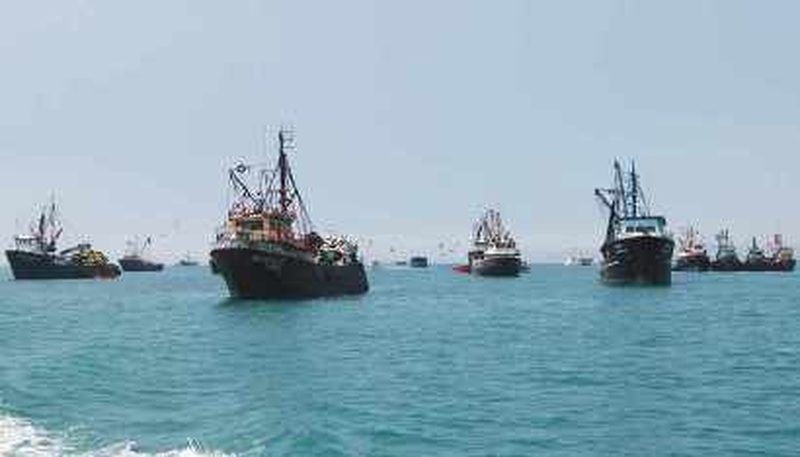
Some of the richest fishing grounds on Earth lie off deserts: the coasts of Peru, Namibia and California, where cold, nutrient-laden water wells up from the deep. This is ocean upwelling, the process by which winds push surface water aside and draw deep water upward, fertilising the sunlit zone with decades of accumulated nutrients. Upwelling zones cover a tiny fraction of the ocean yet yield a large share of the world’s fish catch. They are the reason deep water, cold and dark, is the lifeblood of the seas that feed hundreds of millions of people.
How winds pump the deep ocean
The mechanism is a beautiful piece of physics. Along certain coastlines, steady winds blow parallel to the shore; the Earth’s rotation deflects the moving surface water offshore through the Coriolis effect, a process called Ekman transport. To replace it, cold water rises from depths of a few hundred metres. Off Peru, the southeast trade winds do the job; off California, the northerly winds of summer. Equatorial upwelling works differently, with diverging currents pulling water up along the equator, while the Southern Ocean’s vast upwelling is driven by the westerlies circling Antarctica. Wherever it happens, the signature is the same: cold surface water where warm would be expected.
Why deep water is so fertile
Surface waters in the open ocean are biological deserts because nutrients sink. Dead plankton, faecal pellets and debris rain downward, and bacteria remineralise them, releasing nitrogen, phosphorus, iron and silica back into dissolved form. In the sunlit surface layer, phytoplankton consume these nutrients as fast as they appear; below, in the dark, they accumulate undisturbed for decades. Upwelling short-circuits this: it returns the accumulated nutrients to the light, triggering explosive phytoplankton blooms that turn the water green. Those blooms feed zooplankton, which feed small fish like anchovies and sardines, which feed everything else, up to tuna, seabirds and sea lions.
The fisheries that depend on it
The numbers are staggering. Eastern boundary upwelling systems, off Peru, California, northwest Africa and southwest Africa, produce a wildly disproportionate share of global fish landings. The Peruvian anchoveta fishery, riding the Humboldt Current’s upwelling, has been the largest single-species fishery in the world, though it famously collapsed in 1972 when overfishing met an El Nino.
- Humboldt (Peru-Chile): the world’s most productive fishery system, built on anchoveta.
- Benguela (SW Africa): sardines and hake off Namibia and South Africa.
- California Current: sardines, anchovies and the food web behind them.
- Canary (NW Africa): sustaining West African coastal fisheries.
- Somalia and SW India: seasonal monsoon-driven upwelling feeding regional fisheries.
India’s own southwest coast benefits from seasonal upwelling during the monsoon, when winds drive nutrient-rich water upward along Kerala and Karnataka, supporting the oil sardine and mackerel fisheries that feed millions.
El Nino: when upwelling fails
Every few years, the system stutters. During El Nino, warm water sloshes eastward across the Pacific, capping the Peruvian upwelling with a deep layer of warm, nutrient-poor water. Phytoplankton crash, anchovies starve or migrate, seabirds die in droves, and fisheries collapse. The 1972 and 1982 events devastated Peru’s fishing economy; the effects ripple globally through fishmeal prices that feed aquaculture worldwide. La Nina brings the opposite: intensified upwelling and bumper catches. These oscillations show how tightly human food systems are coupled to ocean physics thousands of kilometres away.
Upwelling in a warming world
Climate change pulls upwelling in competing directions. Stronger land-sea temperature contrasts could intensify the winds that drive coastal upwelling, a hypothesis with some observational support. But warming also strengthens ocean stratification, the layering that resists vertical mixing, potentially choking off the nutrient supply. Deeper source waters are losing oxygen as the ocean warms, so upwelled water may arrive lower in oxygen, stressing marine life. Which effect wins varies by region, and fisheries scientists are watching closely: the future of some of the world’s most productive fisheries hangs on the answer.
FAQs
Why is upwelled water cold? It comes from hundreds of metres down, where sunlight never reaches and temperatures stay near freezing year-round.
Does upwelling affect climate? Yes. Cold upwelled water absorbs CO2 efficiently, and the biological pump it fuels exports carbon to the deep ocean, making upwelling zones important carbon sinks.
Can upwelling be artificially created? Ocean fertilisation experiments have tried pumping deep water upward, but the scale needed is enormous and ecological side effects are poorly understood.
Ocean upwelling is the planet’s great recycling programme: winds dredging the deep sea’s nutrient savings back into the light, powering food webs that feed nations. It is a reminder that the ocean’s productivity, and much of humanity’s protein, depends on physics as much as biology, on winds and currents as much as fish.
Source: National Oceanic and Atmospheric Administration

Khabar 24h Editorial Desk — our explainers are prepared by the Khabar 24h editorial team using AI-assisted research tools, and every piece is reviewed by a human editor before publishing. We do not claim original reporting: our work is turning complex topics into simple, accurate summaries. Spotted an error? Write to contact@khabar24h.com — our corrections policy aims for same-day review.
More from this author →