The James Webb Space Telescope: How It Sees the Universe’s First Galaxies
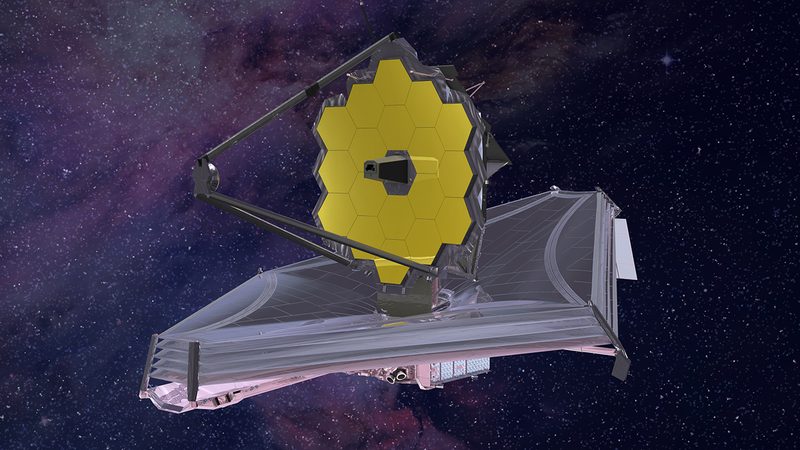
The James Webb Space Telescope is a time machine. Parked 1.5 million kilometres from Earth, its 6.5-metre mirror of gold-coated beryllium collects the faintest infrared light in the universe, light that left the first galaxies more than 13.5 billion years ago, when the cosmos was a few hundred million years old. Since its first images in 2022, Webb has rewritten textbooks on galaxy formation, sniffed the atmospheres of distant worlds, and peered through dust clouds to watch stars being born. It is the most ambitious observatory ever built, and it works by seeing heat.
Why infrared is the key to the early universe
The universe is expanding, and that expansion stretches light. Light emitted by the first galaxies as visible or ultraviolet radiation has been stretched by a factor of ten or more during its 13-billion-year journey, arriving today as infrared. Hubble, which sees mostly visible light, is therefore blind to the earliest galaxies; they have redshifted out of its range. Webb was designed from the start as an infrared telescope, with instruments sensitive to wavelengths up to 28 microns. To see the first stars ignite, you must look in the infrared, and Webb is the first observatory big enough and cold enough to do it well.
Colder than Pluto
Infrared telescopes must be cold, because anything warm glows in infrared and would blind itself. Webb’s instruments operate below minus 220 degrees Celsius, achieved with a tennis-court-sized sunshield of five gossamer layers that blocks heat from the Sun, Earth and Moon. The observatory orbits the Sun-Earth Lagrange point 2, where the three heat sources stay in the same direction, so one shield protects everything. Its primary mirror, too large to fit in any rocket, was folded origami-style for launch and unfolded in space with 132 actuators aligning 18 hexagonal segments to nanometre precision.
What Webb has found so far
The early results have been startling. Webb found galaxies far earlier and more massive than most theories predicted, some shining just 300 million years after the Big Bang, forcing cosmologists to rethink how fast the first structures assembled. It has mapped the atmospheres of exoplanets in unprecedented detail, detecting water, carbon dioxide, methane and hazes on worlds light-years away. Closer to home, it has peered inside stellar nurseries like the Pillars of Creation, revealing newborn stars and the dusty disks that will become planets, and it has traced the chemistry of the early solar system’s building blocks.
How it complements other telescopes
Webb does not replace Hubble or ground-based giants; it joins them. Each observatory covers different wavelengths and different science:
- Hubble still leads in visible and ultraviolet light, essential for studying hot young stars and nearby galaxies.
- Chandra and other X-ray observatories see the violent universe of black holes and supernova remnants.
- ALMA and the GMRT probe cold gas and radio emissions that infrared cannot reach.
- Ground-based giants like the Extremely Large Telescope will follow up Webb’s discoveries with sharper spectroscopy.
The engineering gamble that paid off
Webb was nearly cancelled multiple times during its 25-year development, as costs ballooned past 10 billion dollars. Its deployment involved 344 single-point failures, any one of which could have doomed the mission. That every one succeeded is a testament to obsessive testing, including years of cryogenic trials of the full optical system. The telescope carries enough propellant for well over a decade of operations, and its flawless launch preserved fuel, potentially extending its life to twenty years or more.
FAQs
Why is Webb’s mirror gold? Gold reflects infrared light superbly. The coating is only about 100 nanometres thick, yet it gives the mirror its unmistakable golden hue.
Can Webb see the Big Bang itself? No. The earliest light we can see is the cosmic microwave background, from 380,000 years after the Big Bang. Webb sees the first stars and galaxies, which formed tens of millions of years later.
Will there be a successor? Concepts like the Habitable Worlds Observatory are being studied to directly image Earth-like exoplanets, but nothing is approved yet; Webb will reign for at least another decade.
The James Webb Space Telescope has turned the universe’s first billion years from speculation into observation. Every deep image is a census of cosmic dawn, and every spectrum is a chemical fingerprint from the edge of time. We built a machine to see the beginning, and it is working better than anyone dared hope.
Source: NASA

Khabar 24h Editorial Desk — our explainers are prepared by the Khabar 24h editorial team using AI-assisted research tools, and every piece is reviewed by a human editor before publishing. We do not claim original reporting: our work is turning complex topics into simple, accurate summaries. Spotted an error? Write to contact@khabar24h.com — our corrections policy aims for same-day review.
More from this author →