Human Evolution: The Long Road From Early Apes to Homo Sapiens
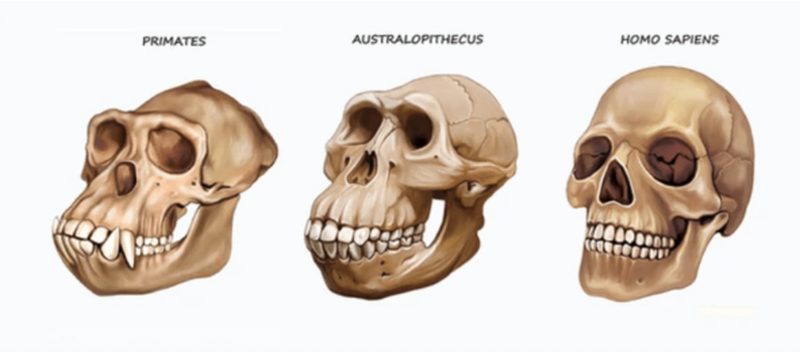
Every human alive today belongs to a single species, Homo sapiens, about 300,000 years old, yet our family tree reaches back more than six million years to ancestors we shared with chimpanzees. The road between was crowded: at various times, multiple human-like species walked the Earth simultaneously, making tools, controlling fire, burying their dead and eventually painting caves, before all but one vanished. Human evolution is not a straight line from ape to human but a branching bush, repeatedly pruned by extinction, with our species as the last twig standing. New fossils and ancient DNA keep rewriting the details, from interbreeding with Neanderthals to mysterious Denisovans. And India has its own chapter in this story, from ancient stone tools to the Narmada hominin, placing the subcontinent on the map of our deep past.
From apes to upright walkers
The human story begins in Africa, where between 6 and 7 million years ago, our lineage split from the ancestors of chimpanzees. The earliest hominins, like Sahelanthropus and Orrorin, were ape-like in most respects but showed the first hints of bipedalism, walking on two legs. Bipedalism was the founding adaptation of our lineage, freeing the hands for carrying and tool use millions of years before brains grew large. Australopithecus, best known from the Lucy skeleton 3.2 million years old, walked upright habitually while retaining a chimp-sized brain and long arms for climbing. For millions of years, human ancestors were essentially upright apes, and it was only with the genus Homo, emerging around 2.8 million years ago, that stone tools, larger brains and a more human body plan appeared together. Homo erectus, the first hominin to leave Africa nearly two million years ago, spread across Asia, controlled fire and had a brain approaching modern size, thriving for over a million years, far longer than our species has existed.
The crowded middle of our family tree
By half a million years ago, the world hosted several human species at once. Neanderthals evolved in Europe and western Asia: stocky, large-brained, burying their dead, making sophisticated tools and possibly wearing jewellery and painting caves. Denisovans, known mainly from DNA in a Siberian cave, ranged across Asia. Homo naledi in southern Africa had a tiny brain yet deliberately disposed of its dead in caves. Mysterious island dwarfs like Homo floresiensis, the Hobbit of Indonesia, shrank to a metre tall. Then anatomically modern Homo sapiens evolved in Africa around 300,000 years ago, evidenced by fossils from Jebel Irhoud in Morocco, and began expanding worldwide about 60,000 years ago. As modern humans spread, they met the Neanderthals and Denisovans, and interbred with them: most non-Africans today carry 1 to 2 per cent Neanderthal DNA, and some Asian and Oceanian populations carry Denisovan genes that help Tibetans live at high altitude. Within a few tens of millennia, all the other human species were gone, leaving us alone, carrying fragments of our extinct cousins in our genomes.
India’s chapter in the human story
The Indian subcontinent was a corridor and a home for ancient humans. Stone tools from Attirampakkam in Tamil Nadu date back 1.5 million years, showing early human presence deep in the peninsula. The Narmada hominin, a skullcap discovered in Madhya Pradesh in 1982, represents an archaic human who lived hundreds of thousands of years ago, though its exact species remains debated. Bhimbetka’s rock shelters preserve art spanning tens of millennia, from hunter-gatherer paintings to later periods. Genetic studies show that the ancestors of most Indians descend from populations that migrated out of Africa via the southern coastal route, with later layers of migration from Central Asia and the Iranian plateau mixing in. The Andaman Islanders preserve some of the oldest-diverging human lineages outside Africa. India’s deep past is still being excavated, literally: new dating techniques and DNA from ancient bones promise to fill the gaps in a record that already shows the subcontinent as a crossroads of human evolution for over a million years.
- Homo sapiens evolved in Africa around 300,000 years ago; the human-chimp split was 6 to 7 million years ago.
- Most non-Africans carry 1 to 2 per cent Neanderthal DNA from ancient interbreeding.
- Stone tools from Attirampakkam, Tamil Nadu, date human presence in India to 1.5 million years ago.
- Homo erectus survived for over a million years, far longer than our species has existed.
- The Narmada skullcap, found in 1982, is India’s most famous archaic human fossil.
Are we still evolving?
Evolution has not stopped; it has changed arenas. Natural selection still operates: genes for lactose tolerance spread with dairy farming within the last 10,000 years, Tibetans evolved altitude adaptations, and disease resistance continues to shape genomes, as the COVID-19 pandemic may yet demonstrate. But culture now evolves faster than genes, and technology buffers many selective pressures: medicine, agriculture and shelter relax selection on traits that once meant life or death. Some biologists argue that sexual selection and drift now dominate human evolution, while others point to ongoing adaptation to diets, pathogens and urban life. The future may bring stranger changes: gene editing could let us direct our own evolution, for better or worse. Whatever comes, the lesson of the fossil record is humility. Species after species of intelligent, adaptable hominins walked this Earth and vanished; our 300,000 years are a blink. Survival, as every extinct cousin demonstrates, is never guaranteed.
FAQs
Did humans evolve from monkeys? No. Humans and modern monkeys share common ancestors; we evolved from earlier primates, not from any living monkey species.
Why did Neanderthals go extinct? Likely a combination of competition with modern humans, small population sizes, climate stress and absorption through interbreeding; the exact mix is debated.
Six million years from upright apes to a species that reads its own genome: human evolution is the longest epic we know, and its final chapters are being written by us.
Compiled by the Khabar 24h Editorial Desk from publicly available sources.

Khabar 24h Editorial Desk — our explainers are prepared by the Khabar 24h editorial team using AI-assisted research tools, and every piece is reviewed by a human editor before publishing. We do not claim original reporting: our work is turning complex topics into simple, accurate summaries. Spotted an error? Write to contact@khabar24h.com — our corrections policy aims for same-day review.
More from this author →