The Carbon Cycle: How Carbon Moves Through Air, Oceans and Life
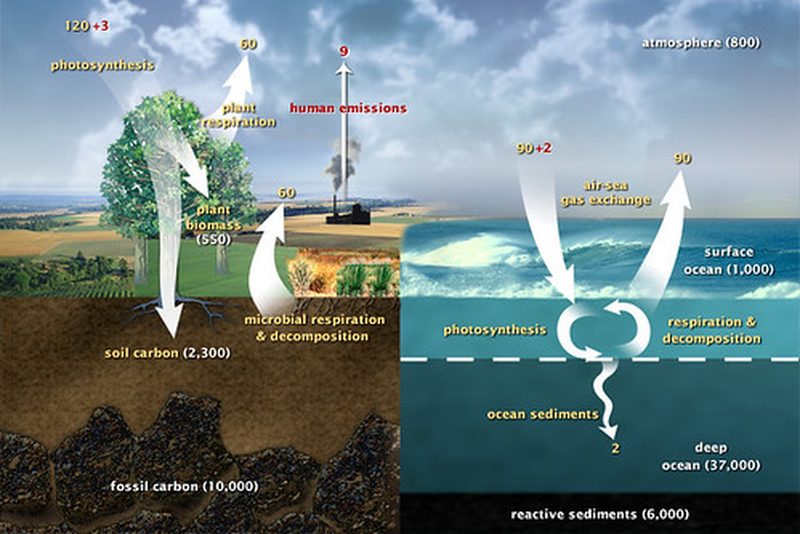
Carbon is the great traveller of the Earth system. It drifts through the air as carbon dioxide, dissolves into the oceans, gets locked into rocks for millions of years, and cycles through every living thing, including you: the carbon in your body was recently in the atmosphere, and before that in plants, soil or the sea. This endless circulation is the carbon cycle, the planetary conveyor that regulates Earth’s climate. Humans have now grabbed the controls, digging up fossil carbon and injecting it into the fast cycle far faster than nature can absorb it.
The fast cycle: breathing of the biosphere
The fast carbon cycle turns over in years to centuries. Plants pull CO2 from the air through photosynthesis, converting it into leaves, wood and roots. Animals eat plants and exhale CO2 back through respiration; when organisms die, decomposers break them down, returning carbon to the air and soil. The oceans exchange CO2 continuously with the atmosphere across their surface, absorbing it in cold waters and releasing it in warm ones. This fast cycle moves around a hundred billion tonnes of carbon each year in each direction, a giant balanced breathing that kept atmospheric CO2 roughly stable for millennia before industry.
The slow cycle: rocks and deep time
Beneath the fast cycle runs a geological one measured in millions of years. Carbon dissolves in rainwater, weathers rocks, and washes to the sea, where marine organisms turn it into limestone; buried and compressed, it becomes rock. Volcanoes and tectonic processes return it to the air over eons. Fossil fuels are the slow cycle’s savings account: ancient plankton and plants buried and cooked into coal, oil and gas over hundreds of millions of years. By burning them, humanity is withdrawing that savings in decades, a transfer from the slow cycle to the fast one that the planet has no quick way to reverse.
Where human carbon goes
Of the roughly 40 billion tonnes of CO2 humans emit each year, only about half stays in the atmosphere. The rest is absorbed by carbon sinks:
- The oceans take up about a quarter, which drives ocean acidification as a side effect.
- Land ecosystems absorb roughly another quarter, as extra CO2 fertilises plant growth, though this sink is vulnerable to drought, fire and deforestation.
- The atmosphere accumulates the remainder, raising CO2 from 280 to over 420 parts per million.
Why the cycle can’t keep up
The sinks are not keeping pace, and they may weaken. Warmer soils respire more carbon, forests stressed by heat and fire can flip from sinks to sources, and the ocean’s ability to absorb CO2 declines as it warms and acidifies. Permafrost thaw adds ancient carbon the fast cycle never budgeted for. This is why emissions must fall to near zero rather than merely slow: as long as we keep injecting fossil carbon into the fast cycle faster than slow geological processes can remove it, the atmospheric stock keeps rising. Net zero means balancing the books, emitting only what sinks can durably absorb.
The cycle in everyday life
You participate in the carbon cycle with every breath: inhaling oxygen, exhaling CO2 that plants may soon photosynthesize. The food you eat is packaged sunlight and air, carbon fixed by photosynthesis weeks or months ago. The deeper connection is through fossil carbon: the fuel in a car, the gas heating a home, the coal behind much electricity, all of it ancient carbon rejoining the fast cycle. Understanding the cycle reframes climate action: it is not about eliminating carbon, which is essential to life, but about stopping the one-way transfer of geological carbon into the living atmosphere.
FAQs
Is carbon bad? No. Carbon is the backbone of all known life. The problem is the rate at which we are moving fossil carbon into the atmosphere, overwhelming the cycle’s natural balance.
Why don’t trees just absorb it all? They absorb a lot, but forests are limited by land, water and nutrients, and much of the carbon they take up returns to the air within decades. Only a fraction gets locked away long-term.
How long does emitted CO2 last? A portion is absorbed within decades, but a significant fraction persists for centuries to millennia, which is why today’s emissions shape the climate for generations.
The carbon cycle is Earth’s great balancing act, honed over billions of years. We have tilted it by treating the atmosphere as a dump for geological carbon. Rebalancing it, by ending the one-way flow and protecting the sinks, is the entire climate challenge in a single diagram.
Source: National Oceanic and Atmospheric Administration

Khabar 24h Editorial Desk — our explainers are prepared by the Khabar 24h editorial team using AI-assisted research tools, and every piece is reviewed by a human editor before publishing. We do not claim original reporting: our work is turning complex topics into simple, accurate summaries. Spotted an error? Write to contact@khabar24h.com — our corrections policy aims for same-day review.
More from this author →