Space Debris: The Growing Junk Crisis in Earth’s Orbit
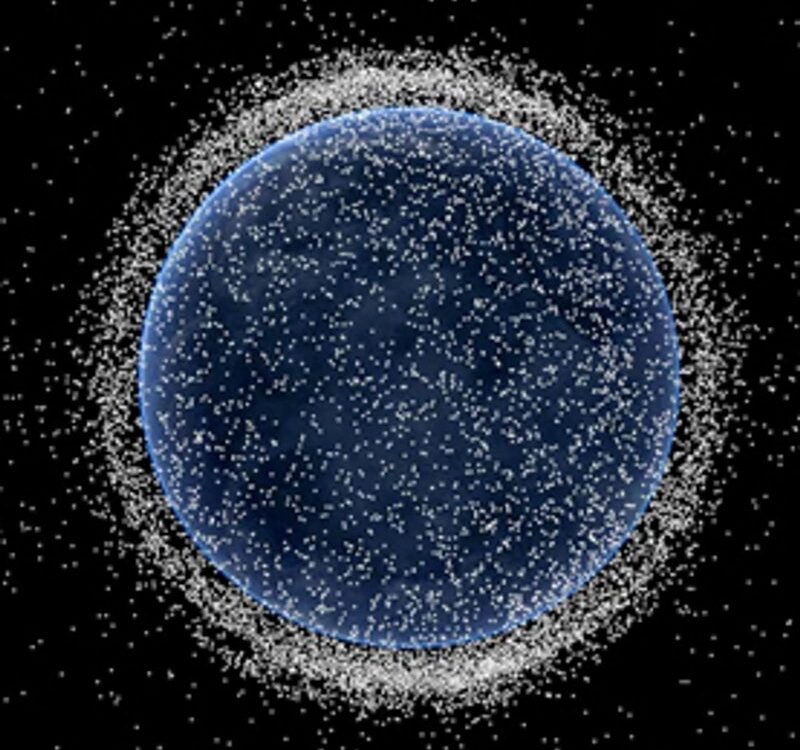
Earth’s orbit is becoming a junkyard. Decades of launches have left behind dead satellites, spent rocket stages, lost tools and millions of fragments from collisions and explosions, all circling the planet at up to 28,000 kilometres per hour. At those speeds, even a paint fleck carries the energy of a bullet, and a collision with a centimetre-sized fragment can end a satellite’s life in an instant. With mega-constellations adding thousands of new satellites every year, space debris has grown from a housekeeping nuisance into a genuine crisis that threatens the orbital infrastructure modern life depends on.
How the junk accumulated
For the first fifty years of the space age, nobody cleaned up. Rockets routinely left their upper stages in orbit after delivering payloads, satellites were abandoned where they died, and anti-satellite weapons tests in 2007 and 2021 deliberately shattered spacecraft into thousands of trackable fragments. Accidental collisions added more: in 2009, a dead Russian satellite smashed into an active American one, creating over 2,000 pieces of debris. Each breakup multiplies the hazard, because every fragment becomes a potential bullet for everything else up there.
The Kessler syndrome: a cascade scenario
In 1978, NASA scientist Donald Kessler described a nightmare feedback loop. If debris density in a given orbit grows high enough, collisions between objects create more debris, which causes more collisions, until the cascade becomes self-sustaining. This Kessler syndrome would not happen everywhere at once, but in the most crowded shells of low Earth orbit it is a real long-term risk. Some modelling suggests that even if humanity stopped launching entirely, collisions among the existing population would keep generating fragments for decades, a sobering reminder that the problem has momentum of its own.
What is at stake
Low Earth orbit is no longer empty frontier; it is critical infrastructure, and the economic value flowing through it grows every year. The threatened assets include:
- Communication and internet constellations that increasingly carry global connectivity.
- Earth-observation satellites used for weather forecasting, disaster response and agriculture.
- The International Space Station and its successors, whose crews periodically dodge tracked debris.
- Navigation satellites in higher orbits, which are harder to reach but not immune.
How the world is responding
Tracking networks now follow more than 35,000 objects larger than 10 centimetres, and satellite operators routinely manoeuvre to avoid them, each dodge burning precious fuel and shortening mission life. New guidelines ask operators to deorbit dead satellites within a few years of mission end, and passivation, venting leftover fuel and discharging batteries, is meant to stop old stages exploding. More ambitiously, several agencies and startups are testing active debris removal: nets, harpoons, robotic arms and magnetic grapples designed to grab large dead objects and drag them into the atmosphere to burn up. The technology works in principle; the economics and legal questions of who pays, and who is allowed to grab whose hardware, are harder.
Why mega-constellations raise the stakes
The newest source of congestion is the rise of mega-constellations, networks of thousands of satellites providing global internet coverage. Each one is designed to deorbit at end of life, but sheer numbers mean more manoeuvres, more close approaches and more chances for something to go wrong. Astronomers have an additional complaint: the satellites streak through telescope images and brighten the night sky. Regulators are now weighing how many satellites each orbital shell can safely hold.
FAQs
Can we see space debris from the ground? Large objects are tracked by radar and telescopes, but the millions of fragments smaller than a centimetre are essentially invisible until they hit something.
Does debris fall back to Earth? Yes, slowly. Atmospheric drag pulls low-orbit debris down over years to decades, but at higher altitudes objects can remain for centuries.
Is orbit already unusable? No. Space remains very big, and active collision avoidance works for now. The concern is the trend: without action, the most useful orbits get steadily more dangerous, and insurance costs for satellite operators keep climbing.
Space debris is a classic tragedy of the commons, unfolding a few hundred kilometres overhead. The good news is that it is a solvable problem, with known technologies and emerging rules. The bad news is that the junk keeps accumulating faster than we remove it, and the clock is ticking. Whether the orbital environment of 2040 is a managed highway or a shooting gallery will be decided by the choices made in this decade.
Source: European Space Agency

Khabar 24h Editorial Desk — our explainers are prepared by the Khabar 24h editorial team using AI-assisted research tools, and every piece is reviewed by a human editor before publishing. We do not claim original reporting: our work is turning complex topics into simple, accurate summaries. Spotted an error? Write to contact@khabar24h.com — our corrections policy aims for same-day review.
More from this author →