Shukrayaan-1: Why Scientists Want to Visit Venus, the Hottest Planet
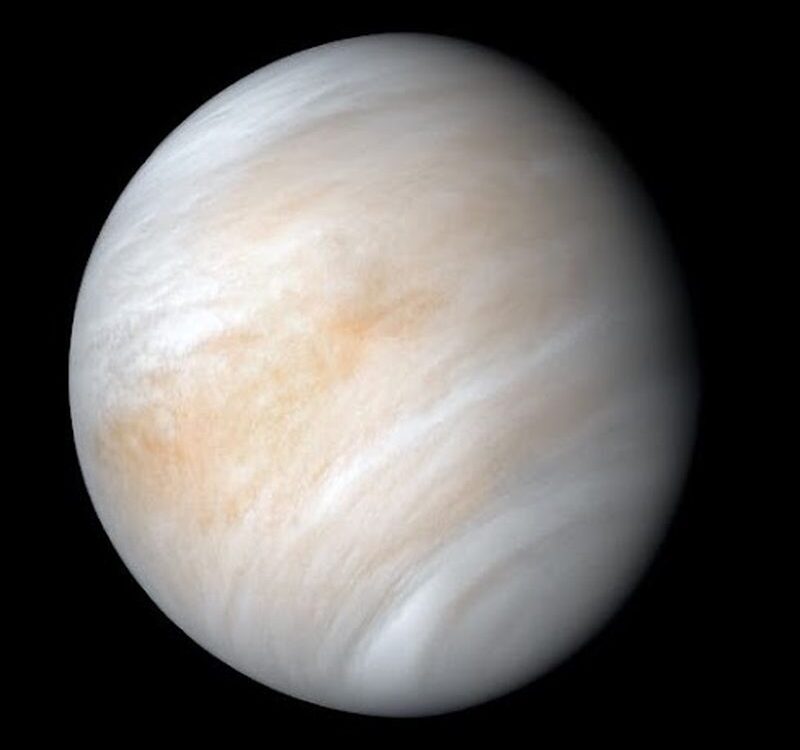
Venus is the planet that got everything wrong. It is nearly Earth’s twin in size and mass, it orbits in the Sun’s habitable zone, and it may once have had oceans. Today it is a pressure-cooker world with surface temperatures hot enough to melt lead, an atmosphere ninety times thicker than Earth’s, and clouds of sulphuric acid. Shukrayaan-1, the Venus orbiter being developed by ISRO, is India’s bid to understand how a world so like ours became so hostile, a question with uncomfortable implications for Earth’s own future.
Earth’s twin, gone wrong
Venus and Earth probably started out remarkably similar. Both are rocky planets of comparable size, and both likely had water early in their histories. Somewhere along the way, Venus fell into a runaway greenhouse effect: warming evaporated more water, water vapour trapped more heat, and the cycle spiralled until the oceans boiled away entirely. The water molecules were then broken apart by sunlight, and the hydrogen escaped to space. What remains is an atmosphere 96 percent carbon dioxide that presses down with the force of a kilometre-deep ocean on Earth. Understanding exactly when and how this happened is one of planetary science’s great unsolved cases.
What Shukrayaan-1 will carry
The mission is planned as an orbiter that will circle Venus studying its surface, subsurface and atmosphere with a suite of Indian and international instruments. Radar is the star of the show: Venus’s permanent cloud cover is opaque to visible light, but synthetic aperture radar can peer through the clouds and map the surface in detail, revealing volcanoes, lava flows and tectonic scars. Other instruments will probe the thick atmosphere’s chemistry and dynamics, hunt for signs of volcanic activity, and study how the solar wind strips gases from the top of the atmosphere, the slow leak that may have helped desiccate the planet.
The volcano question
One of the most exciting mysteries is whether Venus is still volcanically active. The planet’s surface looks geologically young, suggesting it was repaved by lava within the last few hundred million years, recent by planetary standards. Some observations hint at active lava flows and volcanic gases venting today, but the evidence is indirect. Shukrayaan-1’s radar and infrared instruments could settle the question by spotting fresh lava or thermal hotspots. If Venus is alive inside, it would reshape our understanding of how rocky planets cool and recycle their crusts.
Why Venus matters for Earth
Venus is not just a curiosity; it is a cautionary tale and a laboratory. The runaway greenhouse effect that baked Venus is the extreme endpoint of the same physics that warms Earth, and studying it helps climate scientists test their models against a real planet that went all the way. Venus also helps astronomers interpret exoplanets: many rocky worlds discovered around other stars sit where Venus sits, and knowing what a Venus-like planet looks like helps distinguish potentially habitable worlds from hellish ones. There is even an astrobiology angle, the temperate cloud layer 50 kilometres up has the right temperature and pressure for exotic chemistry, and disputed hints of phosphine gas there keep the debate about aerial life simmering.
The challenges of visiting Venus
Getting to Venus is easy; studying it is the hard part. Mission planners must contend with:
- A brutal thermal environment, with intense solar heating near the planet and the need to protect sensitive instruments.
- Communication and power constraints shared with all deep-space missions, requiring large antennas and efficient solar panels.
- Orbital mechanics that demand precise insertion burns to settle into a stable mapping orbit around the planet.
FAQs
Why is Venus hotter than Mercury? Although Mercury is closer to the Sun, Venus’s thick carbon dioxide atmosphere traps heat in a runaway greenhouse effect, raising surface temperatures to about 465 degrees Celsius.
Has India been to Venus before? No. Shukrayaan-1 would be India’s first mission to Venus, following the successful Chandrayaan lunar missions and the Mars Orbiter Mission.
Could humans ever visit Venus? The surface is far too hostile, but some concepts propose crewed airships floating in the temperate cloud layer, where conditions are surprisingly Earth-like.
Shukrayaan-1 is a mission to Earth’s estranged twin, driven by the most human of scientific motives: understanding how a world like ours could go so wrong, so that we can be sure ours does not follow.
Source: ISRO

Khabar 24h Editorial Desk — our explainers are prepared by the Khabar 24h editorial team using AI-assisted research tools, and every piece is reviewed by a human editor before publishing. We do not claim original reporting: our work is turning complex topics into simple, accurate summaries. Spotted an error? Write to contact@khabar24h.com — our corrections policy aims for same-day review.
More from this author →