Plate Tectonics: How Continents Drift and Oceans Grow
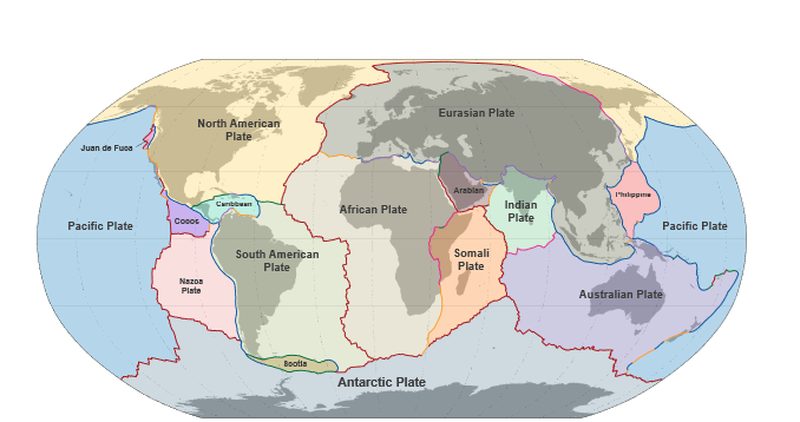
The Himalayas are still rising, about a centimetre a year, because India is still crashing into Asia. The Atlantic Ocean is widening by a few centimetres annually as the Americas drift from Europe and Africa. Japan, California and Indonesia shake because they sit on the boundaries where Earth’s great plates grind past each other. Plate tectonics, the theory that Earth’s outer shell is broken into rigid plates gliding over the hot mantle, is the unifying idea of geology, as central to earth science as evolution is to biology. Proposed in the 1960s, it explained in one stroke the distribution of earthquakes, volcanoes, mountain ranges and fossils. It also explains India’s own dramatic biography: a fragment of Gondwana that broke free, raced across an ocean, and slammed into Asia to raise the world’s highest mountains.
From drifting continents to moving plates
The story begins with Alfred Wegener, who in 1912 proposed continental drift, noting that South America and Africa fit together like puzzle pieces and shared identical fossils and rock sequences across the Atlantic. Geologists ridiculed him, largely because he could not explain what moved the continents. The vindication came in the 1960s from the oceans: sonar mapping revealed the mid-ocean ridge system, a 65,000-kilometre underwater mountain chain where new crust wells up, and magnetic stripes in the seafloor recorded Earth’s flipping magnetic field like a tape recorder, proving the seafloor spreads outward symmetrically. Deep-sea drilling confirmed the pattern: rocks grow older with distance from ridges. The synthesis was plate tectonics: the lithosphere, crust plus rigid upper mantle, is divided into about a dozen major plates and many minor ones, a few dozen to 200 kilometres thick, moving at centimetres per year over the ductile asthenosphere. Wegener was right about the drift; the mechanism was mantle convection, slab pull and ridge push, forces he never knew.
What happens at plate boundaries
Nearly all geological drama happens where plates meet. At divergent boundaries, like the Mid-Atlantic Ridge or East Africa’s Rift Valley, plates pull apart and magma rises to create new crust; Iceland sits astride such a boundary and is literally being torn in two. At convergent boundaries, plates collide: where oceanic crust meets continental crust, the denser oceanic plate dives beneath in subduction, generating the deep earthquakes and explosive volcanoes of the Pacific Ring of Fire; where continents collide, neither subducts easily, and the crust crumples upward into mountains, which is how the Himalayas, Alps and Andes formed. At transform boundaries, like California’s San Andreas Fault, plates slide horizontally past each other, building stress released in sudden earthquakes. India is a textbook of all three: the Himalayan front is an active collision zone, the Andaman-Sumatra trench subducts beneath the islands, and the Kutch region bears transform-like stresses. GPS measurements now track these motions in real time, confirming rates predicted from geology.
India’s 100-million-year voyage
India’s journey is plate tectonics’ most spectacular story. About 140 million years ago, India was nestled against Antarctica, Australia and Africa in the supercontinent Gondwana. Around 120 million years ago it broke free and began drifting north at extraordinary speed, up to 18 centimetres a year, five times today’s typical plate rate, possibly pulled by a double subduction zone. As it travelled, the Reunion hotspot burned through it, creating the Deccan Traps 66 million years ago. About 50 million years ago, India collided with Asia, and it has been pushing north ever since, crumpling the Tethys Ocean’s sediments into the Himalayas and the Tibetan Plateau. The collision continues: India moves northeast at about 5 centimetres yearly, the Himalayas rise, and the accumulated stress releases in great earthquakes like the 2015 Gorkha event in Nepal. The same voyage explains India’s peculiar fossils, Gondwanan flora and fauna, and its coal deposits. You are riding a continent that has travelled thousands of kilometres, and it has not finished moving.
- India drifts northeast at about 5 centimetres per year, still colliding with Asia.
- The Atlantic Ocean widens by a few centimetres each year at the Mid-Atlantic Ridge.
- Seafloor magnetic stripes record Earth’s magnetic reversals like a tape recorder.
- India once raced north at 18 cm per year, five times typical plate speeds.
- The Himalayas rise about a centimetre yearly from the ongoing collision.
FAQs
Will the continents rejoin? Possibly. In 250 million years, models predict a new supercontinent, sometimes called Pangaea Proxima, as the Atlantic closes and the Pacific shrinks.
What drives plate motion? Mainly slab pull, dense subducting plates dragging the rest, plus ridge push and mantle convection currents.
Can we predict earthquakes from plate motion? We can map where stress accumulates and estimate long-term odds, but short-term prediction of specific quakes remains impossible.
Plate tectonics turned geology from stamp-collecting into physics: a planet with a cracked, moving shell, building mountains and oceans as it slowly churns. India is its star witness, a continent caught mid-collision.
Compiled by the Khabar 24h Editorial Desk from publicly available sources.

Khabar 24h Editorial Desk — our explainers are prepared by the Khabar 24h editorial team using AI-assisted research tools, and every piece is reviewed by a human editor before publishing. We do not claim original reporting: our work is turning complex topics into simple, accurate summaries. Spotted an error? Write to contact@khabar24h.com — our corrections policy aims for same-day review.
More from this author →