How Eyes See: The Optics of Human Vision
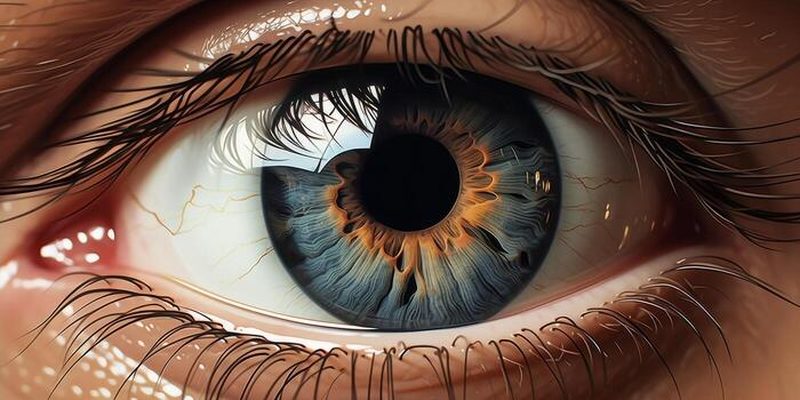
Vision feels effortless: you open your eyes and the world is simply there, in colour, in depth, in motion. But the effortlessness is an illusion created by one of the most sophisticated instruments in nature. Each of your eyes is a living camera, focusing light with a flexible lens onto a light-sensitive retina, which converts photons into electrical signals that the brain reconstructs into the seamless visual world you experience. The eye packs about 100 million light sensors into a space the size of a small ball, resolves detail finer than the best displays, and adapts to light levels spanning a factor of ten billion. Understanding how eyes see means following light’s journey from the cornea to consciousness, through optics, chemistry and some of the brain’s most elaborate computation.
The eye as a camera
The optics begin at the cornea, the transparent front window, which does most of the focusing, bending incoming light by virtue of its curvature. Behind it, the iris, the coloured part, adjusts the pupil’s diameter from about 2 to 8 millimetres, regulating light like a camera aperture. The crystalline lens then fine-tunes focus: ciliary muscles change its shape to bring near or far objects into sharp focus on the retina, a process called accommodation that weakens with age, which is why reading glasses become necessary in middle age. The image projected on the retina is upside down and reversed, and the brain flips it without you ever noticing. Refractive errors are simply mismatches in this optical system: in myopia, the eyeball is too long so distant images focus in front of the retina; in hyperopia, too short; in astigmatism, the cornea is irregularly curved. Spectacles, contact lenses and laser surgery all correct the same thing: getting light to land precisely on the retina.
The retina: where light becomes signal
The retina is brain tissue that migrated into the eye during development, a light-sensing neural computer. Its photoreceptors come in two types: about 120 million rods, exquisitely sensitive and responsible for night and peripheral vision but colour-blind, and about 6 million cones, concentrated in the central fovea, which provide sharp colour vision in daylight. Each photoreceptor contains pigment molecules like rhodopsin that change shape when struck by a photon, triggering a cascade that converts light into an electrical signal, a process so sensitive that rods can respond to a single photon. Three cone types, tuned to short, medium and long wavelengths, let the brain construct the entire rainbow from their relative responses; colour blindness usually means one cone type is missing or altered. The retina does not merely sense; it preprocesses, with layers of neurons extracting edges, motion and contrast before signals even leave the eye via the optic nerve. The blind spot, where the optic nerve exits and there are no receptors, goes unnoticed because the brain fills it in.
From signals to seeing
What the eyes deliver, the brain interprets, and vision is overwhelmingly a brain phenomenon. Signals from the optic nerves travel to the visual cortex at the back of the head, passing through the thalamus, and are processed in a hierarchy: early areas detect edges and orientations, higher areas assemble shapes, faces, motion and scenes. Remarkably, what you perceive is largely prediction: the brain maintains a model of the world and uses incoming signals mainly to correct it, which is why optical illusions work and why you do not notice the constant jitter of your eyes’ saccades. Depth perception fuses the slightly different views of the two eyes, stereopsis, with monocular cues like perspective, shading and motion parallax. Colour constancy lets you recognise a red apple as red under sunlight or lamplight despite wildly different wavelengths reaching the eye. Damage to specific visual areas produces astonishingly specific deficits: some stroke patients lose colour vision but see motion, others cannot recognise faces but see everything else. Seeing, it turns out, is not recording but constructing.
- The retina contains about 120 million rods and 6 million cones.
- Rods can respond to a single photon, enabling vision in near-darkness.
- The eye adapts to light levels spanning a factor of about ten billion.
- The blind spot, where the optic nerve exits, is seamlessly filled in by the brain.
- Colour vision comes from three cone types tuned to different wavelengths.
Protecting the windows
India faces a vision crisis hiding in plain sight. Myopia is exploding among urban children, with studies finding rates exceeding 20 per cent in some cities, driven by intensive near-work and too little outdoor light; more daylight during childhood measurably protects against it. Cataract remains the leading cause of blindness in India, though it is curable with a 15-minute surgery, and programmes to clear the surgical backlog save millions from preventable darkness. Diabetic retinopathy is rising with the diabetes epidemic, making annual eye screening essential for diabetics. Vitamin A deficiency still blinds children in poor regions, preventable with supplementation. And digital eye strain, from hours of screens, causes real discomfort though no permanent damage; the 20-20-20 rule, every 20 minutes look 20 feet away for 20 seconds, helps. The eye is resilient but not invulnerable: sunglasses against UV, safety glasses at work, and regular check-ups after 40 are the unglamorous maintenance this exquisite instrument deserves.
FAQs
Why do we have two eyes? Two slightly different views enable stereoscopic depth perception, and provide backup if one eye is damaged; the brain fuses the images seamlessly.
Can carrots really improve vision? Only if you are vitamin A deficient; for well-nourished people, extra carrots do not sharpen sight, though the vitamin is essential for photoreceptor function.
Why do we blink? To spread tears that keep the cornea moist, clear debris, and nourish the cornea, which has no blood vessels of its own.
From a photon’s flight to the brain’s reconstruction, vision compresses physics, chemistry and computation into a fraction of a second. It feels like opening a window; it is more like watching a masterful forgery, painted fresh 60 times a second.
Compiled by the Khabar 24h Editorial Desk from publicly available sources.

Khabar 24h Editorial Desk — our explainers are prepared by the Khabar 24h editorial team using AI-assisted research tools, and every piece is reviewed by a human editor before publishing. We do not claim original reporting: our work is turning complex topics into simple, accurate summaries. Spotted an error? Write to contact@khabar24h.com — our corrections policy aims for same-day review.
More from this author →