How a Nuclear Reactor Actually Works: Fission Explained
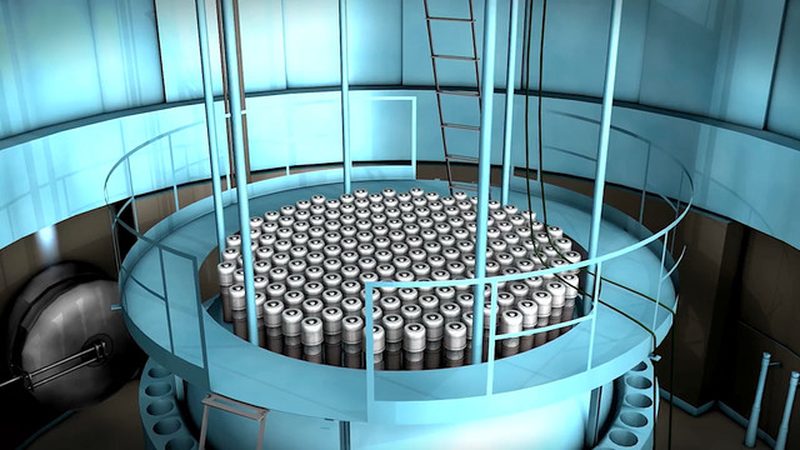
Deep inside every nuclear reactor, atoms are being split apart, and each split releases a burst of energy a million times greater than any chemical reaction. This is nuclear fission: heavy atomic nuclei, usually uranium-235, breaking into lighter fragments when struck by neutrons, converting a tiny amount of mass directly into energy via Einstein’s E=mc2. Control that process, harvest the heat, and you have steady, carbon-free electricity. Lose control of it, and you have the reason reactors are wrapped in metres of concrete and steel.
Splitting the atom
It starts with an unstable nucleus. When a slow-moving neutron strikes uranium-235, the nucleus wobbles, stretches and splits into two smaller nuclei, typically barium and krypton, plus two or three fresh neutrons and a spray of gamma radiation. The fragments fly apart at enormous speed; their kinetic energy becomes heat as they collide with surrounding atoms. Crucially, the mass of the fragments is slightly less than the original nucleus, and the missing mass becomes energy. A single fission releases about 200 million electron volts, and a kilogram of uranium holds as much energy as thousands of tonnes of coal.
The chain reaction
Each fission releases neutrons that can trigger further fissions, a chain reaction. Left alone it would grow exponentially, doubling with every generation in millionths of a second. A reactor’s entire control system exists to hold this reaction at exactly critical: each fission triggering exactly one more, on average. Control rods made of neutron-absorbing boron or cadmium slide in and out of the core to fine-tune the neutron population. Operators can also adjust the moderator, water or graphite that slows neutrons down, because slow neutrons split uranium far more readily than fast ones.
From heat to electricity
The core’s heat must become electricity, and that happens through glorified steam engineering. In the most common design, the pressurised water reactor, water circulates through the core at high pressure so it stays liquid even above 300 degrees Celsius, carrying heat to a steam generator. There, a separate loop of water boils into steam that spins a turbine connected to a generator, exactly like a coal plant but with the furnace replaced by fission. Other designs differ in the details: boiling water reactors let the core water itself boil, heavy water reactors like India’s PHWRs use natural uranium with deuterium-rich moderator, and fast reactors dispense with moderators entirely.
The safety layers
Reactor safety is built on defence in depth, multiple independent barriers between radioactivity and the public:
- Ceramic fuel pellets trap most fission products inside their crystal structure.
- Metal cladding seals the pellets into rods, containing gases the pellets release.
- The reactor vessel and cooling systems keep the core covered with water under all conditions.
- The containment building, metres of steel-reinforced concrete, is the final barrier.
What happens to the waste
After a few years, fuel becomes too depleted in uranium-235 to sustain the chain reaction efficiently, though it still contains most of its original uranium plus plutonium and intensely radioactive fission products. Spent fuel is first cooled in water pools, then stored in dry casks, and ultimately destined for deep geological repositories, where stable rock formations isolate it for the thousands of years some isotopes remain hazardous. Reprocessing, practised by India and France, chemically separates reusable uranium and plutonium from true waste, shrinking the volume that needs final disposal.
FAQs
Can a reactor explode like a bomb? No. Reactor fuel is only a few percent uranium-235, far below weapons grade, and the physics of a power reactor cannot produce a nuclear explosion. The worst accidents are steam explosions and meltdowns, serious but fundamentally different.
Why use uranium-235 specifically? It is the only naturally occurring isotope that sustains a chain reaction with slow neutrons, making it uniquely practical, though it makes up less than 1 percent of natural uranium.
How much fuel does a reactor use? A large reactor consumes only about 25 to 30 tonnes of enriched uranium a year, delivered by a few truckloads, versus millions of tonnes of coal for equivalent output.
A nuclear reactor is, at heart, a kettle heated by splitting atoms, surrounded by some of the most careful engineering humans have ever attempted. The physics is seventy years old; the challenge was never making fission work, but making it work safely, reliably and economically, day after day, for decades.
Source: International Atomic Energy Agency

Khabar 24h Editorial Desk — our explainers are prepared by the Khabar 24h editorial team using AI-assisted research tools, and every piece is reviewed by a human editor before publishing. We do not claim original reporting: our work is turning complex topics into simple, accurate summaries. Spotted an error? Write to contact@khabar24h.com — our corrections policy aims for same-day review.
More from this author →