Gaganyaan: inside India’s long road to its first crewed spaceflight
India has been trying to put its own astronauts into orbit for the better part of a decade. The Gaganyaan mission — the country’s first human spaceflight programme — was announced with a target of 2022, timed to mark 75 years of Independence. Four years past that deadline, no Indian has yet flown on an Indian rocket. But the programme has quietly crossed most of its hardest technical milestones, and its first uncrewed test flight is now the most closely watched date on ISRO’s calendar.
Here is where the mission stands, what has been proven, and what remains.
The spacecraft: what will fly
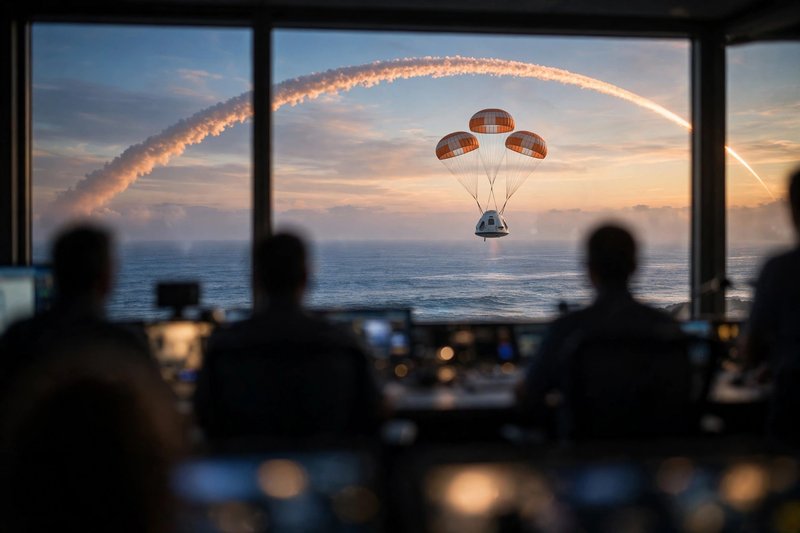
Gaganyaan will carry Indian astronauts — called gaganyatris — into low Earth orbit aboard a human-rated version of the LVM3 rocket, ISRO’s most powerful launcher. The spacecraft itself has two parts: the crew module, a cone-shaped capsule designed to carry up to three astronauts, and the service module beneath it, which provides propulsion, power and life support during the flight. After the mission, the crew module separates, survives the searing heat of re-entry, and splashes down in the ocean, slowed by a sophisticated system of ten parachutes that must deploy in precise sequence.
Four Indian Air Force test pilots were selected as astronaut-designates and introduced by the Prime Minister in February 2024: Group Captains Prasanth Nair, Ajit Krishnan and Angad Pratap, and Wing Commander Shubhanshu Shukla. All four trained in Russia in 2020. Shukla went further — in June 2025 he flew to the International Space Station aboard the Indo-US Axiom-4 mission on a SpaceX rocket, returning on July 15, 2025, becoming the first Indian to visit the ISS.
The test ladder: what has been proven
Human spaceflight is unforgiving, so ISRO has been climbing a ladder of progressively harder tests:
- October 2023: the TV-D1 abort test proved the Crew Escape System, which pulls the crew module away from a failing rocket. India became only the fourth country to demonstrate this life-saving technology.
- August 2025: the first Integrated Air Drop Test released a 4.8-tonne dummy capsule from an IAF Chinook helicopter at 3 km altitude, validating parachute deployment. A second drop test followed in April 2026.
- July 2026: ISRO completed the first ground test of SOLVE, a sub-orbital vehicle designed to carry a mock crew module above 100 km altitude before releasing it for descent trials.
- Alongside these, ISRO says more than 8,000 ground tests have been completed across structures, propulsion and environmental systems.
Still to come is the big one: the first uncrewed orbital flight, designated G1. It will carry Vyommitra — ISRO’s half-humanoid robot — to simulate astronaut functions and monitor life-support systems through launch, orbit and splashdown.
The road ahead: a roadmap in motion
The roadmap has expanded well beyond the original plan. Where Gaganyaan began as two uncrewed flights plus one crewed mission, the programme now spans eight missions — six uncrewed and two crewed — and folds in the first module of the proposed Bharatiya Antariksh Station, India’s own space station. The Union Cabinet has backed this ambition with funding: the programme budget stands at Rs 20,193 crore after an additional Rs 11,170 crore was approved for follow-on missions.
The timeline, however, keeps moving. G1 was at various points targeted for early 2026, but ISRO chairman V. Narayanan has indicated it could slip to the third quarter of 2027, which would push the first crewed flight — H1 — to 2028 or beyond. A parliamentary committee report noted that no firm dates have been communicated, attributing the caution to the unprecedented challenge of human-rated hardware: with crew safety at stake, ISRO is choosing thoroughness over speed.
That caution is the norm, not the exception. NASA’s Artemis programme and SpaceX’s Starship have both slipped repeatedly for the same reason. When Gaganyaan finally flies with a crew, India will become only the fourth nation — after Russia, the United States and China — to independently send humans into space. The wait is frustrating, but for a mission where there is no margin for error, it is also the point.
Compiled by the Khabar 24h Editorial Desk from publicly available sources.
Related stories
View all →
Two New Studies Strengthen Enceladus’s Case in the Search for Life
Two studies published in Science Advances on September 25 have made Saturn’s icy moon Enceladus an even stronger target in the search…

Claude AI Helped Discover New Enzyme System: Anthropic
Anthropic says its Claude AI model helped scientists discover a novel enzyme system, marking a notable advance for AI-assisted scientific research.

Meta Unveils $1,299 VR Glasses With Cinema and Gaming
Meta has unveiled VR Glasses priced at $1,299 with cinema, workspace and gaming features packed into a lightweight 100-gram design.

Khabar 24h Editorial Desk — our explainers are prepared by the Khabar 24h editorial team using AI-assisted research tools, and every piece is reviewed by a human editor before publishing. We do not claim original reporting: our work is turning complex topics into simple, accurate summaries. Spotted an error? Write to contact@khabar24h.com — our corrections policy aims for same-day review.
More from this author →
Leave a Reply