Yakshagana Explained: Karnataka’s All-Night Dance-Drama Tradition
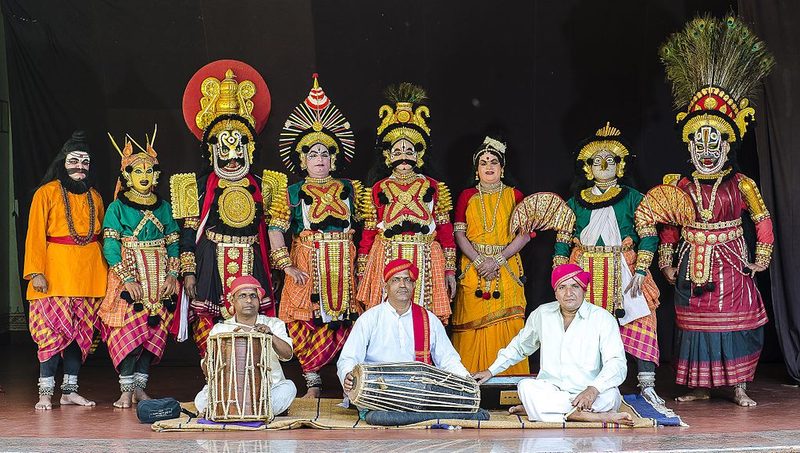
As dusk falls in coastal Karnataka, the drums begin: a rhythm that will not stop until dawn. On a makeshift stage, performers in towering headgear and blazing costumes dance, sing and enact the epics, while hundreds of villagers watch through the night, rapt, fed, unwilling to leave. This is Yakshagana, Karnataka’s all-night dance-drama tradition, and it is among India’s most spectacular living art forms.
What Yakshagana is
Yakshagana is a traditional theatre form from coastal Karnataka and parts of Kerala, combining dance, music, dialogue, elaborate costume and storytelling. Performances dramatise episodes from the Ramayana, Mahabharata and Puranas, beginning after dinner and traditionally running until sunrise. The form is operatic in scale: singers narrate and sing the story from the side while dancer-actors embody the characters, improvising dialogue within the narrative frame.
The word suggests celestial music, and the experience earns the name. The performance is total theatre: no sets to speak of, just the performers, the musicians and the story, holding an audience through the night on sheer virtuosity. For the communities that sustain it, Yakshagana is not entertainment alone but ritual, devotion and collective identity.
The performers and their craft
Yakshagana artists train for years, often from childhood, in institutions and traditional gurukulas. Dancer-actors master stylised movement vocabularies, martial in energy, expressive in gesture; singers, called bhagavatas, carry the narrative weight, singing in classical ragas while conducting the performance’s rhythm; drummers on the chande and maddale drive the night’s pulse with thunderous, intricate patterns.
The costumes are legendary: massive radiant headgear, heavy embroidered jackets, vivid face paint that transforms performers into gods and demons. Donning the costume is itself a ritual, taking hours, and the transformation it effects, ordinary humans becoming mythic beings, is central to the form’s magic.
How an all-night show works
- The prelude: invocatory dances and comic interludes warm up the audience as night falls.
- The prasanga: the main episode, sung by the bhagavata and enacted by the dancers, unfolding over hours.
- Improvisation: actors extemporise dialogue and debates, responding to the audience’s energy.
- The climax: battles and resolutions arriving in the small hours, greeted by a still-packed crowd.
Audiences come and go, eat, doze and return; the performance absorbs it all. The all-night duration is not indulgence but tradition: the story needs the night, and the community keeps vigil with it.
Survival and revival
Yakshagana faces the pressures of all traditional arts: young performers drawn to cities and screens, rising costs, ageing audiences. Yet it endures through remarkable resilience: professional troupes tour extensively, temple committees and cultural organisations sponsor performances, training institutions produce new artists, and the form has adapted, with shortened urban shows, school programmes and digital recordings introducing it to new audiences.
Its greatest strength is community ownership. Yakshagana belongs to its villages and towns in a way no commercial entertainment can replicate; as long as communities gather to keep the night-long vigil, the drums will keep beating till dawn.
Training the next generation
Yakshagana’s future depends on its schools. Traditional gurukulas, where students live with masters and learn through immersion, preserve the form’s deepest knowledge: not just steps and songs but the philosophy of performance. Modern institutions offer structured curricula, combining Yakshagana training with formal education, making the art viable for families who need their children schooled. Young artists face the classic dilemma: the years of training demand full commitment, while economic pressures pull toward cities and other careers. Encouragingly, a new generation is committing, drawn by the form’s prestige and the growing performance economy of festivals and cultural tourism. Women performers, long marginalised in the tradition, are increasingly visible, bringing new energy and audiences. The transmission also modernises: video documentation, online tutorials and workshop formats supplement the old oral methods. The drums will keep beating only if young hands keep learning to play them, and the schools are where that future is decided nightly.
FAQs
How long does a Yakshagana performance last? Traditionally all night, from evening until dawn, though modern urban performances are often shortened to a few hours.
What stories does Yakshagana tell? Episodes from the Ramayana, Mahabharata and Puranas, the prasanga texts that form the tradition’s repertoire.
Where can I watch Yakshagana? In coastal Karnataka’s towns and villages during the performance season, at cultural festivals, and increasingly in Bengaluru and other cities.
Yakshagana is theatre as endurance and devotion: a whole night of gods and demons, drums and dance, reminding modern India that some stories are worth staying awake for.
Compiled by the Khabar 24h Editorial Desk from publicly available sources.

Khabar 24h Editorial Desk — our explainers are prepared by the Khabar 24h editorial team using AI-assisted research tools, and every piece is reviewed by a human editor before publishing. We do not claim original reporting: our work is turning complex topics into simple, accurate summaries. Spotted an error? Write to contact@khabar24h.com — our corrections policy aims for same-day review.
More from this author →