The Northern Lights Explained: Where and When to See the Aurora
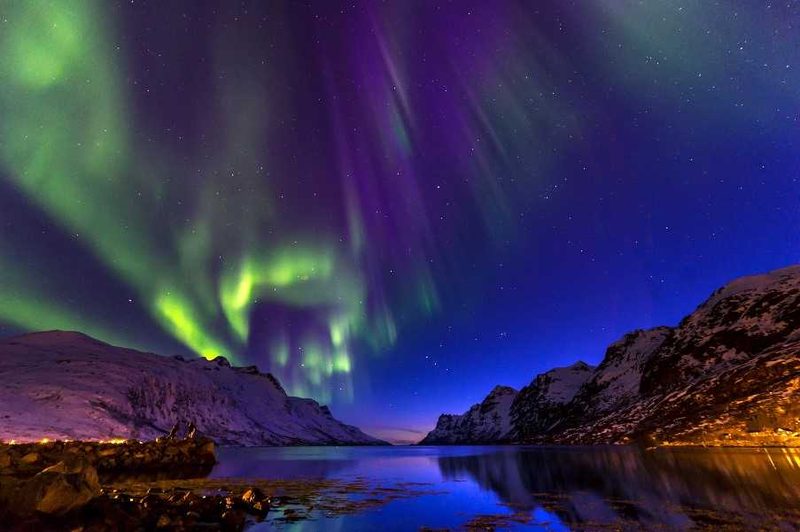
On dark winter nights in the far north, the sky erupts: curtains of green, violet and red light rippling across the stars, moving like something alive. The aurora borealis, the northern lights, is Earth’s most spectacular atmospheric phenomenon, and it draws travellers to the Arctic in their thousands. What causes this celestial light show, where are the best places to see it, and when should you go?
What causes the aurora
The lights begin 150 million kilometres away, on the Sun. Solar wind, a stream of charged particles, constantly buffets Earth; during solar storms, coronal mass ejections hurl billions of tonnes of plasma our way. Earth’s magnetic field funnels these particles toward the poles, where they collide with atmospheric gases. Oxygen glows green and red, nitrogen blue and purple. The result is a luminous curtain, typically 100 to 300 km up, dancing as the particles stream along magnetic field lines. It is space weather made visible.
Solar maximum: why now is the time
Auroras follow the Sun’s 11-year activity cycle, and the mid-2020s brought a solar maximum, the most active period in two decades, producing spectacular displays seen as far south as unusual latitudes. Geomagnetic storms are rated on the Kp index from 0 to 9; Kp 5 and above brings strong displays. Space weather forecasters now predict auroras days ahead, and alert apps ping travellers when the sky is about to ignite. Timing a trip to solar maximum is the single best strategy.
Where to see the northern lights
The auroral oval rings the magnetic poles, so the prime zone spans northern Norway, Swedish Lapland, Finnish Lapland, Iceland, Greenland, Canada’s north, Alaska and Russia’s Kola Peninsula. Tromso in Norway offers lights plus city comforts; Abisko in Sweden is famed for clear skies; Finnish Lapland adds glass igloos and reindeer; Iceland pairs auroras with waterfalls and lagoons. The southern hemisphere has its own aurora australis, best from Tasmania, New Zealand and Antarctica. Dark skies, away from city lights, are essential everywhere.
When to go
Aurora season runs roughly September to March, when nights are dark enough; December and January offer the longest darkness but also the harshest cold and cloudiest weather. Many veterans prefer September-October or February-March for a balance of darkness and clearer skies. The lights are a night phenomenon, typically strongest around midnight, and they demand patience: even in prime season, clouds or quiet solar wind can mean days of waiting. Plan a week minimum; treat the aurora as a bonus, not a guarantee.
How to photograph the aurora
Modern cameras make aurora photography accessible: a tripod is essential, exposures of a few seconds at high ISO capture what the eye sees dimly. Dress for standing still in Arctic cold, far warmer than you think necessary. Phone cameras have improved dramatically, but a proper camera still wins. And remember to look up with your own eyes too: no photo captures the motion, the scale, or the eerie silence of the lights rippling overhead.
The myths and the science ahead
Cultures explained the lights as spirits, omens or celestial battles: the Sami, the Inuit, the Norse all wove them into myth. Science now reads them as data: auroras reveal the Sun-Earth connection that also threatens satellites and power grids. Researchers study them to predict space weather’s technological impacts. The lights are both ancient wonder and modern warning system, beauty with a practical edge.
Chasing the lights: tours and tips
Aurora tourism is now big business: guided chases by minibus, snowmobile safaris, ice hotels with wake-up calls when the lights appear. Book with operators who chase clear skies rather than fixed locations, and temper expectations: even experts get clouded out. The hunt is half the adventure, and the Arctic winter offers plenty besides.
FAQs
What is the best month to see the northern lights? December to February offers the longest dark nights, but September-October and March often have clearer skies.
Can you see them from the UK or northern US? During strong solar storms, yes, occasionally; but the Arctic auroral zone is far more reliable.
Do the lights make noise? Some witnesses report crackling sounds; scientists have recorded auroral sounds, though the mechanism is still debated.
The northern lights are the planet’s greatest free show: solar wind painting the polar sky. Stand beneath them on a frozen night, breath fogging, colours wheeling overhead, and you understand why humans have stared upward in wonder for as long as we have existed.
Compiled by the Khabar 24h Editorial Desk from publicly available sources.

Khabar 24h Editorial Desk — our explainers are prepared by the Khabar 24h editorial team using AI-assisted research tools, and every piece is reviewed by a human editor before publishing. We do not claim original reporting: our work is turning complex topics into simple, accurate summaries. Spotted an error? Write to contact@khabar24h.com — our corrections policy aims for same-day review.
More from this author →