How Network Slicing Works: The 5G Feature Powering Smart Factories
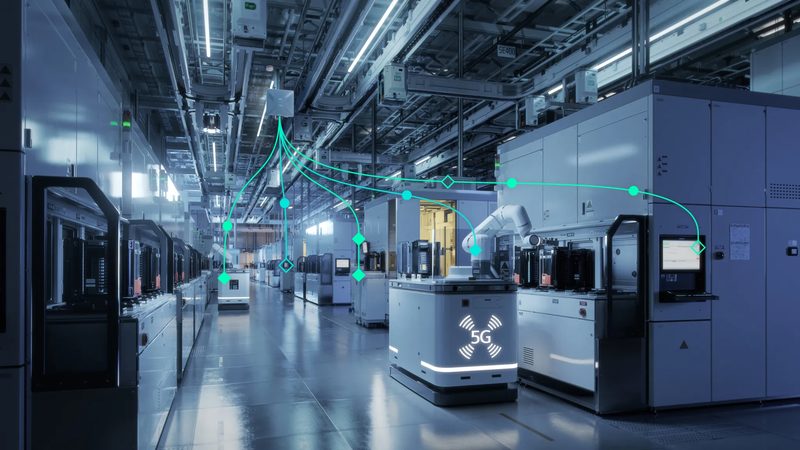
A single 5G network can now behave like many separate networks, each tuned for a different job: one slice with ultra-low latency for factory robots, another with massive capacity for a stadium crowd, a third with maximum reliability for emergency services. This is network slicing, one of the most transformative and least understood features of 5G. It is the technology that lets smart factories, autonomous fleets and remote surgery share the same infrastructure without interfering with each other. This guide explains how it works.
What network slicing is
Network slicing partitions a single physical 5G network into multiple virtual networks, called slices, each with its own guaranteed characteristics for speed, latency, reliability and capacity. Think of a highway that can reconfigure its lanes on demand: an ambulance gets a guaranteed clear lane while regular traffic shares the rest. Unlike simple quality-of-service priority, a slice is an end-to-end construct spanning the radio, transport and core network, with resources reserved rather than merely preferred. Slices are created, modified and torn down in software, in minutes, through orchestration systems. This softwarisation is what makes slicing fundamentally a 5G-standalone capability: it needs the cloud-native 5G core that operators like Jio built from the start.
How a slice is built
Creating a slice involves three layers. The radio access network allocates spectrum and scheduling priority to guarantee the slice’s air-interface performance. The transport network reserves capacity on the fibre links carrying traffic. And the 5G core instantiates dedicated virtual network functions, software versions of what used to be specialised hardware, configured for the slice’s needs. An orchestrator manages the whole lifecycle: translating a request like ultra-reliable low latency for these fifty robots into concrete resource reservations, monitoring that the guarantees hold, and scaling or healing the slice automatically. Isolation is critical: congestion or failure in one slice must not cascade into others, which is why slices get reserved resources rather than shared best-effort capacity.
Why factories are the flagship use case
Smart factories show why slicing matters. A modern plant runs autonomous mobile robots ferrying parts, thousands of sensors reporting conditions, machine-vision cameras inspecting products, and workers with AR headsets, all wireless. These have wildly different needs: robot control demands single-digit millisecond latency and near-perfect reliability, while sensor telemetry needs to connect huge device counts but tolerates delay. Without slicing, one network must compromise; with slicing, each application gets a virtual private network tuned precisely to its requirements, all on shared infrastructure. The factory avoids laying separate wired networks for each system, gains the flexibility of wireless, and pays the operator for guaranteed service levels rather than building telecom infrastructure itself.
Other places slicing will appear
Factories are first, but the pattern generalises.
- Emergency services: a slice that stays fast and reliable even when public networks are congested during disasters.
- Connected vehicles: low-latency slices for vehicle-to-everything communication as autonomous driving develops.
- Healthcare: guaranteed-quality slices for remote diagnostics and, eventually, remote procedures.
- Media and events: temporary high-capacity slices for stadiums, concerts and broadcast contribution.
- Enterprise campuses: companies buying private-network behaviour without building private networks.
The common thread is applications where best-effort internet is not good enough and dedicated infrastructure is too expensive.
The roadblocks and the timeline
Slicing’s promise exceeds its deployment today. End-to-end slicing across multiple operators and vendors remains complex, with standards still maturing. Operators must invest in orchestration and in the standalone cores that slicing requires. The business models are being invented in real time: how do you price a guaranteed-latency slice for a factory? Early commercial deployments focus on private and campus networks, where a single enterprise and operator control the whole environment. Broader public-network slicing will follow as standards, equipment and commercial models converge. Like most telecom revolutions, it will arrive gradually, then suddenly.
FAQs
Will network slicing affect my phone? Indirectly. Consumer plans may eventually offer slices optimised for gaming or video, but the first impact is industrial and enterprise.
Is slicing available in India? Operators have demonstrated slicing capabilities, and private-network deployments for industry are the leading edge. Mass-market slicing is still developing.
How is slicing different from just prioritising traffic? Prioritisation helps when there is spare capacity; slicing reserves dedicated resources end to end, with isolation guarantees prioritisation cannot provide.
Network slicing is 5G’s quiet superpower: the feature that turns a consumer network into industrial infrastructure. As factories, hospitals and fleets discover they can rent certainty instead of building it, the slice will become as fundamental to industry as the leased line once was.
Source: GSMA
Related stories
View all →
IFA 2026: AI Moves Into Smart Glasses, Tiny Phones and Wearables
The biggest trend at IFA 2026 in Berlin is hard to miss: artificial intelligence is moving out of phones and laptops and…
Meta Rolls Out Parental Controls for Threads in India
Meta has added parental supervision controls to Threads in India, following government talks on child safety, content moderation and deepfakes.

Anthropic CEO Vows to Slow AI Releases for Safety
Anthropic CEO Dario Amodei told the UN Security Council the company will slow down AI development as much as needed to keep…

Khabar 24h Editorial Desk — our explainers are prepared by the Khabar 24h editorial team using AI-assisted research tools, and every piece is reviewed by a human editor before publishing. We do not claim original reporting: our work is turning complex topics into simple, accurate summaries. Spotted an error? Write to contact@khabar24h.com — our corrections policy aims for same-day review.
More from this author →