What Are LEO Satellites? How Satellite Internet Reaches Remote India
For decades, satellite internet meant a single large satellite parked 36,000 kilometres above the equator, offering slow, laggy connections as a last resort. A new generation of satellites has rewritten the rules: thousands of small satellites orbiting just a few hundred kilometres up, working as a coordinated fleet to beam broadband to anywhere on Earth. These are LEO satellites, and companies like Starlink, OneWeb and Amazon’s Kuiper are racing to cover India. This guide explains how the technology works and what it means for the country’s remotest corners.
What LEO means and why orbit height matters
LEO stands for low Earth orbit, typically 500 to 1,200 kilometres above the surface, versus 35,786 kilometres for traditional geostationary satellites. Height determines latency: a signal to a geostationary satellite and back takes about half a second, making video calls painful and gaming impossible. To a LEO satellite and back takes mere tens of milliseconds, comparable to terrestrial broadband. The trade-off is coverage: a geostationary satellite sees a third of the planet, while a LEO satellite sees only a small patch, so continuous service needs hundreds or thousands of them in a carefully choreographed constellation. SpaceX’s Starlink operates the largest fleet, with thousands already aloft; OneWeb, backed by Bharti, targets enterprise and government connectivity; Amazon’s Kuiper is deploying its own constellation.
How satellite internet reaches your home
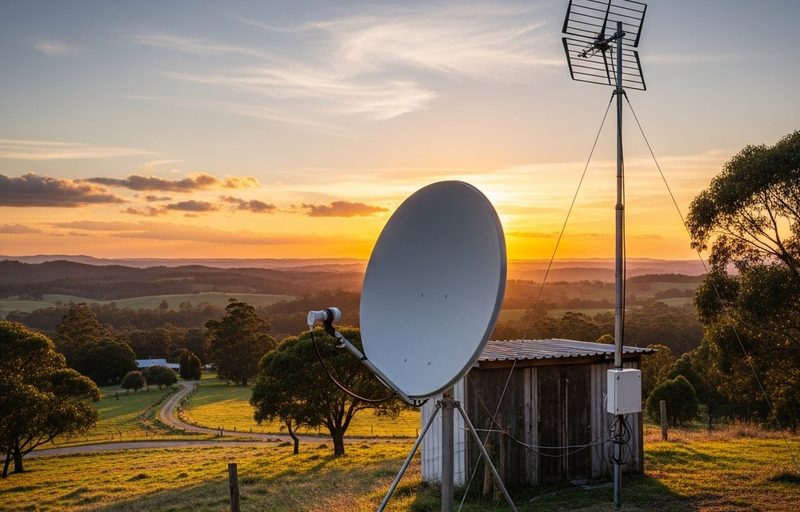
The user experience is surprisingly ordinary. You install a small dish, often described as pizza-box sized, with a clear view of the sky. The dish electronically steers its beam to track satellites passing overhead, handing off from one to the next every few minutes without you noticing. The satellites relay your data through the constellation using laser links between satellites, then down to a ground station connected to the internet backbone. Modern dishes are self-aligning: place it, power it, and the app guides the rest. Speeds typically range from 50 to 200 Mbps, genuine broadband, with latency low enough for video calls and most gaming. Rain and heavy cloud can degrade the signal, but far less than older satellite TV systems.
Why it matters for remote India
India’s connectivity challenge is geographic: laying fibre or building towers across the Himalayas, deserts, islands and dense forests is slow and expensive, which is why remote regions remain poorly served. LEO constellations ignore terrain entirely; a village in Ladakh, a research station in Antarctica’s Indian base, an oil rig offshore and a ship in the Arabian Sea all get the same sky. The applications go beyond homes: connecting rural schools and health centres, providing backup links for banks and ATMs, enabling disaster response when terrestrial networks fail, and serving the military in border areas. For a country with such varied terrain, satellite broadband fills precisely the gaps that ground networks cannot economically reach.
The business and regulatory picture
Satellite broadband in India sits at the intersection of technology and policy. Operators need spectrum allocation and licences from the government, and the framework for satellite spectrum has been actively debated, with the industry favouring administrative allocation over auctions given the global, shared nature of satellite spectrum. Pricing is the other question: satellite terminals and subscriptions cost more than terrestrial broadband, positioning the service for enterprises, institutions and remote households rather than as a mass-market rival to JioFiber. Partnerships matter too; Bharti’s stake in OneWeb gives India a seat at the table. The likely outcome is a layered market: fibre and 5G for the masses, satellite for the unreachable and the critical.
Challenges: debris, astronomy and competition
The technology faces genuine concerns. Tens of thousands of planned satellites raise fears of orbital debris and collisions, though operators use automated avoidance manoeuvres. Astronomers complain that bright satellite trains streak across telescope images, prompting design changes to darken them. And the business case demands enormous capital: building and replenishing a constellation costs billions, and several earlier satellite ventures went bankrupt. Competition is fierce, with multiple constellations chasing the same enterprise customers. Yet the direction is set: launch costs have fallen dramatically thanks to reusable rockets, making constellations economically viable for the first time in history.
FAQs
Is satellite internet available in India now? Services are rolling out as regulatory approvals complete. OneWeb has focused on enterprise and government customers; consumer availability depends on licensing progress.
How fast is LEO satellite internet? Typically 50 to 200 Mbps down with 20 to 50ms latency, comparable to good 4G or basic fibre for most uses.
Will it replace Jio and Airtel broadband? No. It complements them, serving areas and use cases where ground networks cannot reach or as backup connectivity.
LEO satellites are doing for remote connectivity what mobile towers did for voice: making geography irrelevant. For the parts of India that the fibre trench and the cell tower never reached, the answer is finally coming from the sky.
Source: ISRO

Khabar 24h Editorial Desk — our explainers are prepared by the Khabar 24h editorial team using AI-assisted research tools, and every piece is reviewed by a human editor before publishing. We do not claim original reporting: our work is turning complex topics into simple, accurate summaries. Spotted an error? Write to contact@khabar24h.com — our corrections policy aims for same-day review.
More from this author →