India’s Synchrotrons: How the Indus Accelerators Probe Materials Atom by Atom
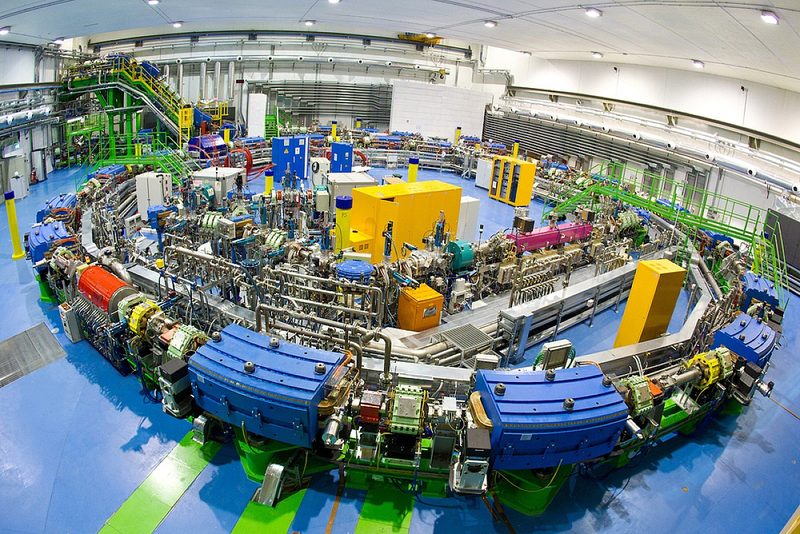
In a circular building in Indore, electrons circulate at nearly the speed of light, and every time magnets bend their path, they shed X-rays of extraordinary brilliance. This is Indus-2, India’s synchrotron, a machine that produces light a billion times brighter than hospital X-rays to probe the atomic structure of everything from turbine blades to tuberculosis proteins to ancient pottery. Alongside its smaller sibling Indus-1, it forms the core of Indian photon science, serving hundreds of researchers yearly across physics, chemistry, biology, materials and heritage science. Synchrotrons are among the most versatile tools in modern science, and India’s machines, built indigenously by the Raja Ramanna Centre for Advanced Technology, represent a strategic capability few nations possess. Here is how they work and what they reveal.
How a synchrotron makes superlight
A synchrotron is a particle accelerator run as a light factory. Electrons are generated, accelerated to nearly light speed in a booster ring, then injected into a storage ring, a polygon of magnets hundreds of metres around, where they circulate for hours. At each bending magnet, and more intensely at insertion devices called undulators and wigglers that wiggle the beam, the electrons emit synchrotron radiation: X-rays spanning a huge energy range, emitted in tight, laser-like beams of staggering brightness. Beamlines, specialised experimental stations arranged around the ring like spokes, each select and shape this light for a purpose: diffraction beamlines read crystal structures, spectroscopy beamlines probe chemical states, imaging beamlines see inside objects. Indus-2 operates at 2.5 gigaelectronvolts with a 172-metre ring; Indus-1, a 450-megaelectronvolt compact source from 1999, serves softer X-ray and ultraviolet users. The brilliance, photons per second per unit area, is what matters: more brilliance means faster measurements, smaller samples and sharper vision, down to atomic positions.
What Indian scientists do with the light
The applications read like a catalogue of modern science. Materials researchers use X-ray diffraction to study superalloys for jet engines, battery electrodes mid-charge, and catalysts atom by atom; Indian work on hydrogen storage materials and perovskite solar cells leans on synchrotron data. Biologists determine protein structures for drug design, including targets from Mycobacterium tuberculosis and drug-resistant pathogens, complementing AI predictions like AlphaFold with experimental reality. Environmental scientists trace heavy-metal pollution and study aerosols; geologists date rocks and read ancient climates in minerals. Heritage science is a delightful niche: synchrotron X-rays have read the composition of Harappan artefacts and pigments in miniature paintings without damaging them. Industry uses the machines too, for failure analysis of components and pharmaceutical crystallography. With dozens of beamlines planned and operating, Indus serves a user community spanning the IITs, CSIR labs, universities and companies, a national facility in the truest sense.
Why synchrotrons are strategic
Only a few dozen synchrotrons exist worldwide, and building one indigenously, as India did with RRCAT, signals deep accelerator expertise with spillovers into medical accelerators, industrial irradiation and potentially future colliders. Beamtime at foreign synchrotrons is competitive and geopolitically contingent; domestic machines guarantee Indian researchers access for priority areas like defence materials, nuclear science and pharmaceuticals. The next frontier is already visible: fourth-generation diffraction-limited storage rings, with hundredfold brighter beams, are being built in China, Europe and America, and India is planning its own upgrades and new facilities to stay competitive. The science they enable is increasingly central to national missions: green hydrogen catalysts, semiconductor materials, battery chemistry and structural biology for drug discovery. A synchrotron is sometimes called a microscope for the atomic age, but it is also an engine of technological sovereignty: the country that can see atoms clearly can build the future precisely.
- Indus-2 circulates electrons at 2.5 GeV in a 172-metre storage ring in Indore.
- Synchrotron X-rays can be a billion times brighter than conventional sources.
- Indus-1, operating since 1999, was India’s first indigenous synchrotron.
- Beamlines serve materials, biology, environment, geology and heritage science.
- Fourth-generation synchrotrons worldwide are pushing brightness a hundredfold higher.
FAQs
Is a synchrotron dangerous? The radiation is contained within shielding; outside the ring, facilities are safe workplaces visited by thousands of users yearly.
How is synchrotron light different from laser light? It spans from infrared to hard X-rays in a continuous spectrum, tunable to any wavelength, unlike a laser’s single colour.
Can industry use Indus? Yes. Proprietary beamtime for companies is available alongside academic access, used for failure analysis and pharma research.
Electrons racing in circles, shedding light bright enough to see atoms: India’s synchrotrons turn accelerator physics into a national microscope, revealing the atomic foundations of everything we make.
Compiled by the Khabar 24h Editorial Desk from publicly available sources.

Khabar 24h Editorial Desk — our explainers are prepared by the Khabar 24h editorial team using AI-assisted research tools, and every piece is reviewed by a human editor before publishing. We do not claim original reporting: our work is turning complex topics into simple, accurate summaries. Spotted an error? Write to contact@khabar24h.com — our corrections policy aims for same-day review.
More from this author →