Reservoir-Induced Seismicity: Why Big Dams Like Koyna Can Trigger Earthquakes
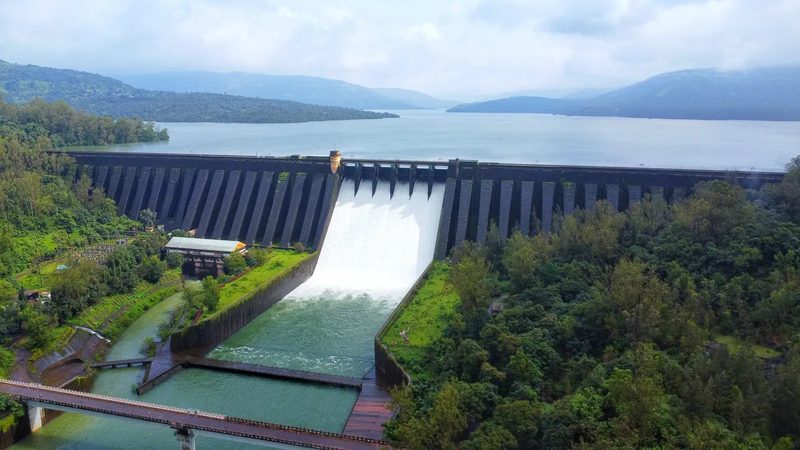
On December 11, 1967, the town of Koynanagar in Maharashtra was devastated by a magnitude 6.3 earthquake that killed 177 people and damaged the Koyna Dam itself. The epicentre lay almost directly beneath the reservoir, and the timing, a few years after the reservoir first filled, convinced seismologists of a startling conclusion: the earthquake had been triggered by the dam. Koyna became the world’s most famous case of reservoir-induced seismicity, the phenomenon by which the impoundment of large reservoirs triggers earthquakes in previously quiet regions. The mechanism, water seeping kilometres down to lubricate ancient faults combined with the sheer weight of billions of tonnes of water, is now well established, with dozens of cases worldwide. For a country building and operating thousands of large dams, understanding it is a matter of public safety.
How water wakes sleeping faults
Two mechanisms link reservoirs to earthquakes. The first is loading: a large reservoir adds billions of tonnes of weight to the crust, changing the stress on underlying rocks, though this elastic effect alone is usually small. The second, more important, is pore-pressure diffusion: reservoir water seeps down through fractured rock over months and years, reaching depths of several kilometres, where it increases fluid pressure in fault zones. This reduces the effective friction holding faults locked, the same principle as hydroplaning, allowing tectonic stresses that have accumulated over millennia to release as earthquakes. The delay between filling and quakes, often 2 to 5 years, matches the time water needs to percolate downward. Crucially, reservoirs do not create tectonic stress; they advance the clock on earthquakes that would eventually happen anyway, triggering them earlier and sometimes larger than they might otherwise have been. Koyna’s geology was primed: the region sits near ancient fault systems in the Deccan basalts, stressed by India’s ongoing northward push.
Koyna: the case that proved it
Koyna remains the textbook example and an active natural laboratory. The 1967 mainshock was followed by decades of smaller tremors that continue to this day, one of the longest reservoir-triggered sequences ever recorded, with thousands of events mapped in exquisite detail by a dedicated seismic network. The correlation with reservoir levels is striking: seismicity often increases months after the water level peaks, consistent with downward diffusion. In a remarkable scientific effort, Indian researchers drilled a 3-kilometre-deep borehole into the fault zone near Koyna to study the triggered earthquakes at their source, among the deepest such investigations in the world. The lessons reshaped dam engineering: seismic hazard assessments for new dams now consider induced seismicity, reservoir filling is sometimes staged to manage pore-pressure effects, and monitoring networks are standard at major projects. Other suspected cases include the Zipingpu Dam near the 2008 Sichuan earthquake, though that link remains debated, and cases in Brazil, China and the United States.
Living safely with big dams
India has over 6,000 large dams, the third-highest number in the world, and more are planned for hydropower and irrigation. Reservoir-induced seismicity does not mean dams should not be built, but it means they must be sited, designed and monitored with the phenomenon in mind. Modern practice includes detailed fault mapping before construction, seismic design of dam structures to withstand shaking, staged reservoir filling with seismic monitoring, and emergency preparedness for downstream communities. The Koyna Dam itself was strengthened after 1967 and continues to operate safely under intense scientific scrutiny. The broader lesson extends beyond dams: any activity that injects fluids underground, from wastewater disposal to geothermal energy, can trigger earthquakes by the same pore-pressure physics, as Oklahoma’s induced earthquake swarm demonstrated. The Earth is critically stressed in many places, and humans have learned, sometimes tragically, that adding water can be the final nudge. Respect for that physics is now part of responsible engineering.
- The 1967 Koyna earthquake measured magnitude 6.3 and killed 177 people.
- Reservoir water can take 2 to 5 years to seep deep enough to trigger faults.
- India operates over 6,000 large dams, the third most in the world.
- Pore-pressure diffusion reduces fault friction, advancing the clock on natural quakes.
- Koyna’s triggered tremors continue more than 50 years after the mainshock.
FAQs
Can reservoirs cause earthquakes anywhere? No. They trigger quakes only where faults are already stressed near failure; in stable geology, large reservoirs cause no seismicity.
Is the Koyna Dam safe today? Yes. It was strengthened after 1967 and is among the most seismically monitored dams in the world.
Do all big dams trigger earthquakes? No. Only a small fraction of reservoirs worldwide show clear induced seismicity; most large dams have no associated earthquakes.
Koyna taught the world that even the weight of water can move the Earth. It remains a warning and a laboratory: build big, but listen to the ground beneath.
Compiled by the Khabar 24h Editorial Desk from publicly available sources.

Khabar 24h Editorial Desk — our explainers are prepared by the Khabar 24h editorial team using AI-assisted research tools, and every piece is reviewed by a human editor before publishing. We do not claim original reporting: our work is turning complex topics into simple, accurate summaries. Spotted an error? Write to contact@khabar24h.com — our corrections policy aims for same-day review.
More from this author →