Hydrothermal Vents: Oases of Life Around Underwater Volcanoes
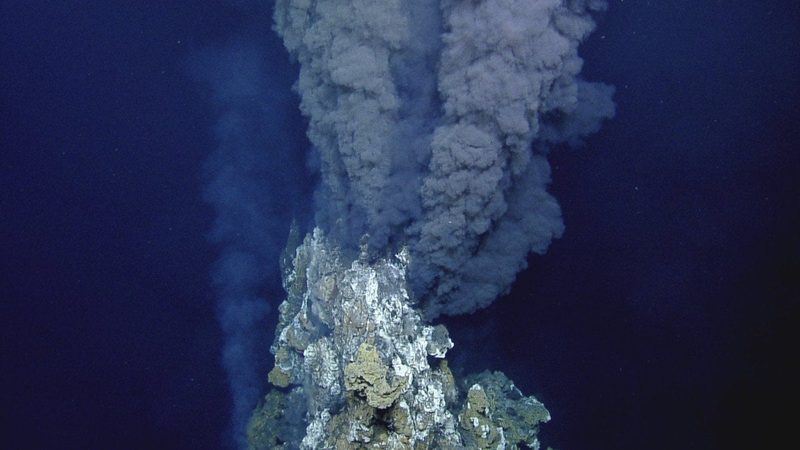
In 1977, scientists exploring the Galapagos Rift expected a barren abyss and found instead a thriving oasis: towering chimneys belching black smoke, surrounded by giant tube worms, white crabs and clams, all living in total darkness. Hydrothermal vents, cracks where seawater meets magma-heated rock, had revealed entire ecosystems that never see the sun. Their inhabitants run on chemical energy instead of sunlight, rewriting the rules of what life needs. Vents remain among the most alien and illuminating environments on Earth, and new vent fields are still being discovered every year.
How vents form
The recipe for a vent starts with plate tectonics and a great deal of water. At mid-ocean ridges, where plates pull apart, seawater seeps kilometres down through cracked crust, approaching magma chambers. Superheated to 300 or 400 degrees Celsius, the water dissolves metals and sulphur from the rock, becoming acidic and chemically loaded. It then jets back up through chimney structures, and when the scalding fluid hits near-freezing seawater, dissolved minerals precipitate instantly, building the vent’s towering spires. Black smokers, named for their dark particle plumes, are the hottest and most dramatic; white smokers and diffuse seeps run cooler and gentler.
Life without sunlight
The foundation of vent ecosystems is chemosynthesis. Bacteria oxidise hydrogen sulphide and other chemicals in the vent fluid, using the energy to fix carbon, exactly the role photosynthesis plays at the surface. These microbes live freely in mats and, remarkably, inside animals: giant tube worms have no mouth or gut, surviving entirely on symbiotic bacteria housed in a specialised organ. Around them gather clams, mussels, shrimp with light-sensing organs on their backs, and the famous yeti crabs farming bacteria on their hairy arms. Hundreds of vent species are found nowhere else on Earth, making each vent field a unique and irreplaceable biological treasure.
Oases in the deep desert
Vents are islands of abundance in a food-poor abyss. Biomass around an active vent can be thousands of times denser than the surrounding seafloor, drawing in octopuses, fish and wandering predators from far away. But vent fields are ephemeral: individual vents clog and die within decades, while new ones open elsewhere along the ridge. Species must therefore disperse their larvae across kilometres of barren seafloor to colonise new vents, an extraordinary life-history gamble. The result is a shifting archipelago of oases, winking on and off across geological time.
Origins of life?
Vents feature in one of science’s grandest debates: where did life begin? The alkaline vent hypothesis proposes that gentle, warm, mineral-rich vents on the early Earth provided exactly the chemical gradients and sheltered pores that the first cells needed, an alternative to the Darwinian warm pond. Laboratory experiments show vent-like conditions can synthesise key biomolecules. Whether or not life started at vents, they prove that life needs only chemical energy, water and rock, a finding that electrifies the search for life on Europa, Enceladus and other ocean worlds with suspected seafloor vents.
Threats from mining
Vent chimneys concentrate valuable metals, copper, gold, zinc, making them targets for deep-sea mining. The debate is fierce:
- Miners argue vents are small, ephemeral and renewable on geological timescales.
- Biologists counter that vent species are uniquely vulnerable, with nowhere else to go if their field is destroyed.
- Regulators at the International Seabed Authority are still writing the rules, with several nations pushing for moratoriums.
FAQs
How hot is vent water? The hottest black smokers exceed 400 degrees Celsius but do not boil, because the immense deep-sea pressure keeps the water liquid.
Can anything live in the vent fluid itself? Microbes thrive in the mixing zones; the superheated core fluid is too hot even for them, but life crowds every gradient around it.
Are there vents in Indian waters? Yes. India’s Central Indian Ridge hosts vent fields that Indian research vessels have explored, with unique fauna being described.
Hydrothermal vents shattered the assumption that all life needs the sun, revealing a shadow biosphere powered by Earth’s inner heat. In their black smokers and white crabs, we see both a possible cradle of life and a preview of what might live in alien oceans, all of it hidden kilometres beneath the waves, in darkness that has lasted since long before humans existed.
Source: Woods Hole Oceanographic Institution

Khabar 24h Editorial Desk — our explainers are prepared by the Khabar 24h editorial team using AI-assisted research tools, and every piece is reviewed by a human editor before publishing. We do not claim original reporting: our work is turning complex topics into simple, accurate summaries. Spotted an error? Write to contact@khabar24h.com — our corrections policy aims for same-day review.
More from this author →