Can AI Do Science? How Algorithms Are Discovering New Materials
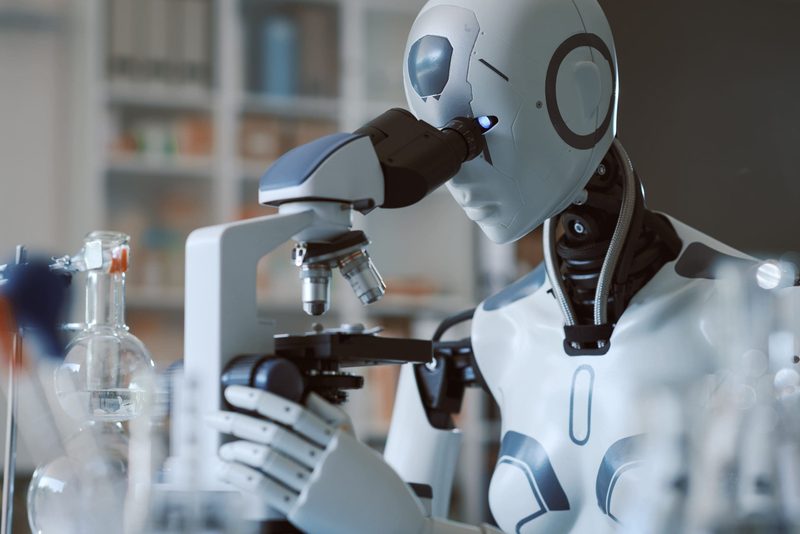
In 2023, Google DeepMind announced that its GNoME system had predicted 2.2 million new crystal structures, of which 380,000 were stable enough to synthesise, a haul equivalent to centuries of human materials discovery. Around the same time, self-driving laboratories, robotic systems guided by AI, began synthesising and testing new materials around the clock without human intervention. These are not incremental improvements to existing tools; they are a change in who, or what, does science. Algorithms now propose hypotheses, design experiments, analyse results and iterate, compressing discovery cycles from years to days. The question is no longer whether AI is useful in science but how far the partnership goes: can AI genuinely do science, with its creativity, intuition and understanding, or is it an extraordinarily powerful assistant to human scientists who still supply the insight?
How AI discovers materials
Materials discovery was historically slow because the search space is vast: the number of possible inorganic compounds dwarfs the atoms in the universe, and each candidate traditionally required synthesis and testing. Machine learning inverts the process. Models trained on databases of known materials learn the relationship between composition, structure and properties, then screen millions of hypothetical compounds computationally, predicting which will be stable, conductive, magnetic or catalytic. GNoME’s 2.2 million predictions came from this approach, and hundreds have already been synthesised independently, including new battery and superconductor candidates. In chemistry, AI predicts reaction outcomes and retrosynthesis routes, planning how to build complex molecules; in drug discovery, it designs novel molecules against protein targets, with AI-designed drugs now in clinical trials. Self-driving labs close the loop: the AI proposes experiments, robots execute them, results feed back, and the system learns overnight what took human teams months. Lawrence Berkeley National Laboratory’s A-Lab demonstrated the full cycle, autonomously synthesising dozens of predicted materials in days.
What AI still cannot do
Impressive as this is, current AI does science without understanding it, and the distinction matters. Machine learning models are supreme interpolators: they generalise brilliantly within the distribution of their training data but struggle with true novelty, the out-of-distribution leaps that characterise scientific revolutions. They optimise objectives humans define, which means they inherit human blind spots; an AI tasked with maximising battery capacity will not question whether batteries are the right goal. They cannot yet do the conceptual work of science: framing the right question, recognising when an anomaly matters, or building explanatory theories rather than predictive correlations. The history of science is full of discoveries made by noticing what the experiment was not supposed to show, from penicillin’s mouldy plate to the cosmic microwave background’s persistent hiss; whether AI can replicate that serendipity-attention remains doubtful. Most philosophers and practitioners converge on a middle view: AI is transforming the practice of science the way the telescope transformed astronomy, enormously extending human reach while leaving the interpretation, the why, to humans.
India’s stake in the AI-science revolution
For India, AI-driven science is a strategic opportunity to leapfrog. Materials discovery matters directly for national priorities: better batteries for electric vehicles and grid storage, cheaper solar materials, catalysts for green hydrogen, and high-performance alloys for aerospace and defence. Indian institutes are moving: the IITs, IISc and CSIR labs are building AI-for-science programmes, applying machine learning to drug discovery for tuberculosis and neglected diseases, to crop science, and to materials for energy. The advantages are real: AI-led discovery is less capital-intensive than traditional big science, favouring talent over equipment budgets. The risks are real too: dependence on foreign AI models and datasets, a brain drain of AI talent, and the temptation to treat AI predictions as answers rather than hypotheses needing experimental proof. The countries that benefit most will be those that pair AI capability with strong experimental infrastructure and domain expertise, using algorithms to amplify, not replace, the scientific method.
- DeepMind’s GNoME predicted 2.2 million new crystal structures, with 380,000 potentially stable.
- Self-driving labs at Berkeley autonomously synthesised dozens of new materials in days.
- AI-designed drug molecules are now in human clinical trials.
- The space of possible inorganic compounds vastly exceeds what humans could ever test manually.
- Indian institutes are applying AI to TB drug discovery, crop science and energy materials.
FAQs
Has AI actually discovered anything real? Yes. Hundreds of GNoME-predicted materials have been independently synthesised, and AI-designed molecules are in clinical trials, though most remain early-stage.
Could AI win a Nobel Prize? The 2024 chemistry Nobel went to AlphaFold’s creators, humans, for AI-assisted discovery; whether an AI could be a laureate is a philosophical and legal question for the future.
Will AI replace scientists? Unlikely. It automates prediction and experimentation, but question-framing, interpretation and the pursuit of understanding remain deeply human.
AI does not do science the way humans do, but it is undeniably doing something that accelerates science beyond historical precedent. The scientist of the future may be a partnership: human curiosity asking the questions, machine intelligence searching the spaces too vast for minds alone.
Compiled by the Khabar 24h Editorial Desk from publicly available sources.

Khabar 24h Editorial Desk — our explainers are prepared by the Khabar 24h editorial team using AI-assisted research tools, and every piece is reviewed by a human editor before publishing. We do not claim original reporting: our work is turning complex topics into simple, accurate summaries. Spotted an error? Write to contact@khabar24h.com — our corrections policy aims for same-day review.
More from this author →