How Tides Work: The Moon’s Pull on Earth’s Oceans
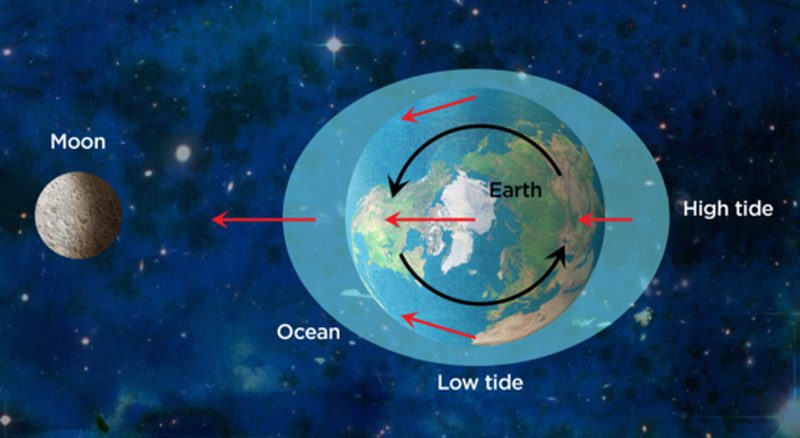
Twice a day, the oceans breathe in and out, rising metres up beaches and harbour walls, then withdrawing again. These tides are among the most visible astronomical phenomena on Earth, and their cause is gravity, specifically the Moon’s gravity pulling on the oceans. The full story involves a second, counterintuitive bulge on the far side of the planet, the Sun’s supporting role, and the shape of coastlines that can amplify a modest oceanic tide into a towering bore. Tides are celestial mechanics made visible in water.
The Moon’s pull and the two bulges
The Moon’s gravity tugs the ocean toward it, creating a bulge of water on the Moon-facing side of Earth. But there is a matching bulge on the opposite side, which surprises many people. It arises because the Earth-Moon system orbits their common centre of mass: the far side of Earth is effectively flung outward by this orbital motion, like water pressed to the outside of a spinning bucket. The result is two tidal bulges on opposite sides of the planet. As Earth rotates beneath them, most coastlines pass through both bulges daily, giving two high tides and two low tides roughly every 24 hours and 50 minutes.
Why the timing shifts daily
Tides run about 50 minutes later each day because the Moon is moving too. While Earth spins once, the Moon advances in its orbit, so Earth must rotate a little extra to bring the same coastline back under the lunar bulge. This is why tide tables march steadily through the clock over a month. The Moon’s orbit is also tilted and elliptical, so the two daily tides are often unequal in height, and their timing and size vary through the month in patterns that coastal navigators have tracked for millennia.
The Sun’s supporting role
The Sun also raises tides, about half as strong as the Moon’s despite its vastly greater mass, because tides depend on the difference in gravity across Earth’s diameter, which falls off with the cube of distance. When the Sun and Moon align at new and full moon, their tides add up, producing extra-high spring tides; when they pull at right angles during quarter moons, they partially cancel, giving modest neap tides. The fortnightly spring-neap cycle is the Sun’s signature written over the Moon’s daily rhythm.
Why some places have huge tides
In the open ocean, tides are less than a metre, barely noticeable. Coastlines transform them. Funnel-shaped bays and estuaries concentrate the tidal flow, amplifying the range: the Bay of Fundy in Canada, shaped like a giant megaphone, sees tides over 16 metres. Resonance matters too; if a bay’s natural sloshing period matches the tidal period, each tide pumps the oscillation higher, like pushing a swing.
- Semidiurnal tides: two high and two low tides daily, the most common pattern.
- Diurnal tides: one high and one low per day, in parts of Southeast Asia and the Gulf of Mexico.
- Spring tides: largest range, when Sun and Moon align at new and full moon.
- Neap tides: smallest range, when Sun and Moon pull at right angles.
- Tidal bores: a wall of water surging upriver where strong tides meet river flow.
India’s Gulf of Khambhat and Gulf of Kutch see ranges over 10 metres for similar reasons, while enclosed seas like the Mediterranean barely feel tides at all.
Tides as energy and history
Tidal energy is the most predictable renewable: tides can be forecast centuries ahead. Tidal barrages and underwater turbines harvest it in a few sites worldwide, though high costs and environmental concerns limit deployment. Tides also shape planetary history: tidal friction is gradually slowing Earth’s rotation, lengthening the day by milliseconds per century, and long ago it locked the Moon’s rotation so it always shows the same face. The tides we watch today are slowly braking the planet’s spin.
FAQs
Do tides affect the land too? Yes. The solid Earth rises and falls about 30 centimetres with bodily tides, imperceptible but measurable with precise instruments.
Why do some places have only one tide a day? In parts of the Gulf of Mexico and Southeast Asia, geography and the Moon’s declination combine to suppress one of the two daily tides, giving diurnal instead of semi-diurnal tides.
Can tides trigger earthquakes? There is weak evidence that tidal stresses can slightly advance the timing of quakes on already-critical faults, but tides do not cause earthquakes.
Tides are the Moon’s handwriting on the oceans, edited by the Sun and amplified by coastlines. Twice daily, gravity from a quarter-million miles away lifts trillions of tonnes of water, a quiet demonstration that the Earth is not an isolated planet but a body dancing with its neighbours.
Source: National Oceanic and Atmospheric Administration

Khabar 24h Editorial Desk — our explainers are prepared by the Khabar 24h editorial team using AI-assisted research tools, and every piece is reviewed by a human editor before publishing. We do not claim original reporting: our work is turning complex topics into simple, accurate summaries. Spotted an error? Write to contact@khabar24h.com — our corrections policy aims for same-day review.
More from this author →