How Solar Panels Turn Sunlight Into Electricity
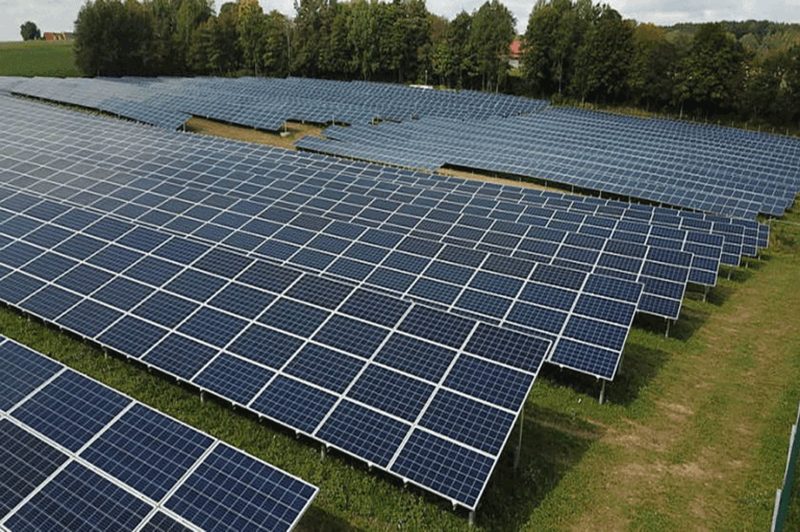
A solar panel has no moving parts, makes no noise and needs no fuel, yet it turns sunlight directly into electricity with an elegance no other generator can match. The secret is the photovoltaic effect: photons of light knocking electrons loose inside silicon, and a carefully engineered electric field sweeping those electrons into a current. From rooftop installations to gigawatt solar parks, the same physics scales from milliwatts to megawatts. Understanding how a panel works explains both why solar power has become so cheap and where its limits lie.
The photovoltaic effect
It begins with a photon striking silicon. If the photon carries enough energy, it knocks an electron out of its atomic bond, creating a free electron and a positively charged hole where it was. Left alone, the electron would quickly fall back and the energy would be lost as heat. A solar cell prevents that with a built-in electric field, created by doping the silicon: one layer is infused with phosphorus to provide extra electrons (n-type), the other with boron to provide extra holes (p-type). At the junction, the field sweeps electrons one way and holes the other, driving a current through an external circuit. Light in, electricity out, with nothing consumed.
Why silicon dominates
Silicon won for practical reasons as much as physical ones. Its band gap, the energy needed to free an electron, of 1.1 electron volts matches the solar spectrum well: it captures a large fraction of sunlight’s photons while wasting relatively little energy per photon. Silicon is the second most abundant element in the Earth’s crust, and decades of semiconductor industry investment made ultra-pure silicon cheap. Alternatives exist, perovskites, cadmium telluride and multi-junction cells, some more efficient, but none has yet matched silicon’s combination of efficiency, durability and cost. The familiar blue-black panels are essentially slabs of the same material as computer chips, optimised for light instead of logic.
From cell to panel to power plant
A single cell produces only about half a volt, so cells are wired in series into modules of 60 or 72 cells, yielding the panels on rooftops. Modules are strung into arrays, and the direct current they produce is converted to grid-compatible alternating current by inverters. Utility solar parks add tracking systems that tilt panels to follow the sun, boosting output by up to a quarter.
- Cell: a silicon wafer with a p-n junction that turns photons into current.
- Module: 60-72 wired cells sealed behind glass for decades outdoors.
- Inverter: converts the panel’s direct current into grid-ready alternating current.
- Tracker: tilts panels to follow the sun, raising output by up to 25 percent.
- Array: modules wired together, from rooftop kilowatts to gigawatt solar parks.
The whole assembly is solid-state and modular: a solar farm is just a very large number of identical small generators, which is why solar scales so smoothly from a village microgrid to a gigawatt installation.
Efficiency and its limits
Commercial panels convert about 20 to 23 percent of sunlight into electricity, a figure that has climbed steadily for decades. The theoretical limit for a single silicon junction, the Shockley-Queisser limit, is about 33 percent; real cells lose energy to reflection, heat and photons too weak to free electrons. Laboratory multi-junction cells that stack materials to catch different colours of light have exceeded 47 percent, and perovskite-silicon tandems promise to push commercial efficiencies toward 30 percent. But efficiency is only half the story: solar’s triumph came from collapsing costs, with panel prices falling roughly 90 percent in a decade, making even modest efficiencies economically unbeatable in sunny regions.
The challenges: night, dust and land
Solar’s weaknesses are well known. It produces nothing at night and less on cloudy days, so grids need storage, backup or continental-scale interconnection. Dust and soiling can cut output significantly in arid regions, requiring cleaning. Large parks need land, though rooftops, canals and agrivoltaics, panels raised above crops, ease the pressure. And panels eventually wear out: after 25 to 30 years, output declines, creating a coming wave of decommissioned modules that the recycling industry is racing to handle. None of these is fatal; all are engineering and planning problems with known solutions.
FAQs
Do solar panels work on cloudy days? Yes, at reduced output. Panels use diffuse as well as direct light, typically producing 10 to 25 percent of their sunny-day output under heavy cloud.
How long do panels last? Most carry 25-year performance warranties and degrade slowly, losing under 1 percent of output per year; many will generate usefully for 30 years or more.
What happens to old panels? They are mostly glass and aluminium, both recyclable, plus small amounts of silicon and metals. Recycling infrastructure is scaling up as the first big installations retire.
The solar panel is a quiet revolution made of sand and sunlight: quantum physics, manufactured by the square kilometre, delivering the cheapest electricity in history across much of the world. Its limits are real but manageable, and its trajectory, from space-age curiosity to the backbone of the energy transition, is one of the great technology stories of our time.
Source: National Renewable Energy Laboratory

Khabar 24h Editorial Desk — our explainers are prepared by the Khabar 24h editorial team using AI-assisted research tools, and every piece is reviewed by a human editor before publishing. We do not claim original reporting: our work is turning complex topics into simple, accurate summaries. Spotted an error? Write to contact@khabar24h.com — our corrections policy aims for same-day review.
More from this author →