Nuclear Fusion: Why Recreating the Sun’s Power on Earth Is So Hard
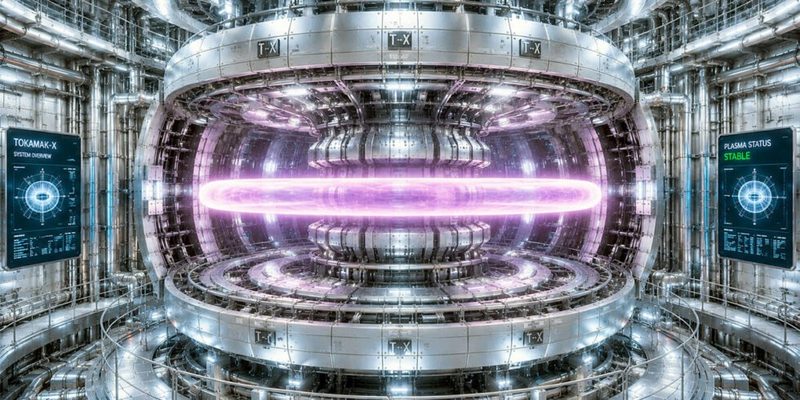
The Sun has been running a fusion reactor for 4.6 billion years, fusing hydrogen into helium at 15 million degrees and bathing Earth in the waste heat. Recreating that process on Earth promises nearly limitless clean energy from seawater: deuterium from the oceans and lithium for tritium breeding could power civilisation for millennia. Yet after seventy years of effort, fusion remains the energy of the future, always a few decades away. The reason is not lack of understanding but the savage difficulty of containing something hotter than the Sun’s core.
How fusion works
Fusion is the opposite of fission: light nuclei are forced together until they merge, and the resulting nucleus weighs slightly less than the parts, with the difference released as energy. The easiest reaction on Earth fuses deuterium and tritium, two heavy forms of hydrogen, producing helium and a high-energy neutron. The catch is the Coulomb barrier: both nuclei are positively charged and repel each other fiercely. Overcoming that repulsion requires temperatures above 100 million degrees, hotter than the Sun’s core, because the Sun compensates with crushing pressure that we cannot replicate. At those temperatures, fuel becomes plasma, a roiling soup of ions and electrons.
The containment problem
No material vessel can hold 100-million-degree plasma; it would vaporise instantly. The leading approach is magnetic confinement: the tokamak, a doughnut-shaped chamber where powerful magnetic fields suspend the plasma without touching the walls. The rival method is inertial confinement, where lasers crush a fuel pellet so violently that fusion ignites before the pellet blows apart, as demonstrated at the US National Ignition Facility. Both must solve plasma instabilities, turbulent, writhing behaviours that can quench the reaction in milliseconds. Containing a star turns out to be a problem in taming chaos, and plasma physicists have spent careers learning its unruly moods.
The milestones so far
Progress is real, if slower than hoped. The JET tokamak in Britain set fusion power records in the 1990s and again in its final campaigns. In 2022, the National Ignition Facility achieved scientific breakeven, releasing more fusion energy than the laser energy delivered to the fuel, a genuine landmark. Private fusion companies have raised billions of dollars, pursuing compact tokamaks, stellarators and exotic concepts. And in southern France, ITER, the 35-nation tokamak, is assembling the largest fusion device ever, designed to produce ten times more fusion power than the heating power injected.
Why it is so hard
The difficulties compound. Tritium, one half of the fuel, barely exists naturally and must be bred from lithium inside the reactor. The 14 MeV neutrons from fusion batter the reactor walls, making materials brittle and radioactive, a materials science nightmare. Extracting heat and converting it to electricity at power-plant scale is unproven. And the economics are daunting: a fusion plant must compete with fission, solar and wind that keep getting cheaper. Each challenge is solvable in principle; solving them all simultaneously, affordably, and at the scale of a power grid is the work of decades.
What fusion would change
If it works, the payoff is civilisational:
- Abundant fuel: deuterium from seawater and lithium are effectively inexhaustible.
- No carbon emissions and no long-lived actinide waste like fission produces.
- Inherent safety: the plasma contains seconds of fuel, so runaway reactions are physically impossible.
- Energy-dense baseload power that works day and night, anywhere on Earth.
FAQs
When will fusion power the grid? Honest estimates cluster around the 2040s to 2050s for first commercial plants, if current projects succeed. It will not arrive in time to solve the near-term climate crisis, which must be addressed with the technologies we already have.
Is fusion the same as fission? No. Fission splits heavy atoms; fusion merges light ones. Fusion produces no chain reaction and far less long-lived waste.
Could a fusion reactor explode? No. The plasma holds tiny amounts of fuel and cools instantly if confinement fails; a meltdown-style accident is physically impossible.
Fusion is the hardest engineering challenge humanity has ever set itself: building a star in a bottle, and then plugging it into the grid. The physics says it is possible. The engineering says it is brutally hard. The prize, clean energy for as long as civilisation endures, says it is worth trying.
Source: ITER Organization

Khabar 24h Editorial Desk — our explainers are prepared by the Khabar 24h editorial team using AI-assisted research tools, and every piece is reviewed by a human editor before publishing. We do not claim original reporting: our work is turning complex topics into simple, accurate summaries. Spotted an error? Write to contact@khabar24h.com — our corrections policy aims for same-day review.
More from this author →