How the Giant Metrewave Radio Telescope in Pune Listens to the Cosmos
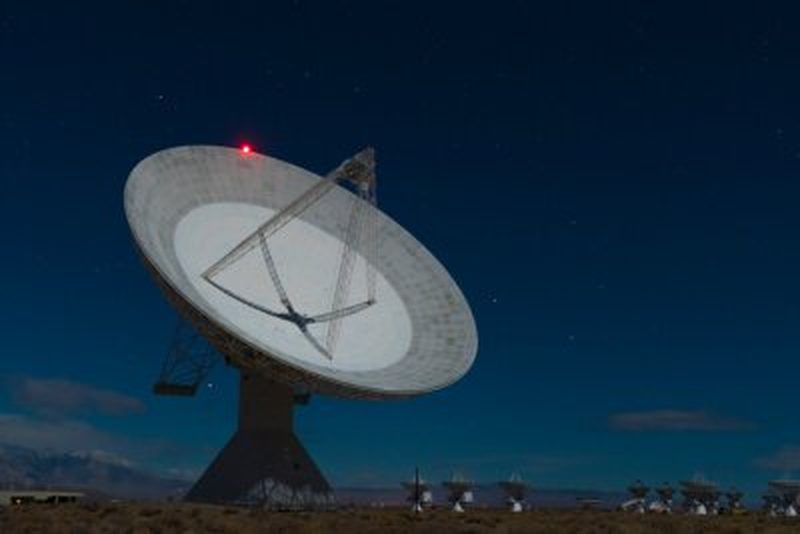
On a plateau near Pune, thirty dish antennas, each 45 metres across, stand pointed at the sky in a Y-shaped formation spanning 25 kilometres. This is the Giant Metrewave Radio Telescope, the GMRT, one of the world’s largest and most sensitive radio observatories. While optical telescopes capture the light our eyes can see, the GMRT listens to the universe’s radio whispers: the faint crackle of hydrogen gas, the lighthouse beams of spinning pulsars, and the afterglow of colliding galaxies. It has put India firmly on the map of global radio astronomy.
Why radio astronomy matters
Most of the universe is invisible to optical telescopes. Cold hydrogen gas, the raw material of stars, emits no visible light but glows faintly at the 21-centimetre radio wavelength. Supermassive black holes blast jets of particles that shine in radio. The cosmic microwave background, the Big Bang’s afterglow, peaks in microwaves. Radio waves also slice straight through interstellar dust that blocks visible light, revealing star formation hidden inside dark clouds. A radio telescope is not a lesser telescope; it is a different sense organ, perceiving a universe that optical instruments cannot detect.
How the GMRT works
Each of the GMRT’s thirty dishes collects radio waves and funnels them to a receiver, but the real magic is interferometry. By combining the signals from all dishes with precise timing, the array synthesises the resolving power of a single dish 25 kilometres across, far sharper than any individual antenna could achieve. Computers correlate the signals, correcting for the Earth’s rotation and atmospheric distortion, to build detailed radio images of the sky. The GMRT operates at metre wavelengths, a band where it remains among the most sensitive instruments on Earth, complementing higher-frequency arrays like ALMA.
Landmark discoveries
The GMRT’s sharp low-frequency vision has produced a string of headline results. It discovered some of the most distant known galaxies by detecting their redshifted hydrogen signals, pushing the 21-centimetre technique toward the cosmic dawn. Its pulsar surveys have found dozens of new spinning neutron stars, including millisecond pulsars that serve as cosmic clocks for hunting gravitational waves. The telescope mapped giant radio galaxies with jets spanning millions of light-years, traced magnetic fields in galaxy clusters, and recently upgraded receivers have made it several times more sensitive, opening new hunts for the epoch of reionisation, when the first stars lit up the universe.
Radio quiet in a noisy world
Radio telescopes fight an enemy that optical observatories never face: us. Mobile phones, satellites, power lines and even microwave ovens all broadcast in radio bands, and a single passing satellite can outshine a distant galaxy by orders of magnitude. The GMRT’s site was chosen partly for its relative radio quietness, and its engineers deploy sophisticated interference excision, flagging and removing human-made signals in real time. Protecting radio-quiet zones is now a global policy battle, as mega-constellations of satellites threaten to drown out the faintest cosmic signals.
India’s radio astronomy future
The GMRT is both a world-class facility and a training ground. Hundreds of Indian astronomers learned interferometry on its data, and it hosts international observers from dozens of countries. India is also a partner in the Square Kilometre Array, the next-generation global radio observatory under construction in Australia and South Africa, with Indian industry building key components. The upgraded GMRT, with its wideband receivers, will work alongside the SKA, ensuring that the dishes near Pune remain at the frontier for decades.
FAQs
Can the GMRT see through clouds? Yes. Radio waves pass through clouds, rain and daylight unaffected, so the GMRT observes around the clock in all weather, unlike optical telescopes.
Why thirty dishes instead of one big one? A single 25-kilometre dish is impossible to build. Interferometry links smaller dishes to achieve the same sharpness, with the added benefit of flexibility.
Has the GMRT searched for aliens? Its sensitive receivers have been used in SETI experiments, scanning nearby stars for artificial signals, though none have been found.
The GMRT proves that world-class science does not require the world’s biggest budget, just a good site, clever engineering and sharp questions. Every day, its dishes near Pune turn the sky’s faintest radio murmurs into discoveries about how galaxies, stars and the universe itself came to be.
Source: National Centre for Radio Astrophysics

Khabar 24h Editorial Desk — our explainers are prepared by the Khabar 24h editorial team using AI-assisted research tools, and every piece is reviewed by a human editor before publishing. We do not claim original reporting: our work is turning complex topics into simple, accurate summaries. Spotted an error? Write to contact@khabar24h.com — our corrections policy aims for same-day review.
More from this author →