The Non-Aligned Movement: India’s Cold War Foreign Policy Legacy
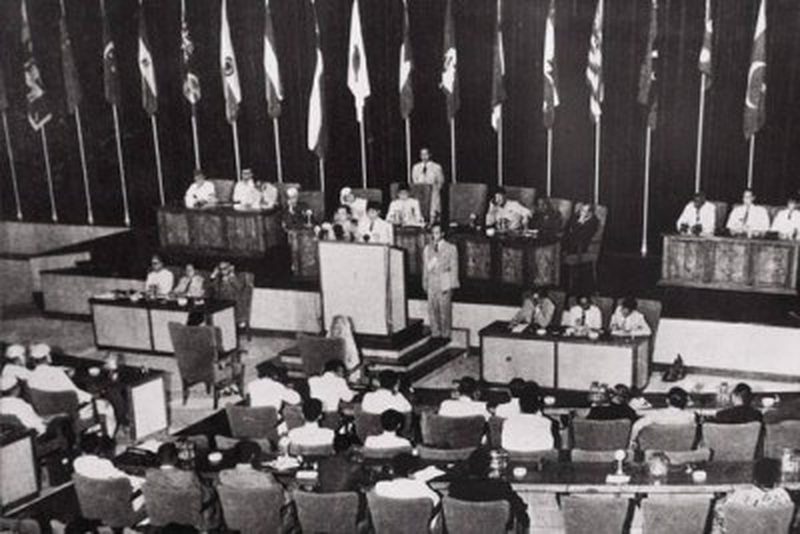
The Non-Aligned Movement — 120 developing nations refusing to take sides in the Cold War — was India’s great diplomatic invention and, for decades, the institutional voice of the Third World. Founded at Belgrade in 1961 by Nehru, Nasser, Tito, Nkrumah and Sukarno, it gave newly independent states a platform independent of Washington and Moscow. The Cold War’s end was supposed to kill it; instead NAM survives, diminished but defiant, as a symbol of the Global South’s enduring demand for strategic independence.
Why did Nehru champion non-alignment?
For newly independent India, non-alignment was both principle and pragmatism. Ideologically, Nehru believed colonialism’s victims should not trade British domination for American or Soviet tutelage, and that India could be a moral force for peace. Practically, non-alignment let India accept aid from both blocs — Soviet steel plants and American food aid — while avoiding entanglement in superpower wars. The 1955 Bandung Conference of Asian and African nations was the movement’s spiritual birthplace; Belgrade 1961 gave it institutional form, with principles of sovereignty, non-aggression and peaceful coexistence.
What did NAM achieve?
At its 1970s peak, NAM was a formidable bloc. It drove the UN’s decolonisation agenda, pushed the New International Economic Order demanding fairer trade, and gave small states collective bargaining power. India used NAM to lead on disarmament and apartheid sanctions. But the movement’s contradictions were real: members included authoritarian regimes and Soviet clients, Cuba’s tilt toward Moscow split the movement, and India’s own 1971 treaty with the USSR stretched non-alignment’s credibility. Critics called it non-aligned only in name — aligned, in practice, against the West.
Did the Cold War’s end kill NAM?
Many predicted NAM would dissolve with the bipolar order it defined itself against. Instead it adapted, pivoting to issues of globalisation, development and multilateral reform — opposing the Iraq War, demanding UN Security Council expansion and defending Palestinian rights. Membership held at 120, making it the largest grouping after the UN. But the energy faded: summits became ritualistic, great powers stopped courting it, and rising powers built their own platforms — BRICS, the G20 — that eclipsed NAM’s relevance.
What is NAM’s legacy for India?
Non-alignment shaped independent India’s diplomatic DNA, and its echoes are everywhere in today’s multi-alignment.
- Strategic autonomy: the refusal to join alliances persists — India is in the Quad but not a US ally, buys Russian oil despite Western pressure.
- Global South leadership: the Voice of Global South summits and G20 presidency consciously revive Nehru’s Third World mantle.
- Moral vocabulary: sovereignty, non-interference and multilateral reform remain Indian talking points.
- The critique: realists argue non-alignment was moralising cover for weakness, and that today’s multi-alignment is the same instinct updated.
NAM’s world is gone, but its question endures: must smaller powers choose between great powers, or can they chart their own course? As US-China rivalry forces choices across the Global South, the non-aligned instinct — hedge, diversify, refuse camps — is back in fashion. The movement may be a shadow; the idea is having a renaissance.
NAM’s institutional afterlife
Though diminished, NAM’s machinery still functions: summits every few years (most recently in Kampala in 2024), a coordinating bureau at the UN, and working groups on issues from Palestine to UN reform. Its resolutions still carry the weight of 120 votes in General Assembly politics, where numbers matter. More importantly, NAM’s vocabulary — South-South cooperation, a new international economic order, non-interference — migrated into BRICS declarations, G77 positions and African Union communiqués. The movement’s body is frail; its ideas were absorbed into the Global South’s permanent diplomatic language.
What today’s leaders take from NAM
Modern Indian diplomacy rarely invokes NAM by name, yet its instincts are visible: the refusal to condemn Russia, the Voice of Global South summits, the insistence that the G20 serve developing countries. Across Africa and Southeast Asia, leaders hedging between Washington and Beijing practise non-alignment without the label. The movement’s greatest legacy may be normalising the idea that small states need not choose — a proposition the Cold War’s heirs are testing anew.
FAQs
Who founded the Non-Aligned Movement?
Nehru of India, Nasser of Egypt, Tito of Yugoslavia, Nkrumah of Ghana and Sukarno of Indonesia, at the 1961 Belgrade summit following the 1955 Bandung Conference.
Was India truly non-aligned?
Largely, though critics note the 1971 Indo-Soviet treaty and reliance on Soviet arms tilted India toward Moscow, especially after the 1962 China war.
Does NAM still exist?
Yes — 120 members make it the largest grouping after the UN, though summits are now largely symbolic and BRICS and the G20 have eclipsed its influence.
Compiled by the Khabar 24h Editorial Desk from publicly available sources.

Khabar 24h Editorial Desk — our explainers are prepared by the Khabar 24h editorial team using AI-assisted research tools, and every piece is reviewed by a human editor before publishing. We do not claim original reporting: our work is turning complex topics into simple, accurate summaries. Spotted an error? Write to contact@khabar24h.com — our corrections policy aims for same-day review.
More from this author →