Why Diwali Firecrackers End Up in Court Every Year: The Green Crackers Question
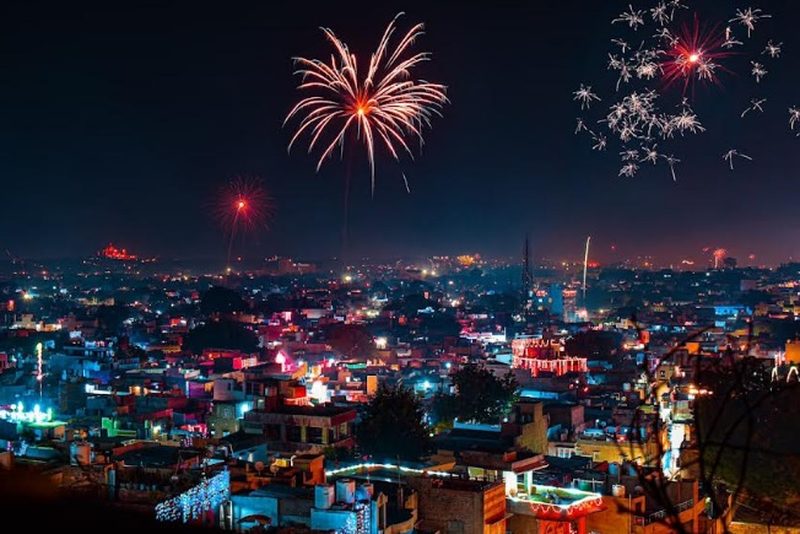
It is among India’s most predictable annual rituals, and it has nothing to do with religion: weeks before Diwali, state governments announce firecracker restrictions, manufacturers and traders rush to court, judges parse the difference between green and conventional crackers, and the festival arrives amid legal confusion. The Supreme Court has weighed in repeatedly, most consequentially in 2018, and again in subsequent years, yet the battle returns every autumn. At stake are public health, livelihoods, and the character of the festival itself. This is why Diwali firecrackers end up in court every year.
The science of the smoke
The case against conventional firecrackers rests on chemistry. Firecrackers release fine particulate matter, PM2.5 and PM10, along with gases like sulphur dioxide and nitrogen oxides, and heavy metals used for colour, barium for green, strontium for red, in intense, localised bursts. In north India, Diwali coincides with the onset of winter inversion and the paddy-stubble burning season, a combination that routinely pushes Delhi’s air quality into the severe category in the days after the festival. Hospitals report spikes in respiratory distress, and studies have documented measurable jumps in PM levels on Diwali night. Defenders of crackers argue that Diwali is a blip compared to year-round sources like vehicles, dust, and industry, and that singling out the festival is selective. Public health researchers respond that a blip that hospitalises people is still a blip worth addressing, and that episodic spikes on top of already-poor baseline air quality are precisely what make Diwali dangerous in the Indo-Gangetic plain.
What green crackers are
Green crackers are the technological compromise, developed by the Council of Scientific and Industrial Research’s laboratories, principally NEERI. They are formulated to reduce emissions: less particulate matter, typically claimed at 30 per cent or more reduction, lower levels of sulphur and nitrogen oxides, and the elimination of barium. They come in variants with names like SWAS, safe water releaser, which releases water vapour to suppress dust, and STAR, safe thermite cracker. The Supreme Court’s 2018 judgment permitted only green crackers, mandated that they be sold through licensed traders, restricted bursting to designated time windows, typically 8 to 10 pm on Diwali, and directed that e-commerce sales of crackers be curbed. The idea was to preserve the festival’s celebratory core while cutting its toxic load. In practice, the green cracker regime has faced problems of enforcement, certification, and public awareness that courts revisit annually.
Why the bans keep getting challenged
The litigation cycle has a rhythm. State governments, particularly Delhi’s, announce complete bans on all crackers including green ones, citing air quality emergencies. Firecracker manufacturers, concentrated in Sivakasi, Tamil Nadu, which employs lakhs in the industry, challenge the bans as disproportionate and destructive to livelihoods, arguing that green crackers were specifically developed as the court-approved middle path. Courts then navigate between competing expert claims about emissions, enforcement realities, and the scope of earlier orders. The Supreme Court has, over successive Diwalis, refined its position: upholding the green-cracker-only regime nationally, allowing states to impose stricter bans where air quality warrants, and repeatedly expressing frustration at poor enforcement. Each year’s orders add another layer to a jurisprudence that is now among the most detailed anywhere on the regulation of a festival.
Enforcement: the perennial weak link
Whatever the courts order, the ground reality on Diwali night often tells a different story. Banned crackers remain widely available through informal channels, bursting routinely exceeds the permitted time windows, and police enforcement is patchy against the sheer scale of neighbourhood-level celebration. Air quality data from recent Diwalis in Delhi shows the familiar post-festival spike persisting despite bans, suggesting that prohibition without compliance achieves little. This enforcement gap fuels arguments on both sides: ban supporters say it proves the need for stricter action at the manufacturing source in Sivakasi, while industry voices say it proves bans do not work and only the green-cracker middle path is realistic. Some cities have experimented with community fireworks displays and laser shows as alternatives, with mixed public reception.
Where the debate goes from here
The firecracker question sits at the intersection of three legitimate claims: the right to breathe clean air, the right to livelihood of Sivakasi’s workers, and the right to celebrate a festival as generations have. The green cracker was supposed to reconcile them, and it remains the most promising technical answer, but only if certification is credible, enforcement is real, and the public buys in. Longer-term, the debate may shift as Delhi’s winter air crisis forces harder choices about all pollution sources, crackers included. Until then, expect the annual ritual to continue: the October announcements, the court filings, the judicial parsing of barium content, and Diwali night itself, loud, luminous, and legally ambiguous.
FAQs
What are green crackers? Firecrackers developed by CSIR labs with reduced emissions, no barium, and lower particulate output, approved by the Supreme Court as the only permitted category nationally.
Are firecrackers completely banned in Delhi? Delhi has imposed complete bans including on green crackers in recent years, citing air quality emergencies; the legality and enforcement are litigated annually.
When can crackers be burst? Under the Supreme Court’s framework, bursting is restricted to designated hours, typically 8 pm to 10 pm on Diwali, where crackers are permitted at all.
Diwali’s cracker wars are really a debate about what kind of celebration a modern India wants: one that lights up the sky without choking the air. The courts have sketched an answer; making it real, one Diwali night at a time, is the hard part.
Compiled by the Khabar 24h Editorial Desk from publicly available sources.

Khabar 24h Editorial Desk — our explainers are prepared by the Khabar 24h editorial team using AI-assisted research tools, and every piece is reviewed by a human editor before publishing. We do not claim original reporting: our work is turning complex topics into simple, accurate summaries. Spotted an error? Write to contact@khabar24h.com — our corrections policy aims for same-day review.
More from this author →