Sagarmala Explained: India’s Port-Led Development Programme
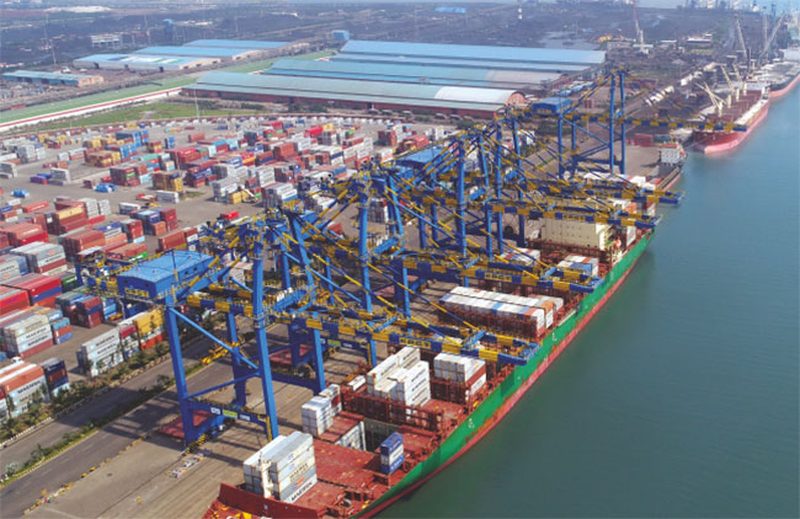
India has a 7,500-kilometre coastline and a dozen major ports, yet for decades its ports were congested, shallow and poorly connected to the hinterland, and coastal shipping was an afterthought. The Sagarmala programme, launched in 2015, set out to change the economics of the coastline with a simple insight: countries that industrialise near their ports, like China and South Korea, slash logistics costs. Sagarmala’s vision was port-led development: modernise the ports, connect them efficiently to the hinterland, industrialise the coast around them, and develop coastal communities. This explainer breaks down the programme’s four pillars and assesses how far it has come.
The four pillars
Sagarmala is organised around port modernisation and new port development, port connectivity enhancement, port-linked industrialisation, and coastal community development. The first pillar covers mechanisation, deepening of drafts and new berths at major ports. The second builds the road and rail links that decide whether a port actually serves its hinterland: dedicated rail corridors, last-mile road connectivity and inland waterways. The third promotes coastal economic zones and industrial clusters near ports, so that manufacturing locates where shipping is cheapest. The fourth covers the human side: skill development for coastal communities, fishing harbour modernisation and cruise tourism. The programme’s project list runs into the hundreds, implemented by ports, states and central agencies.
Why ports were the bottleneck
Before Sagarmala, Indian ports suffered from a familiar set of ailments: slow turnaround times for ships, shallow drafts that barred large vessels, manual cargo handling, and hinterland connections so poor that cargo often travelled hundreds of kilometres by road. Transshipment, the business of transferring containers between large mother vessels and smaller feeders, went almost entirely to Colombo, Singapore and Port Klang, because no Indian port could receive the biggest ships. The result was higher logistics costs for Indian trade and a strategic vulnerability: Indian cargo depended on foreign hubs. Sagarmala’s diagnosis was that fixing ports without fixing connectivity, and vice versa, would fail; the two had to move together.
What has changed
Port performance has improved measurably: turnaround times at major ports have fallen sharply, mechanisation has raised handling capacity, and several ports now receive larger vessels. Connectivity projects, including rail links to ports and the development of inland waterways as feeder routes, have cut hinterland transit times. The transshipment story is turning: Vizhinjam in Kerala, developed as a deepwater transshipment hub, has begun receiving mother vessels, chipping away at Colombo’s dominance. Coastal shipping volumes have grown from a low base, and cruise tourism has taken off from Mumbai, Kochi and Goa. The programme’s project-tracking shows a large share of projects completed or under implementation.
Port-linked industrialisation
The most ambitious pillar is also the slowest. Coastal economic zones and port-based industrial clusters were meant to replicate the East Asian model of factories beside berths, but land acquisition, environmental clearances and state-level coordination have made progress uneven. Some states, notably Gujarat and Andhra Pradesh, have moved faster, leveraging existing port-industrial ecosystems. Special economic zones and industrial corridors near ports, such as those linked to the Delhi-Mumbai Industrial Corridor, show the model’s potential. The lesson emerging is that ports can be built by central agencies, but industrialisation needs states to deliver land, power and clearances, and that coordination remains the binding constraint.
The community pillar
Sagarmala’s fourth pillar addresses the people who live off the sea: fishing communities, whose harbours are being modernised with cold chains and hygienic handling; coastal youth, targeted by skill-development programmes for port and logistics jobs; and tourism, through cruise terminals and coastal circuits. This is the programme’s social licence: port-led development that displaces fishing villages or degrades coasts without sharing benefits breeds the opposition that has stalled projects elsewhere. Balancing industrial ambition with coastal ecology and community rights remains Sagarmala’s most delicate task, and the one where success is hardest to measure in cargo tonnes.
FAQs
What is Sagarmala? A central programme launched in 2015 for port-led development, covering port modernisation, connectivity, coastal industrialisation and community development.
How long is India’s coastline? About 7,500 km, with 12 major ports and around 200 non-major ports.
What is transshipment? Transferring cargo between large mother vessels and smaller feeder ships at a hub port; India historically lost this business to Colombo and Singapore.
Sagarmala’s insight was that the sea is not India’s edge but its front door. A decade in, the ports are faster and the ships are bigger; the harder work of building coastal industry and sharing the gains is still underway.
Source: Press Information Bureau

Khabar 24h Editorial Desk — our explainers are prepared by the Khabar 24h editorial team using AI-assisted research tools, and every piece is reviewed by a human editor before publishing. We do not claim original reporting: our work is turning complex topics into simple, accurate summaries. Spotted an error? Write to contact@khabar24h.com — our corrections policy aims for same-day review.
More from this author →