Chandrayaan-4: the audacious plan to bring moon rock home to India
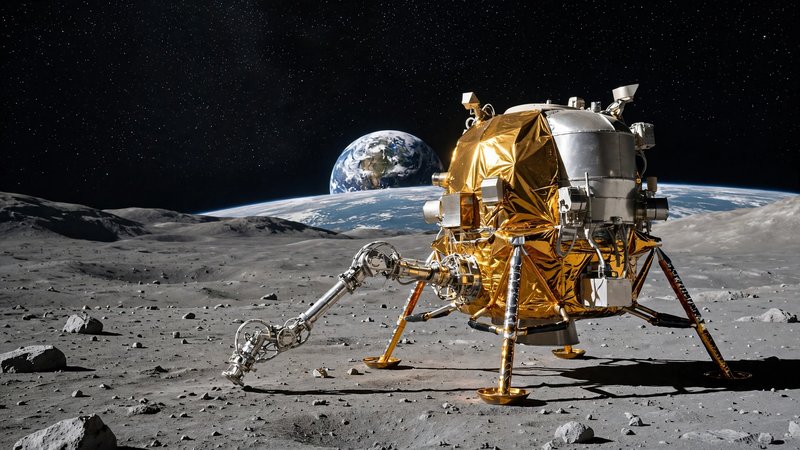
On August 23, 2023, India did what no country had ever done: it landed a spacecraft near the Moon’s south pole. Chandrayaan-3’s Vikram lander touched down where no mission had gone before, and the Pragyan rover rolled out onto the lunar surface. Now ISRO is preparing something even harder — not just landing on the Moon, but coming back. Chandrayaan-4, India’s planned lunar sample-return mission, aims to scoop up Moon rock and soil and fly it home to Earth.
Only three nations have ever pulled this off: the United States with the Apollo and Luna-era missions, the Soviet Union with its robotic Luna probes, and China with Chang’e-5 in 2020. If Chandrayaan-4 succeeds, India becomes the fourth.
A mission in four acts
The government’s stated objective, laid out in a December 2025 Rajya Sabha answer, is a sequence of four feats: land on the lunar surface, extract a sample using a robotic arm, ascend from the surface, and bring the collected sample back to Earth. The spacecraft’s configuration has been finalised, and the critical design of its avionics, mission planning and flight dynamics is complete. The planned timeline is 2027, with a parliamentary committee report narrowing the target to October 2027.
The landing site has been chosen with unusual care: the Moon’s southern polar region, between roughly 84 and 86 degrees south latitude. The region is geologically diverse, sits close to permanently shadowed craters, and may hold water ice. The lunar poles remain among the least explored places in the solar system, which is exactly why the world’s space agencies are all racing to understand them.
Why it needs two rockets
A sample-return mission is really several missions bolted together, and it is too heavy for a single Indian rocket. So ISRO will launch it in pieces:
- A PSLV rocket launches the returner module — the part that will ultimately carry the samples home — into Earth orbit first.
- An LVM3 rocket launches the main stack: a transfer module, the lander with its robotic sampler, and an ascent module.
- The modules meet and dock in orbit. The lander descends to the surface, the robotic arm collects lunar soil and rock, and the sealed samples are loaded into the ascent module.
- The ascent module launches off the Moon, docks with the returner, transfers the samples, and the re-entry capsule brings them home to Earth.
Every one of those steps — precision landing, robotic sampling, launching from another world, autonomous docking — is a technology India will need for far bigger ambitions. The government has set a national goal of landing Indian astronauts on the Moon by 2040, and Chandrayaan-4 is the rehearsal.
Why it matters
Why go to such lengths for a handful of dust? Because a sample studied on Earth is worth far more than any instrument a spacecraft can carry. In terrestrial laboratories, scientists can probe the soil for water molecules, ancient mineral compositions and even helium-3, hunting for clues about how the Moon formed and what the early Earth was like. Chandrayaan-3’s instruments analysed the surface in place; Chandrayaan-4’s samples would let scientists interrogate the same terrain with equipment no spacecraft could carry — electron microscopes, mass spectrometers and dating instruments that can read billions of years of history grain by grain. The south pole’s suspected water ice matters for another reason: it could one day sustain human outposts and be converted into rocket fuel.
Chandrayaan-4 is also one piece of a crowded lunar roadmap. After it comes Chandrayaan-5, a joint mission with Japan’s JAXA space agency carrying a 350-kg Japanese rover — far larger than the 27-kg Pragyan. ISRO is simultaneously developing its Venus orbiter Shukrayaan and the first module of the Bharatiya Antariksh Station. The Moon, in other words, is no longer a destination for India. It is a programme.
Compiled by the Khabar 24h Editorial Desk from publicly available sources.

Khabar 24h Editorial Desk — our explainers are prepared by the Khabar 24h editorial team using AI-assisted research tools, and every piece is reviewed by a human editor before publishing. We do not claim original reporting: our work is turning complex topics into simple, accurate summaries. Spotted an error? Write to contact@khabar24h.com — our corrections policy aims for same-day review.
More from this author →
Leave a Reply