The Moon Landing Explained: How Apollo 11 Put Humans on the Moon
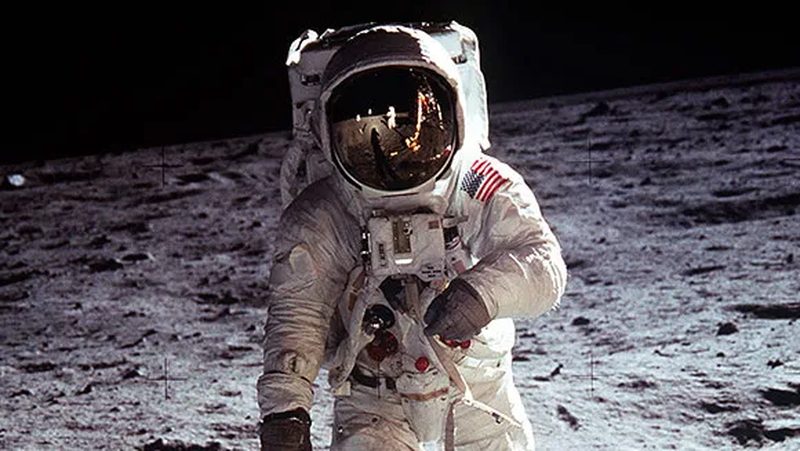
At 20:17 UTC on 20 July 1969, the lunar module Eagle touched down in the Sea of Tranquillity, and hours later Neil Armstrong descended its ladder to become the first human to walk on another world. One small step, watched by some 600 million people, remains the most-watched event in history and humanity’s greatest technological achievement. How did Apollo 11 do it, why did it happen then, and what did it leave behind?
The race that made it happen
Apollo was born of Cold War panic. When the Soviets launched Sputnik in 1957 and put Gagarin in orbit in 1961, America feared technological eclipse. Kennedy’s 1961 pledge, to land a man on the Moon before the decade was out, was a geopolitical gamble: a peaceful contest to prove the superiority of the American system. NASA got a blank cheque, at its peak consuming over 4 per cent of the federal budget and employing 400,000 people. The Moon shot was politics by other means, and the politics made the impossible fundable.
The machine: how Apollo worked
The engineering was audacious. The Saturn V, still the most powerful rocket successfully flown, stood 111 metres tall and burned 2,700 tonnes of fuel to hurl Apollo toward the Moon. The mission profile, lunar orbit rendezvous, was a daring choice: a command module orbited while the spindly lunar module descended, saving enormous weight. The onboard computer had less processing power than a modern calculator, and Armstrong had to fly the final descent manually past a boulder field with 25 seconds of fuel left. It was triumph balanced on a knife’s edge.
The landing and the first steps
The world remembers the words: Houston, Tranquillity Base here. The Eagle has landed, then Armstrong’s one small step for man. What followed was two and a half hours of moonwalking: planting the flag, deploying experiments, collecting 21.5 kg of rocks, while Michael Collins orbited alone above, the loneliest human in history. The crew’s calm under pressure, the 1202 computer alarms, the fuel, became legend. Nixon called it the most historic telephone call ever made, from the White House to the Moon.
The science it brought back
Apollo was not just a stunt. The 382 kg of lunar rocks revealed the Moon’s origin in a giant impact, rewrote planetary science, and are still studied today. Instruments left behind, seismometers, laser reflectors still used to measure the Earth-Moon distance, returned data for decades. The programme’s technological spillovers, from computing to materials science to systems engineering, seeded modern industry. And the view back, Earthrise and the Blue Marble, gave humanity its first true portrait of itself and fuelled the environmental movement.
Why we stopped going
After six landings, Apollo ended in 1972, a victim of its own success: the political point was made, budgets shrank, and the public lost interest. No human has left low Earth orbit since. The reasons were mundane, cost, risk, Vietnam, domestic priorities, but the result was a half-century pause that still puzzles. The Moon became a monument to what a superpower could do when it decided to, and a reproach to the decades of not deciding.
The return to the Moon
Now the Moon is back. NASA’s Artemis programme aims for a sustained return, this time with international partners and commercial rockets, targeting the water-rich south pole. China has landed rovers on the far side and plans crewed missions; India, Japan and private companies join the rush. The motives mix science, resources and geopolitics, a new space race with more players. Whether this return endures where Apollo didn’t depends on finding a purpose beyond flags and footprints.
Voices from the Moon
The astronauts’ words became scripture: Armstrong’s careful small step, Aldrin’s magnificent desolation, Collins’ lonely vigil in orbit. Less quoted but telling is the plaque they left: we came in peace for all mankind. The mission carried no weapons, only science and symbolism. In a century of division, Apollo remains the rare achievement claimed, however imperfectly, for the whole species.
FAQs
When did humans first land on the Moon? 20 July 1969, when Apollo 11’s Eagle touched down; Armstrong and Aldrin walked on the surface hours later.
How many people have walked on the Moon? Twelve, all American men, across six Apollo landings between 1969 and 1972.
Was the Moon landing faked? No. The evidence, from lunar rocks to retroreflectors to independent tracking, is overwhelming; the conspiracy theories do not survive scrutiny.
Apollo 11 proved that human beings, given a deadline and a budget, can leave their planet. Half a century later, its footprints are still there in the lunar dust, waiting for the next ones.
Source: NASA

Khabar 24h Editorial Desk — our explainers are prepared by the Khabar 24h editorial team using AI-assisted research tools, and every piece is reviewed by a human editor before publishing. We do not claim original reporting: our work is turning complex topics into simple, accurate summaries. Spotted an error? Write to contact@khabar24h.com — our corrections policy aims for same-day review.
More from this author →