9/11 Explained: The Attacks That Reshaped the 21st Century
On a clear Tuesday morning in September 2001, 19 al-Qaeda hijackers seized four American airliners and turned them into weapons. Two struck the World Trade Center’s Twin Towers in New York, one hit the Pentagon, and one, brought down by passengers, crashed in Pennsylvania. Nearly 3,000 people died. The attacks of 11 September 2001 were the deadliest terrorist act in history, and they reshaped global politics, security and daily life in ways still unfolding a quarter-century later.
What happened that morning
The timeline is seared into memory. At 8:46 am, American Airlines Flight 11 hit the North Tower; at 9:03, United Flight 175 hit the South Tower, live on television. At 9:37, Flight 77 struck the Pentagon; at 10:03, United Flight 93 crashed in Shanksville after passengers fought the hijackers. The South Tower collapsed at 9:59, the North at 10:28, killing hundreds of firefighters and office workers. By day’s end, lower Manhattan was a smoking ruin, and the world had changed.
Who did it and why
The attackers were al-Qaeda, the jihadist network led by Osama bin Laden, mostly Saudi nationals. Their motives, laid out in bin Laden’s declarations, mixed grievances: US troops in Saudi Arabia, sanctions on Iraq, support for Israel, and a broader war against Western influence in the Muslim world, framed in a radical theology most Muslims reject. The plot was years in the making, exploiting the openness of American aviation security. It was terrorism as spectacle: the towers were chosen as symbols of American economic power.
The wars that followed
America’s response defined a generation. Within weeks, the US invaded Afghanistan to destroy al-Qaeda and topple the Taliban, beginning America’s longest war, which would end chaotically in 2021 with the Taliban’s return. In 2003, the US invaded Iraq on false claims of weapons of mass destruction, unleashing a catastrophe that killed hundreds of thousands and birthed ISIS. The War on Terror spread to Pakistan, Yemen, Somalia and beyond: drone strikes, special forces raids, and a global shadow war with no end date.
How 9/11 changed everyday life
The attacks rewrote the texture of modern life. Airport security became a global gauntlet of scanners, liquid bans and pat-downs. Surveillance expanded massively: the Patriot Act, NSA bulk collection revealed by Snowden, CCTV and data retention. Islamophobia surged, with hate crimes and discriminatory policies targeting Muslims. Politics polarised around security; the language of terrorism reshaped law, media and elections worldwide. A generation has grown up knowing no other world.
The human cost
Beyond the 2,977 killed that day, the toll sprawls: hundreds of thousands dead in the ensuing wars, millions displaced, first responders dying of 9/11-related illnesses decades later. American veterans carry the wars’ wounds; Iraqi, Afghan and other civilians bore the heaviest burden. The attacks also killed hope in their way: the post-Cold War optimism of the 1990s died with the towers. Counting 9/11’s cost means counting everything that flowed from it.
9/11’s legacy a quarter-century on
Bin Laden was killed in 2011; al-Qaeda is diminished but its ideology franchised into ISIS and others. The US left Afghanistan; Iraq remains scarred. The security architecture built after 9/11 endures, normalised. Historians now debate whether the response matched the threat, or whether the wars magnified it. What is certain: 19 men with box cutters and flight training exposed the vulnerability of a superpower and set the 21st century’s course. We still live in the world they made that morning.
Remembering and understanding
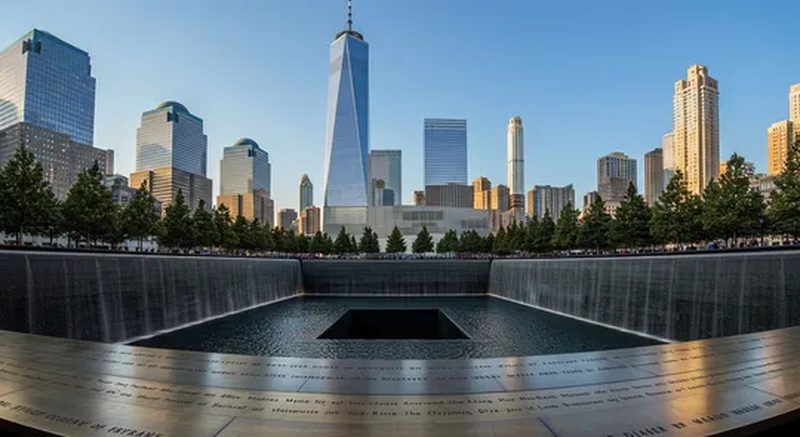
The 9/11 Memorial’s twin reflecting pools mark the towers’ footprints, with victims’ names etched in bronze; the museum below tells the day’s story in artefacts and voices. Remembrance rituals recur each September, yet historians urge understanding alongside memory: how the attacks happened, why, and what the response cost. Memory honours the dead; understanding might prevent the next catastrophe.
FAQs
How many people died on 9/11? 2,977 victims, plus the 19 hijackers, in New York, Washington and Pennsylvania.
Who was responsible? Al-Qaeda, led by Osama bin Laden; the hijackers were mostly Saudi nationals.
Why did the US invade Iraq? The Bush administration claimed Saddam Hussein had weapons of mass destruction and al-Qaeda ties; both claims proved false.
September 11 was the day the 21st century truly began: a morning of blue sky that ended in rubble, war and a permanent state of vigilance. Its memorials urge us never to forget; its history urges us to understand.
Source: 9/11 Memorial & Museum

Khabar 24h Editorial Desk — our explainers are prepared by the Khabar 24h editorial team using AI-assisted research tools, and every piece is reviewed by a human editor before publishing. We do not claim original reporting: our work is turning complex topics into simple, accurate summaries. Spotted an error? Write to contact@khabar24h.com — our corrections policy aims for same-day review.
More from this author →