What Is a Chip Fab? Inside the Factories That Make Semiconductors
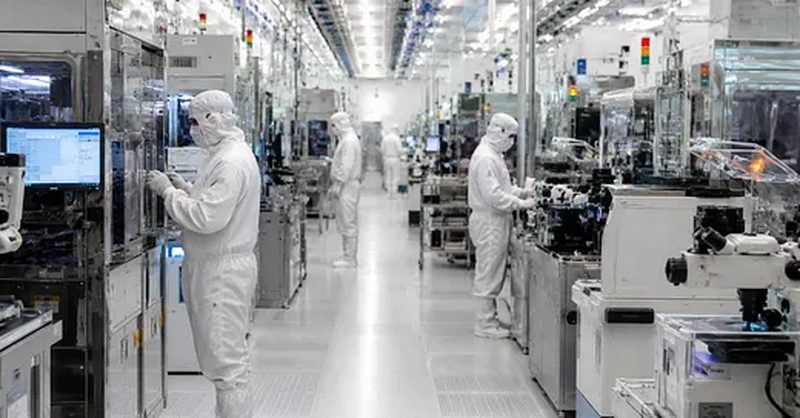
There are factories, and then there are chip fabs. A modern semiconductor fabrication plant costs 15 to 20 billion dollars to build, more than a nuclear aircraft carrier, takes years to construct, and must operate with a level of cleanliness that makes hospital operating theatres look dusty. Inside, workers in full “bunny suits” tend machines the size of buses that print circuits with light, in rooms where a single speck of dust can destroy millions of dollars of product. As India races to build its own fabs and the world rethinks where chips get made, understanding what a fab actually is has become essential knowledge.
What exactly is a chip fab?
A fab, short for fabrication plant, is the factory where raw silicon wafers are transformed into finished semiconductor chips through hundreds of precise steps. The biggest fabs are run by pure-play foundries like TSMC in Taiwan and Samsung in South Korea, which manufacture chips designed by other companies, Apple, Nvidia, Qualcomm, AMD. Others are run by integrated manufacturers like Intel, which both design and build. A leading-edge fab is among the largest and most expensive industrial investments on the planet: TSMC’s newest facilities cost upwards of 20 billion dollars each and employ thousands of engineers. Building one requires not just money but a deep bench of specialised talent, ultra-pure water and power infrastructure, and access to equipment from a fragile global supply chain.
The cleanroom: cleaner than clean
The heart of every fab is the cleanroom, where wafers are processed. Cleanrooms are rated by how many particles of a given size float in each cubic metre of air; the most critical areas meet ISO Class 1 or 2, meaning fewer than a handful of particles larger than a fraction of a micron. For comparison, ordinary room air contains millions. Achieving this requires air filtered and recirculated dozens of times per hour, workers in full-body bunny suits with only their eyes exposed, and strict protocols: no paper, no pencils, controlled cosmetics. A single dust particle landing on a wafer during lithography can short-circuit features thousands of times smaller than itself, turning a potential flagship processor into scrap. Wafers travel between machines in sealed pods handled by overhead robots, touched by human hands as rarely as possible.
The machines that make it possible
A fab’s most famous residents are its lithography scanners, particularly the extreme ultraviolet machines from ASML, the only company on earth that makes them. Each EUV machine costs well over 150 million dollars, contains more than 100,000 parts, and uses lasers vaporising tin droplets 50,000 times per second to generate the 13.5-nanometre light that prints the tiniest features. Around them stand hundreds of other specialised tools: etching machines that carve patterns with plasma, deposition chambers that grow atomic-scale layers, ion implanters that shoot dopant atoms into silicon, and metrology tools that inspect features a few atoms wide. A fab’s toolset is so specialised that a disruption at any single supplier, a Dutch lithography maker, a Japanese chemicals firm, an American design software company, can stall the entire industry.
Why fabs cost so much
The price tag comes from three directions.
- The building itself: vibration-proof foundations, ultraclean air handling, and water purification plants that make water purer than anything in nature, since a fab can use tens of millions of litres daily.
- The equipment: hundreds of precision tools, each costing millions to hundreds of millions of dollars, with the lithography scanners alone running into billions per fab.
- The operating cost: enormous electricity consumption, a constant supply of ultra-pure chemicals and gases, and thousands of highly trained engineers working around the clock, because a fab that stops loses millions per day.
India’s fab ambitions
India has announced semiconductor mission incentives worth tens of thousands of crores to attract fab and OSAT investments, with projects proposed in Gujarat and Assam among others. The logic is strategic: domestic fabrication reduces dependence on concentrated supply chains, builds high-skill employment, and anchors an electronics manufacturing ecosystem. The challenges are equally real: fabs need assured water and power, a trained workforce that takes years to build, and customers willing to buy the output. Global experience shows fabs succeed as decade-long commitments, not quick wins. Whether India joins the small club of countries that fabricate leading-edge chips will be one of the defining industrial stories of the next ten years.
FAQs
How many fabs are there in the world? A few hundred, but only a handful can make the most advanced logic chips. That concentration is exactly why chip supply is so geopolitically sensitive.
How long does it take to build a fab? Typically three to five years from groundbreaking to volume production, plus years more to reach full efficiency and yield.
What is the difference between a fab and a foundry? A fab is the physical factory; a foundry is the business model of manufacturing chips for other companies. TSMC is a foundry that operates fabs; Intel operates fabs mostly for itself.
Chip fabs are where the digital age is physically manufactured: billion-dollar buildings of filtered air and ultraviolet light, turning sand into the brains of civilisation. Whoever builds and runs them shapes the technology of the coming decades, which is why the race to build more of them, in more places, matters to everyone.
Compiled by the Khabar 24h Editorial Desk from publicly available sources.

Khabar 24h Editorial Desk — our explainers are prepared by the Khabar 24h editorial team using AI-assisted research tools, and every piece is reviewed by a human editor before publishing. We do not claim original reporting: our work is turning complex topics into simple, accurate summaries. Spotted an error? Write to contact@khabar24h.com — our corrections policy aims for same-day review.
More from this author →