Javelin Throw Technique Explained: Run-Up, Release and Biomechanics
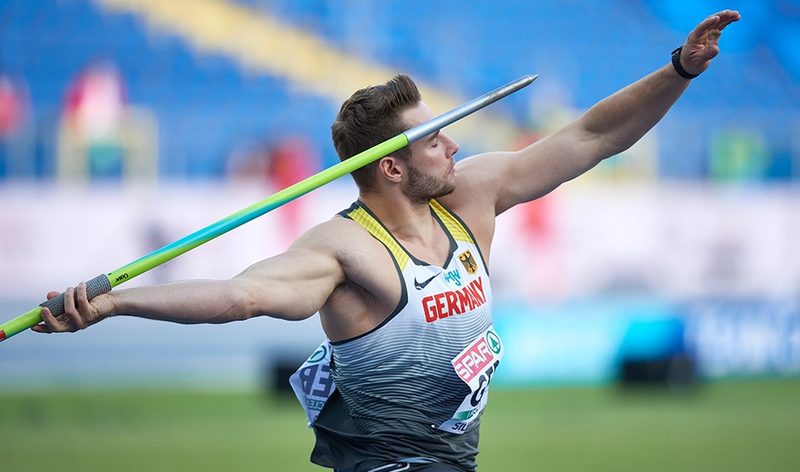
The javelin throw is track and field’s most technical power event: a 30-metre sprint that ends with the precise release of an 800-gram spear. Throws beyond 90 metres look like pure strength, but biomechanics research shows they are masterpieces of timing, where the speed of the run-up is converted into the speed of the implement through a precisely sequenced chain of body movements. Here is how the technique works, phase by phase.
What are the phases of the javelin throw?
Coaches divide the throw into four phases. The run-up builds controlled speed over roughly 30 metres, with the javelin carried above the shoulder, tip pointing slightly up. The crossover phase, the final five or so strides, sees the thrower turn sideways, drawing the throwing arm back while the legs continue driving forward. The delivery phase is the explosive release: the front leg plants and blocks, the hips drive forward, the torso rotates and the arm whips through. The follow-through and recovery see the thrower decelerate without crossing the foul line. Each phase must flow into the next; a flaw in the run-up cannot be fixed at release.
How does the run-up generate power?
Speed is the raw material of the throw. Elite throwers reach run-up velocities of 7 to 8 metres per second, and studies show a strong correlation between approach speed and release speed. But raw sprinting is not enough: the thrower must stay relaxed, keep the javelin steady and hit precise stride markers. The rhythm matters more than maximum velocity. The final strides lengthen slightly as the thrower prepares for the crossover, and the penultimate stride is often the longest, setting up the planting of the block leg. Coaches use video analysis and radar to fine-tune this rhythm, because a rushed run-up destroys the timing of everything that follows.
What happens during the crossover steps?
The crossover is the most distinctive and most difficult part of javelin technique. In the final strides, the thrower turns the body sideways to the direction of the throw while the throwing arm extends fully behind. The legs cross over, right over left for a right-handed thrower, while the hips remain facing forward as long as possible. This creates separation between the hips and shoulders, stretching the muscles of the torso like a drawn bowstring. The javelin stays aligned with the thrower’s shoulder line, pointing at the target sector. Get the crossover wrong, rushing it or losing the javelin’s alignment, and the throw loses both power and accuracy.
How does the release actually work?
The delivery begins when the front foot plants firmly ahead of the body. This is the block: the leg acts as a brake, and the sudden deceleration of the lower body catapults the upper body forward. The hips drive over the block leg, the chest comes through, and the throwing arm, which has been trailing behind, whips forward in a long, accelerating arc. Release happens above the head at an angle of roughly 35 to 40 degrees, with the javelin leaving the hand at speeds exceeding 30 metres per second in elite men. The wrist flicks through at the last instant, imparting a slight spin that stabilises the spear in flight. The entire delivery takes about a tenth of a second.
Why is the block leg so important?
Biomechanists call the block the key to the throw. Without a firm plant, the run-up’s energy dissipates instead of transferring upward. The block leg must land with the knee nearly straight and absorb enormous forces, several times the thrower’s body weight, in a fraction of a second. A soft or bent block leaks power; a late block throws off the arm’s timing. Strength training for javelin therefore emphasises single-leg stability, eccentric quadriceps strength and the ability to decelerate violently. It is a paradox of the event: the thrower’s ability to stop suddenly determines how far the spear flies.
What separates 80-metre throwers from 90-metre throwers?
The difference is rarely strength alone. Ninety-metre throwers combine elite run-up speed with flawless sequencing: every segment of the body, from the block leg to the fingertips, fires in the correct order with no wasted motion. Their release angles are consistently optimal, their javelins leave with minimal wobble, and their technique holds up under championship pressure. They also stay healthy: the javelin’s forces punish elbows and shoulders, and longevity at the top requires world-class physiotherapy and load management. Consistency is the final separator. Anyone can produce one huge throw; the greats produce 87 metres when it matters.
- Run-up: 30 metres of controlled acceleration, javelin carried high and steady.
- Crossover: sideways turn with arm drawn back, creating hip-shoulder separation.
- Block: front leg plants and brakes, transferring energy upward.
- Release: arm whips through at 35-40 degrees, javelin exceeding 30 m/s.
- Recovery: controlled deceleration without crossing the foul line.
FAQs
How heavy is a javelin? The men’s javelin weighs 800 grams and the women’s 600 grams, with minimum lengths of 2.6 and 2.2 metres respectively.
What is the men’s javelin world record? Jan Zelezny of the Czech Republic threw 98.48 metres in 1996, a record that has stood for three decades.
Why do javelin throwers cross the foul line sometimes? The follow-through’s momentum can carry them over; any touch beyond the line invalidates the throw, which is why the recovery phase is carefully trained.
The javelin throw is physics made visible: speed converted to distance through timing, leverage and nerve. Watch the crossover steps next time, and you will see where 90 metres is really born.
Source: World Athletics biomechanics reports

Khabar 24h Editorial Desk — our explainers are prepared by the Khabar 24h editorial team using AI-assisted research tools, and every piece is reviewed by a human editor before publishing. We do not claim original reporting: our work is turning complex topics into simple, accurate summaries. Spotted an error? Write to contact@khabar24h.com — our corrections policy aims for same-day review.
More from this author →