Why the Western Ghats Are Among the World’s Richest Biodiversity Hotspots
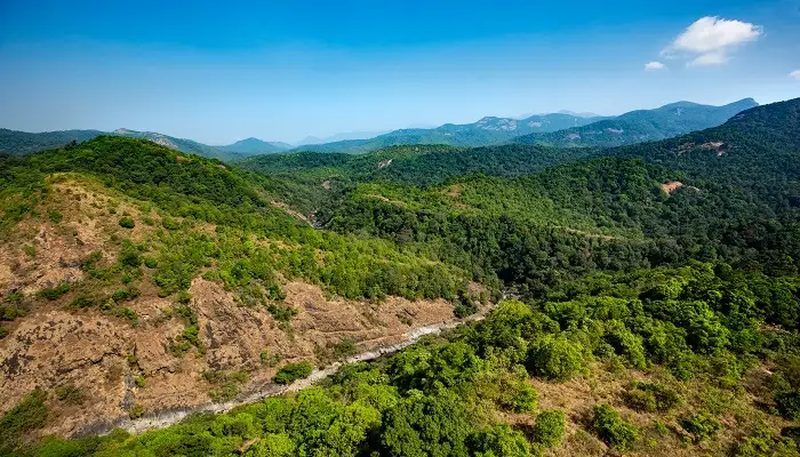
Stretching 1,600 kilometres along India’s west coast, the Western Ghats are older than the Himalayas and richer in species than almost any place on Earth. This ancient mountain chain harbours thousands of species found nowhere else: lion-tailed macaques, Malabar civets, purple frogs and hundreds of endemic plants. Recognised as one of the world’s eight hottest biodiversity hotspots, the Ghats pack more biological wealth per square kilometre than nearly anywhere else. The reasons lie in deep geological time, dramatic climate and splendid isolation.
Ancient mountains, stable climate
The Ghats’ age is their first secret. Formed when Madagascar split from India around 150 million years ago, these mountains have stood through the age of dinosaurs, the Deccan Traps eruptions and the rise of the Himalayas. That immense stability gave evolution time, uninterrupted millions of years for species to diversify without the resets of glaciation that scoured northern lands. Many Ghats lineages are ancient relicts, survivors of Gondwanan flora and fauna found elsewhere only in Madagascar, Sri Lanka or Southeast Asia.
The second secret is the monsoon. The Ghats intercept the southwest monsoon, forcing moist air upward into some of the heaviest rainfall on Earth, over 7,000 millimetres a year in places like Agumbe and Cherrapunji’s western counterparts. This wall of rain creates steep ecological gradients: dripping evergreen rainforest on the windward west, moist deciduous forest on the crest, and dry scrub in the eastern rain shadow, all within a few dozen kilometres. More habitats in less space means more species.
Isolation engines: sky islands
The Ghats’ peaks function as sky islands. High-elevation shola-grassland mosaics, found above 1,800 metres in the Nilgiris, Anamalais and Palanis, are isolated from each other by warmer valleys, trapping cold-adapted species on separate mountaintops. Cut off for millions of years, each island evolved its own endemics: the Nilgiri tahr on its cliffs, dozens of dancing frogs in its streams, and shola trees found on single massifs. The Palghat Gap, a 30-kilometre-wide low pass, splits the Ghats into distinct northern and southern biotas, doubling the evolutionary experiments.
The numbers testify to this engine: over 7,400 flowering plant species with nearly 2,000 endemic, 500-plus bird species, 140 mammals, and amphibian diversity that keeps exploding as researchers look harder, with new frog species described nearly every year. The purple frog, a living fossil whose closest relatives are in the Seychelles, embodies the Ghats’ Gondwanan heritage.
- Age: ~150 million years of unbroken evolutionary time.
- Rainfall: up to 7,000+ mm/year on windward slopes, creating stacked habitats.
- Sky islands: isolated shola-grassland peaks driving speciation.
- Endemism: thousands of species found nowhere else on Earth.
- Recognition: UNESCO World Heritage Site and global biodiversity hotspot.
Wealth under threat
This richness is under siege. Plantations of tea, coffee and rubber, hydroelectric dams, mining, roads and urban sprawl have fragmented the forests, while invasive species like lantana and eucalyptus degrade what remains. The Gadgil and Kasturirangan committee reports proposed ecologically sensitive zoning for the Ghats, sparking fierce political battles between conservation and development that continue today.
Yet the Ghats also show conservation working: tiger reserves like Periyar and Kalakkad-Mundanthurai anchor large forest blocks, community reserves and sacred groves protect fragments, and research stations from Agumbe to the Nilgiris keep revealing new species. The Ghats’ lesson is that biodiversity hotspots are not museums but living engines, still generating species, and that protecting the engine matters as much as protecting its products.
FAQs
What is a biodiversity hotspot? A region with exceptional endemic species facing exceptional habitat loss; the Ghats qualify on both counts.
Why are there so many endemic frogs? Ancient stable climate plus isolated sky-island streams let frog lineages diversify undisturbed for millions of years.
Can I visit? Yes. National parks and wildlife sanctuaries across Kerala, Karnataka, Tamil Nadu, Goa and Maharashtra offer access, with monsoon-season visits the most spectacular.
The Western Ghats are 150 million years of evolution written in green: ancient mountains, monsoon-drenched and fragmented into sky islands, still minting new species. In an age of extinction, they are both a treasure house and a warning, proof of what deep time can build and how quickly the present can dismantle it. Protecting them is not nostalgia for a pristine past but an investment in an evolutionary engine that is still running.
Source: UNESCO World Heritage Centre

Khabar 24h Editorial Desk — our explainers are prepared by the Khabar 24h editorial team using AI-assisted research tools, and every piece is reviewed by a human editor before publishing. We do not claim original reporting: our work is turning complex topics into simple, accurate summaries. Spotted an error? Write to contact@khabar24h.com — our corrections policy aims for same-day review.
More from this author →