The Greenhouse Effect Explained: How CO2 and Methane Warm the Planet
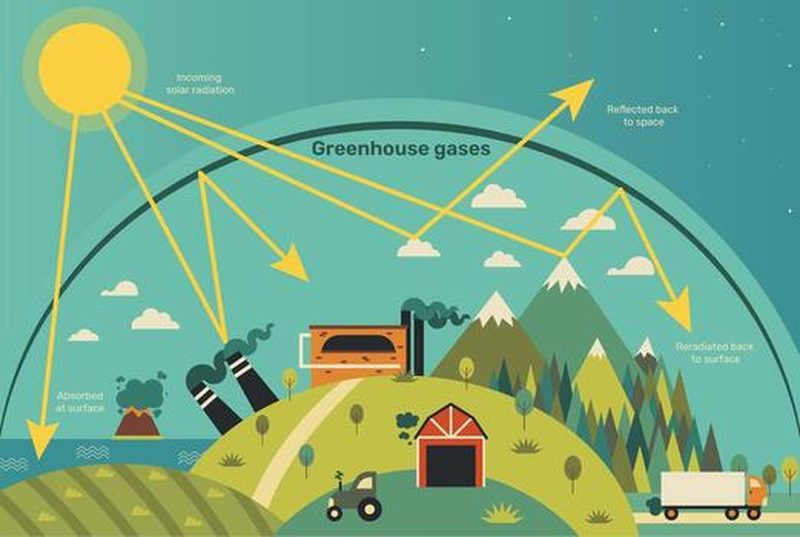
The Earth should be a frozen rock. At our distance from the Sun, without an atmosphere, the planet’s average temperature would sit around minus 18 degrees Celsius, and liquid water could not survive. Instead the surface averages a comfortable 15 degrees, and the difference is the greenhouse effect: certain gases in the atmosphere absorb heat radiating from the ground and re-emit it in all directions, including back downward, like a blanket around the planet. It is entirely natural, and life depends on it. The problem is that humans have thickened the blanket.
How the blanket works
Sunlight arrives mostly as visible light, which passes through the atmosphere and warms the ground. The ground then radiates that energy back upward as infrared heat. Greenhouse gases, carbon dioxide, methane, nitrous oxide and water vapour, are transparent to incoming visible light but absorb outgoing infrared, trapping the energy. The warmed atmosphere radiates heat both upward to space and downward to the surface, raising temperatures until a new balance is reached. Without this effect, Earth would be an iceball; with too much of it, the planet overheats. Venus is the cautionary extreme, its runaway greenhouse effect having baked it to 465 degrees.
Why CO2 and methane matter most
Water vapour is actually the strongest greenhouse gas, but it acts as a feedback rather than a driver: warmer air holds more moisture, which traps more heat, amplifying whatever started the warming. Carbon dioxide is the main control knob humans are turning. It persists in the atmosphere for centuries, and burning fossil fuels has raised its concentration from about 280 parts per million before industry to over 420 today, a level not seen in millions of years. Methane is shorter-lived but far more potent per molecule, and it pours from agriculture, landfills, fossil fuel leaks and thawing permafrost. Nitrous oxide from fertilisers adds a long-lived third punch.
The evidence in the thermometre record
The warming predicted by greenhouse physics is exactly what thermometres show. Global surface temperatures have risen about 1.2 degrees Celsius since the late 19th century, with the fastest warming in recent decades and the Arctic heating nearly four times faster than the global average. Nights are warming faster than days, winters faster than summers, and the upper atmosphere is cooling while the lower atmosphere warms, a distinctive fingerprint of greenhouse trapping rather than a brighter Sun. Oceans have absorbed most of the excess heat, expanding as they warm and driving sea-level rise alongside melting ice.
Common confusions, cleared up
The greenhouse effect is widely misunderstood, and a few clarifications help:
- It is not the ozone hole. Ozone depletion and the greenhouse effect are separate problems with separate causes, though some chemicals affect both.
- CO2 is plant food, but that does not cancel warming. Extra CO2 can boost some plant growth, but heat stress, drought and floods damage agriculture far more.
- Small concentrations still matter. The atmosphere is thin; adding a few hundred parts per million of a strong absorber measurably changes the planet’s energy balance.
What thickening the blanket means
Every additional increment of greenhouse gases commits the planet to more warming, more intense heatwaves, heavier rainfall, stronger storms and higher seas. Because CO2 lingers for centuries, today’s emissions shape the climate for generations. The physics is unforgiving but also empowering: it means cutting emissions will, over time, slow and eventually stop the warming. The greenhouse effect itself is not the enemy; it is the reason Earth is habitable. The enemy is the speed at which we are strengthening it.
FAQs
Is the greenhouse effect natural? Yes, and essential. Without it Earth would be frozen. The current concern is the human-caused enhancement from burning fossil fuels and other activities.
Which gas should we worry about most? Carbon dioxide, because of its sheer quantity and centuries-long lifetime. Methane cuts pay off faster but CO2 determines the long-term outcome.
Can we reverse the enhanced greenhouse effect? We cannot quickly remove what is already there, but stopping emissions halts further warming, and carbon removal could slowly draw levels down over decades.
The greenhouse effect is the most important piece of physics most people never think about: an invisible blanket, woven from a few trace gases, that sets the temperature of everything. We did not create it, but we are now in control of how thick it gets, and that control is the defining power and responsibility of our age.
Source: NASA

Khabar 24h Editorial Desk — our explainers are prepared by the Khabar 24h editorial team using AI-assisted research tools, and every piece is reviewed by a human editor before publishing. We do not claim original reporting: our work is turning complex topics into simple, accurate summaries. Spotted an error? Write to contact@khabar24h.com — our corrections policy aims for same-day review.
More from this author →