Rayleigh Scattering: Why the Sky Is Blue and Sunsets Are Red
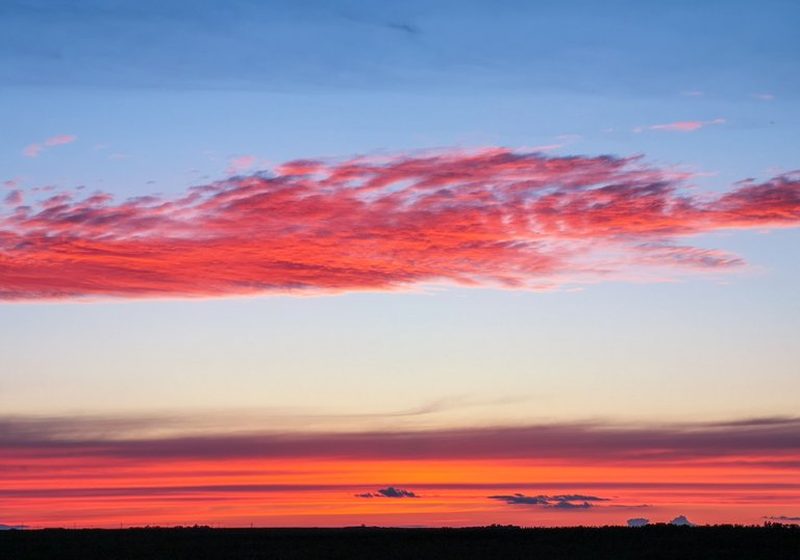
Every day, the sky performs two colour shows and charges no admission. At noon it is a deep, clear blue; at sunset it ignites in oranges, reds and purples. Both displays are the work of a single phenomenon: Rayleigh scattering, the scattering of sunlight by the molecules of air itself. First explained by the British physicist Lord Rayleigh in the 1870s, it is a triumph of nineteenth-century physics that remains the correct explanation 150 years later. The blue of the sky is not a colour painted on some celestial dome but sunlight broken apart by the very air we breathe, and the red of sunset is what remains when the blue has been scattered away. Once you understand the mechanism, you never look at the sky the same way again.
How air molecules scatter sunlight
Sunlight looks white but is a mixture of all the colours of the rainbow, each corresponding to a different wavelength. When sunlight enters the atmosphere, it collides with nitrogen and oxygen molecules, which are far smaller than the wavelength of light. These tiny molecules scatter short wavelengths, blue and violet light, far more strongly than long wavelengths like red and orange; the scattering intensity grows as the inverse fourth power of wavelength, so blue light is scattered roughly five times more than red. The scattered blue light comes at your eyes from every direction, which is why the whole sky glows blue rather than just the region around the Sun. Violet is scattered even more strongly than blue, but the sky does not look violet because the Sun emits less violet light, our eyes are less sensitive to it, and ozone absorbs some of it. Rayleigh worked all this out with pencil, paper and Maxwell’s equations, decades before anyone could photograph the effect or measure it precisely.
Why sunsets turn red
At sunset, the geometry changes everything. When the Sun sits low on the horizon, its light must travel through far more atmosphere to reach you, up to forty times more air than at noon. Along this long path, so much blue and green light is scattered away in other directions that little remains in the direct beam; what survives the journey is the red and orange light that air scatters least. That is why the Sun itself looks red at sunset and why the clouds and haze near the horizon catch fire with warm colours, reflecting the reddened light. The most spectacular sunsets often follow volcanic eruptions or heavy pollution, because extra particles in the air scatter even more light, though the finest colours come from clean air with just the right amount of high cloud. The same physics explains the blue-grey of distant mountains, aerial perspective, and why the Moon looks red during a total lunar eclipse: Earth’s atmosphere scatters away the blue sunlight and bends the remaining red light into Earth’s shadow.
Scattering beyond the sky
Rayleigh scattering shows up in surprising places. The blue eyes of some people and the blue feathers of a kingfisher are not pigmented blue at all; their colour comes from microscopic structures that scatter short wavelengths, the same physics as the sky, which is why a blue feather held against a dark background looks different from pigment. The milky blue of glacial meltwater and the blue of a gas flame’s base involve related scattering. Engineers exploit the wavelength dependence too: fibre-optic communications lose signal partly to Rayleigh scattering in the glass, which is why researchers developed ultra-transparent fibres, and lidar systems use scattered laser light to profile the atmosphere. Even climate science leans on it: the cooling haze that follows major volcanic eruptions is sunlight scattered by sulphate particles, and proposals for solar geoengineering are, in essence, proposals to engineer scattering deliberately. A phenomenon first derived to explain a pretty sky turned out to be a tool for probing atmospheres, building communications and pondering the climate.
- Blue light is scattered about five times more strongly than red light by air molecules.
- At sunset, sunlight travels through up to 40 times more atmosphere than at noon.
- Violet light scatters most of all, but human eyes are relatively insensitive to it.
- Volcanic eruptions can intensify sunsets worldwide by adding scattering particles.
- A total lunar eclipse looks red because Earth’s atmosphere scatters blue light out of the sunbeam.
Questions the sky still asks
For all its explanatory power, Rayleigh scattering leaves room for wonder. Why is the zenith at noon a deeper blue than the horizon? Because you look through less air toward the zenith, so less white light from multiple scattering dilutes the blue. Why is the sky on Mars butterscotch rather than blue? Because Martian dust, larger than air molecules, scatters differently, and iron oxide tints everything rust. Why do some sunsets turn purple? That requires a layer of volcanic aerosols high in the stratosphere scattering the reddened light a second time. And the phenomenon has a famous historical footnote: for years, physicists could not explain why the sky was blue without also predicting that it should be violet, until the details of solar output and human vision resolved it. Rayleigh scattering is settled science, but it rewards attention: the sky is a daily physics demonstration, free and unrepeatable in exactly the same colours twice.
FAQs
If blue scatters most, why isn’t the sky violet? The Sun emits less violet light than blue, our eyes are less sensitive to violet, and atmospheric ozone absorbs some violet, leaving blue dominant.
Why are clouds white if the sky is blue? Cloud droplets are much larger than air molecules, so they scatter all wavelengths equally, a process called Mie scattering, which produces white.
The next time the sky burns red at dusk, remember: you are watching sunlight filtered through a hundred kilometres of air, the blue stolen away molecule by molecule, leaving only fire behind.
Source: NASA

Khabar 24h Editorial Desk — our explainers are prepared by the Khabar 24h editorial team using AI-assisted research tools, and every piece is reviewed by a human editor before publishing. We do not claim original reporting: our work is turning complex topics into simple, accurate summaries. Spotted an error? Write to contact@khabar24h.com — our corrections policy aims for same-day review.
More from this author →