How Hibernation Works: The Biology of the Big Sleep
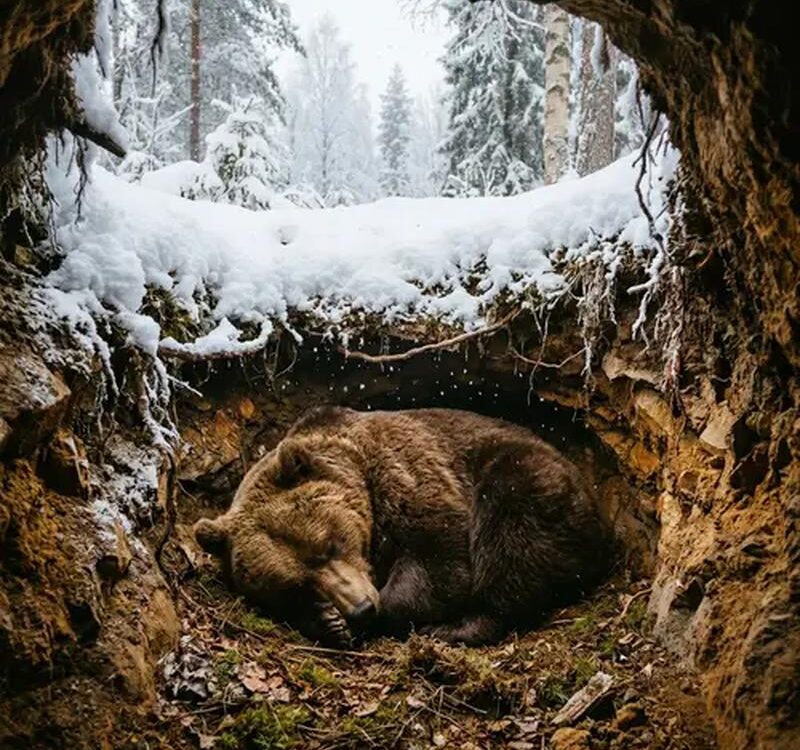
Every autumn, across the cold forests of the northern hemisphere, bears, marmots, ground squirrels and bats do something that would kill a human in hours: they lie down, stop eating and drinking, and let their body temperature plummet, sometimes to within a degree of freezing, for months on end. Hibernation is one of the most extreme physiological feats in nature, a controlled shutdown of the body’s systems that lets an animal survive winter on stored fat alone.
What hibernation actually is, and what it is not
True hibernation is defined by a dramatic, regulated drop in metabolic rate, heart rate and body temperature. An Arctic ground squirrel, the champion hibernator, can let its core temperature fall to minus 2.9 degrees Celsius, below the freezing point of water, while its heart beats just a few times a minute instead of several hundred. Breathing may pause for minutes at a stretch. In this state the animal burns as little as one to five per cent of its normal energy, stretching a summer’s worth of fat across six to eight months. Bears are a special case: they are often called hibernators, but their body temperature drops only modestly, by about five or six degrees, and they can wake quickly. Biologists sometimes call bear dormancy a lighter form of hibernation, or denning, because the animal remains far more alert and can even give birth and nurse cubs during the winter. What hibernation is not, crucially, is ordinary sleep. A hibernating animal cannot be easily roused, its brain activity looks nothing like sleep, and waking up requires a massive, energy-expensive rewarming effort.
How the body survives months without food or water
The central puzzle of hibernation is how tissues survive conditions that would destroy them in a non-hibernator. Part of the answer is preparation: in late summer and autumn, hibernators enter a phase of intense feeding called hyperphagia, sometimes doubling their body weight as fat. Fat is the ideal winter fuel because it yields more than twice the energy per gram of carbohydrates or protein, and burning it produces metabolic water, which helps the animal survive without drinking. During hibernation, the body runs almost entirely on these fat stores, sparing protein so that muscles and organs are not consumed. The heart is protected by special adaptations in its muscle cells that keep it beating reliably at temperatures that would cause cardiac arrest in other mammals. Kidneys, which would fail in a dehydrated human within days, somehow recycle urea and maintain fluid balance. Even the brain, starved of its normal glucose supply, switches to burning ketones derived from fat. Researchers studying these tricks hope to borrow them for medicine, from preserving organs for transplant to protecting the brains of stroke patients.
Why don’t hibernators freeze, starve or waste away?
Each of the obvious dangers of a months-long fast has a biological workaround. Freezing is prevented because hibernators can supercool: their body fluids resist forming ice crystals below zero, and if ice does begin to form, they rouse slightly to melt it. Starvation is avoided by the sheer efficiency of the torpid state and by periodic arousals. Most hibernators do not sleep straight through winter; every one to three weeks they rewarm to near-normal temperature for a day or so, in bouts called interbout arousals, which burn most of the winter’s energy budget but appear necessary to restore brain function, fight infection and clear metabolic waste. Muscle wasting, which afflicts bedridden humans within weeks, is largely avoided because hibernators periodically shiver and tense their muscles during arousals, and their muscle proteins are protected by changes in gene expression. Bone loss is similarly minimal: hibernating bears recycle calcium rather than excreting it, maintaining bone density that a human on bed rest would lose rapidly. The emerging picture is not of a body passively shutting down but of one actively defending itself on every front.
- Arctic ground squirrels reach the lowest body temperature of any mammal, about minus 2.9 degrees Celsius.
- A hibernating marmot’s heart may beat 3 to 4 times per minute, down from over 200 when active.
- Bears can recycle their own urea into protein, essentially drinking their waste to survive without water.
- Most small hibernators rewarm every few weeks; these arousals consume up to 80 per cent of winter energy.
- Fat-tailed dwarf lemurs in Madagascar are the only primates known to truly hibernate.
Could humans ever hibernate?
The question is no longer pure science fiction. Space agencies have funded serious research into synthetic torpor for long spaceflights, since a hibernating crew would need far less food, water and living space on a voyage to Mars. Researchers have identified molecules, including adenosine and hydrogen sulfide, that can trigger torpor-like states in non-hibernating animals, and studies of hibernator genomes are revealing the genetic switches involved. But humans are tropical apes with none of the supporting adaptations: our hearts fail in the cold, our muscles waste quickly, and our brains cannot run on ketones for months. True human hibernation, if it ever comes, will require either engineering those protections into us or inducing them pharmacologically, and both remain distant prospects. For now, the big sleep belongs to the squirrels, marmots, bats and bears that have had millions of years to perfect it.
FAQs
Do bears really hibernate? Bears enter a deep winter dormancy, but their body temperature drops only slightly and they can wake easily, so many biologists distinguish it from the deep hibernation of ground squirrels and marmots.
Do hibernating animals eat or drink at all? No. They survive entirely on stored body fat, and they produce water metabolically from burning that fat. They also do not urinate for months.
Hibernation remains one of biology’s most elegant solutions to scarcity: when the world offers nothing, the body simply turns the world off. Understanding how may one day help us survive our own extremes, from operating theatres to interplanetary space.
Compiled by the Khabar 24h Editorial Desk from publicly available sources.

Khabar 24h Editorial Desk — our explainers are prepared by the Khabar 24h editorial team using AI-assisted research tools, and every piece is reviewed by a human editor before publishing. We do not claim original reporting: our work is turning complex topics into simple, accurate summaries. Spotted an error? Write to contact@khabar24h.com — our corrections policy aims for same-day review.
More from this author →