How Birds Navigate Thousands of Kilometres: The Science of Migration
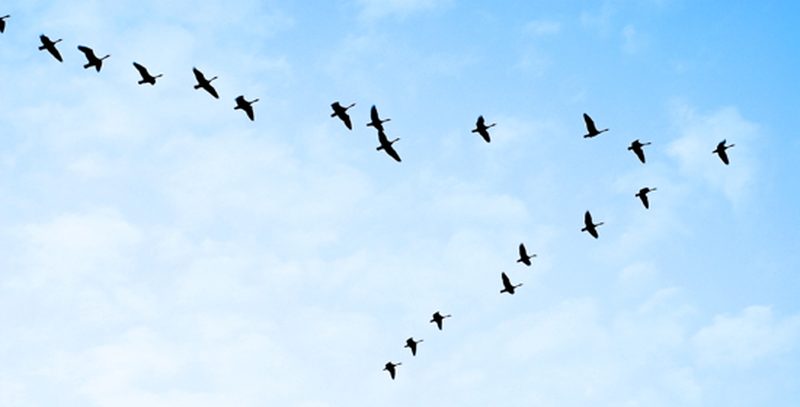
Every year, an Arctic tern flies from Greenland to Antarctica and back, a round trip of up to 90,000 kilometres, the longest migration on Earth. Bar-tailed godwits cross the Pacific non-stop for eleven days without food, water or rest. And they do it with navigational precision that shames human technology, returning to the same breeding patch year after year. How birds navigate thousands of kilometres, over featureless oceans and in darkness, is one of biology’s most beautiful solved mysteries, with a quantum twist.
A toolbox of compasses
Birds do not rely on a single sense but a redundant toolkit. The sun compass lets day migrants track the sun’s arc, compensating for its movement across the sky with an internal clock. Night migrants use a star compass, learning the pattern of constellations around the celestial pole as chicks; planetarium experiments showed that warblers orient correctly under artificial skies and lose their bearings when the stars are scrambled. Landmarks, coastlines, rivers and mountain ranges guide the final approach, and smell may help seabirds map the open ocean.
The magnetic compass is the most remarkable. Birds can sense Earth’s magnetic field and use both its direction and its inclination, the angle at which field lines dip into the Earth, which varies predictably with latitude, giving a rough map as well as a compass. But the sensor is not a chunk of magnetite in the beak, as once thought. The leading theory is quantum: light-sensitive proteins called cryptochromes in the retina form radical pairs whose chemistry depends on the magnetic field’s orientation, effectively letting birds see the magnetic field as a visual pattern overlaid on their surroundings.
Fuel, timing and extreme endurance
Navigation is only half the miracle; the other half is physiology. Before migration, birds gorge until they double their weight, converting food into fat, the highest-density fuel, and even shrinking their digestive organs to save weight. A godwit’s eleven-day Pacific crossing burns through that fat at a precisely regulated rate, while its flight muscles run at extraordinary efficiency. Some species sleep half their brain at a time while flying; swifts may stay airborne for months.
Timing is tuned by day length, an ancient and reliable calendar. Hormonal cascades triggered by changing photoperiod put birds into migratory restlessness, Zugunruhe, captive birds hopping in the migratory direction at the right season. Climate change is now scrambling these cues: birds arrive to find their insect food already peaked, a mismatch called phenological asynchrony that is driving declines in long-distance migrants worldwide.
- Sun compass: tracking the sun’s position, corrected by the internal clock.
- Star compass: constellations around the celestial pole guide night migrants.
- Magnetic compass: Earth’s field sensed, possibly via quantum cryptochrome chemistry.
- Landmarks and smell: coastlines, rivers and odour maps for fine navigation.
- Fuel: fat stores doubled before departure; organs shrunk to save weight.
India on the migratory map
India sits at the crossroads of the Central Asian Flyway, hosting millions of winter migrants: Siberian cranes once graced Bharatpur, demoiselle cranes still pour into Rajasthan’s Khichan, and waders from the Arctic crowd coastal mudflats from Pulicat to the Gulf of Mannar. Satellite tracking has revealed astonishing routes, like the bar-headed geese crossing the Himalayas at altitudes where the air is too thin for helicopters. Protecting these travellers means protecting chains of wetlands across continents, since a migrant is only as safe as its most threatened stopover.
The threats are mounting: wetland drainage, hunting along flyways, light pollution that disorients night migrants, and glass buildings that kill millions. Yet the science of migration also offers hope: tracking data now pinpoints the critical sites, and international agreements along flyways are growing teeth. To follow a godwit’s track on a screen is to watch evolution’s greatest journey, repeated billions of times each year.
FAQs
Do birds really sense magnetic fields? Yes. Experiments shifting artificial magnetic fields redirect caged migrants, and cryptochrome proteins in the eye are the leading sensor candidate.
How do young birds know the way? The migratory direction is partly inherited; experienced adults refine routes, and social species learn by following flocks.
What is the longest migration? The Arctic tern’s pole-to-pole journey, up to 90,000 km annually, chasing endless summer.
Bird migration is navigation by sun, stars, magnetism and memory, powered by fat and timed by daylight. That a ten-gram warbler can cross continents and return to the same bush is not just a marvel of biology; it is a reminder of how much intelligence evolution packed into a feathered brain.
Source: Cornell Lab of Ornithology

Khabar 24h Editorial Desk — our explainers are prepared by the Khabar 24h editorial team using AI-assisted research tools, and every piece is reviewed by a human editor before publishing. We do not claim original reporting: our work is turning complex topics into simple, accurate summaries. Spotted an error? Write to contact@khabar24h.com — our corrections policy aims for same-day review.
More from this author →